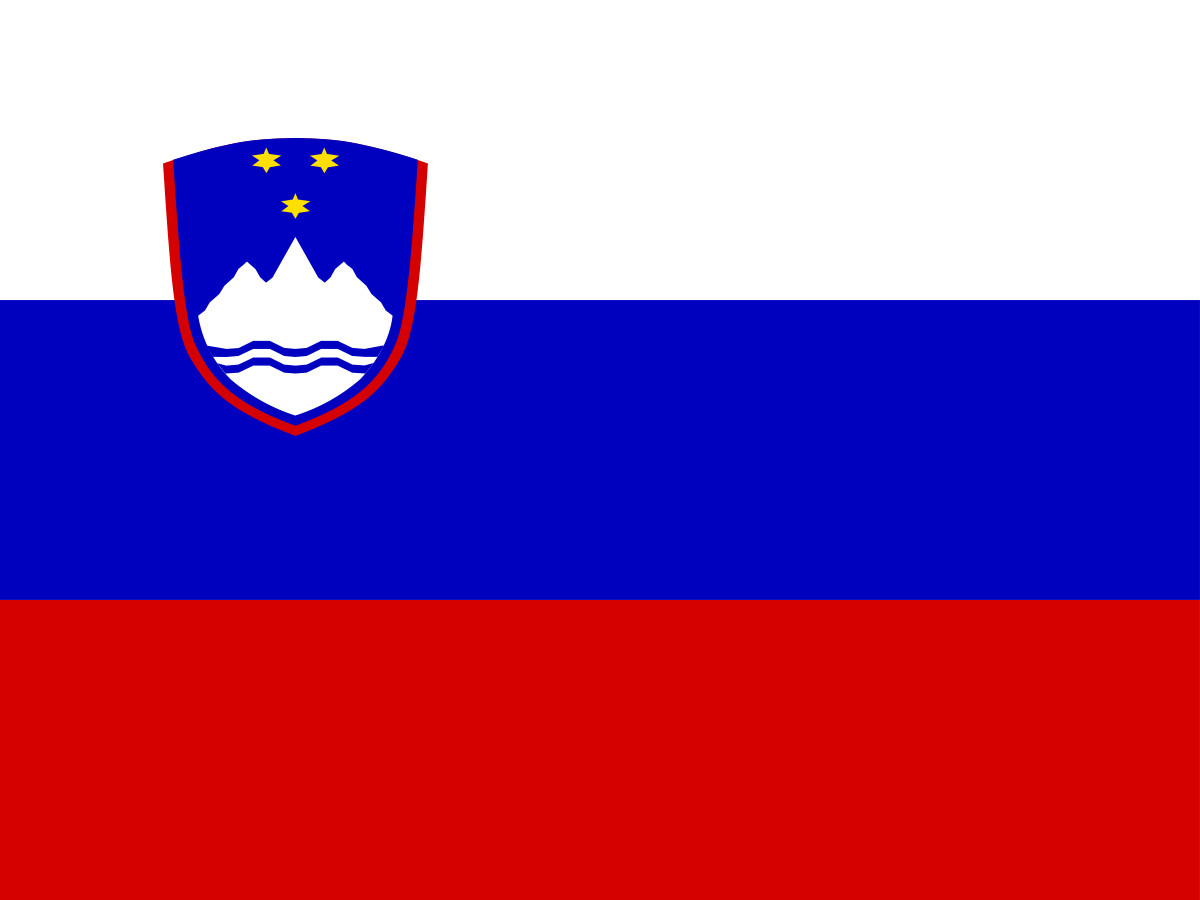
Slovenia Flag
Pan-Slavic colours with the coat of arms showing Mount Triglav, the country's highest peak, with three stars and wavy blue lines for rivers and the sea.
Development indicators
Flag symbolism
Pan-Slavic colours with the coat of arms showing Mount Triglav, the country's highest peak, with three stars and wavy blue lines for rivers and the sea.
Did you know?
Slovenia has over 10,000 caves, including the famous Postojna Cave system.
Test your knowledge
Think you know your world flags? Try the FlagAtlas daily challenge, speed quiz, or explore all Europe flags.
About Slovenia
Slovenia is a small country in Central Europe, where the Alps, forests, karst landscapes and a short Adriatic coastline meet. It borders Austria, Italy, Hungary and Croatia.
Slovenia became independent in 1991 and is now a member of the European Union, NATO and the euro area. Its capital is Ljubljana.
The Slovenia flag
The flag has three horizontal bands of white, blue and red, with the national coat of arms towards the hoist. The present flag was adopted in 1991 when Slovenia became independent.
White, blue and red
The three colours are part of the traditional Pan-Slavic colour tradition and have been associated with Slovenian national identity since the 19th century.
The coat of arms
The coat of arms shows Mount Triglav in white against blue, two wavy blue lines below it and three golden six-pointed stars above.
Mount Triglav
Mount Triglav is Slovenia's highest mountain at 2,864 metres and one of the country's strongest national symbols.
The three stars
The three golden stars are traditionally associated with the Counts of Celje, an influential medieval noble family.
The waves
The two blue wavy lines represent Slovenia's rivers and the Adriatic Sea, linking the coat of arms to the country's geography.
Why the flag is distinctive
Slovenia's white-blue-red bands resemble several other European flags. The Triglav coat of arms makes the Slovenian flag immediately recognisable.
A short history
Slovenian lands have been influenced by Roman, Slavic, medieval Central European, Habsburg and Yugoslav history. A strong Slovenian national movement developed during the 19th century.
After the First World War Slovenia became part of Yugoslavia. In 1991 it declared independence following a referendum and the Ten-Day War.
History timeline
Slavic-speaking groups settled extensively in the eastern Alpine region.
Carantania emerged as an important early Slavic polity in the Alpine region.
Much of the territory became connected with the Habsburg lands and wider Central Europe.
The Slovenian national movement promoted the idea of bringing Slovenian-speaking lands together.
Slovenia became part of the newly created Kingdom of Serbs, Croats and Slovenes.
Slovenian territory was divided and occupied by Axis powers.
Slovenia became one of the republics of the new Yugoslav federation.
The collapse of communist governments across Eastern Europe accelerated political change in Yugoslavia.
An overwhelming majority voted for Slovenian independence.
Slovenia declared independence on 25 June. The Ten-Day War followed before Yugoslav forces withdrew.
Slovenia joined both organisations.
Slovenia became the first former Yugoslav republic to adopt the euro.
Slovenia is a democratic European state with a diversified economy and a major tourism sector.
Ljubljana
Ljubljana is Slovenia's capital and largest city, known for its historic centre, castle, bridges and the Ljubljanica River.
Lake Bled
Lake Bled is one of Slovenia's most recognisable landscapes, with a small island, church and medieval castle overlooking the water.
Lake Bohinj
Lake Bohinj is Slovenia's largest natural lake and lies within Triglav National Park.
Julian Alps
The Julian Alps dominate north-western Slovenia and contain high peaks, valleys, waterfalls and alpine lakes.
Triglav National Park
Triglav National Park protects a large part of the Julian Alps and is Slovenia's only national park.
Karst and caves
Slovenia is famous for karst geology. Postojna Cave and the UNESCO-listed Škocjan Caves are among its best-known underground landscapes.
Climate
Slovenia combines Alpine, continental and Mediterranean climate influences, with colder mountain conditions and milder conditions near the coast.
Forests
More than half of Slovenia is covered by forest, making it one of Europe's most heavily forested countries.
Wildlife
Slovenia's mountains and forests support brown bears, wolves, lynx, chamois, red deer and golden eagles.
Brown bears
Slovenia has an important population of brown bears, especially in the extensive forests of the south.
Economy
Slovenia has a high-income, export-oriented economy. Major sectors include manufacturing, pharmaceuticals, engineering, automotive components, tourism and services.
Tourism
Tourism combines Alpine landscapes, lakes, caves, historic towns, wine regions and the Adriatic coast.
The Adriatic coast
Slovenia has a short Adriatic coastline around Koper, Piran and Izola, with a distinctly Mediterranean character.
Culture
Slovenian culture includes strong traditions of literature, folk music, crafts, festivals and Alpine customs.
Slovene language
Slovene is a South Slavic language written in the Latin alphabet. It has a particularly rich range of regional dialects.
Food
Slovenian cuisine combines Alpine, Mediterranean and Central European influences. Well-known foods include potica, štruklji, jota and kranjska klobasa.
Wine
Slovenia has a long winemaking tradition, with several distinct wine regions and many local grape varieties.
Religion
Slovenia has a historically strong Roman Catholic tradition, although the country has become increasingly secular.
France Prešeren
France Prešeren is Slovenia's best-known poet. His poem 'Zdravljica' provides the words for the central stanza used in the national anthem.
National anthem
Slovenia's anthem is based on the seventh stanza of 'Zdravljica' by France Prešeren and celebrates friendship and peaceful coexistence.
European Union
Slovenia joined the European Union and NATO in 2004, entered the Schengen Area in 2007 and adopted the euro in 2007.
Sport
Slovenia has a strong sporting culture, particularly in ski jumping, cycling, basketball, mountaineering and winter sports.
Why is Slovenia's flag interesting?
The flag combines familiar Pan-Slavic colours with a highly distinctive coat of arms. Triglav, the Adriatic and rivers, and the three stars of the Counts of Celje make the design specifically Slovenian.
Explore Slovenia on FlagAtlas
Keep exploring flags and educational resources.
Sources & further reading
This upgraded page keeps the supplied Slovenia page's existing flag image, emoji copier, printable link and navigation. The original page identifies the flag image as /flags/slovenia-flag.png and the printable as /colouring/slovenia/. fileciteturn187file0L131-L141