About Spain
Spain is a country in southwestern Europe occupying most of the Iberian Peninsula. It also includes the Balearic Islands in the Mediterranean, the Canary Islands in the Atlantic and two autonomous cities, Ceuta and Melilla, on the North African coast.
Spain is one of Europe's most geographically and culturally diverse countries, with Mediterranean beaches, Atlantic coasts, high mountains, fertile plains and dry interior landscapes.
CapitalMadrid
RegionSouthern Europe
PopulationAbout 49 million
CurrencyEuro (€)
Official languageSpanish
Form of stateParliamentary monarchy
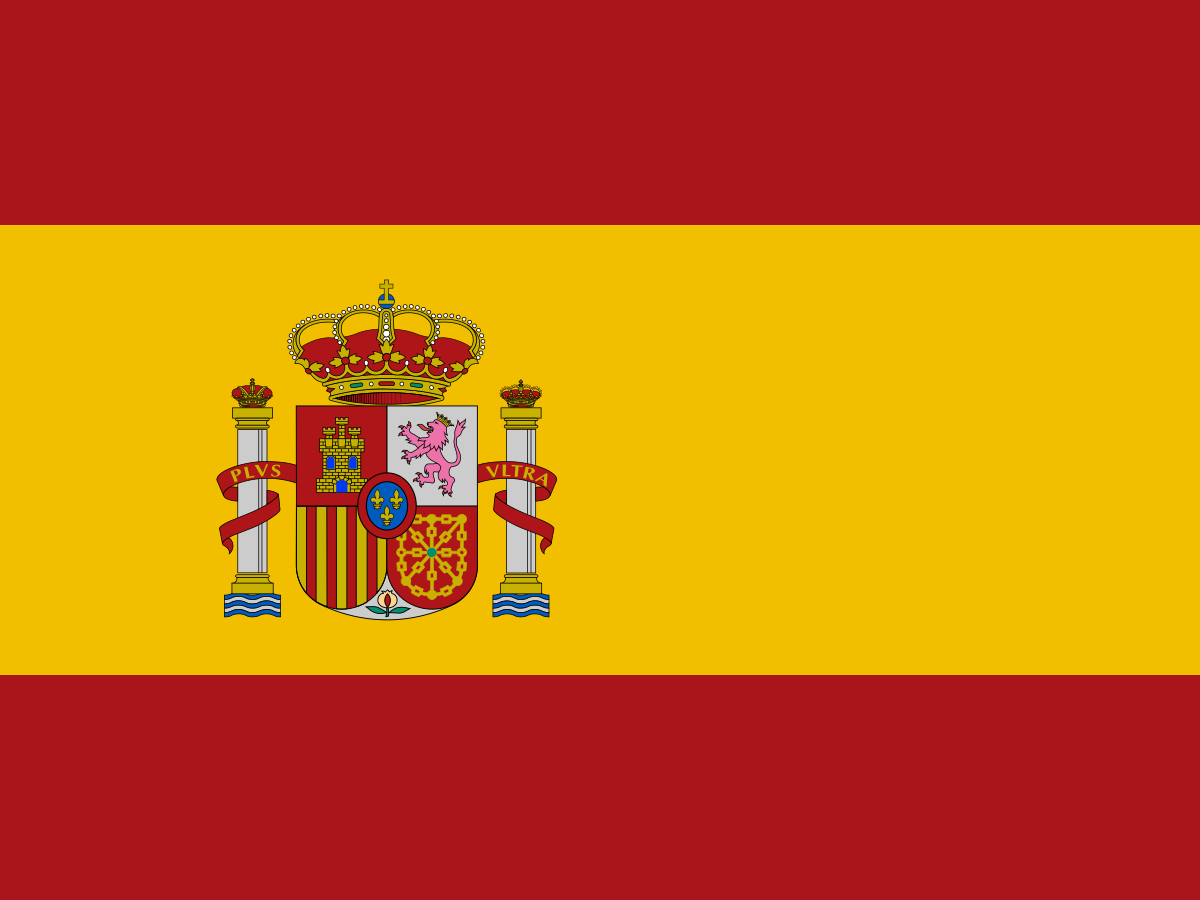
The Spain flag
The Spanish flag has three horizontal bands: red, yellow and red. The yellow band is twice the height of each red band, and the national coat of arms is positioned towards the hoist.
The current design was adopted in 1978 after Spain became a constitutional democracy. The red and yellow colours themselves have much older origins.
Red
The flag's red bands are inherited from historic Spanish heraldic and naval traditions. The exact modern colour specifications are defined by Spanish law rather than being assigned a simple official symbolic meaning.
Yellow
The large yellow central band makes the Spanish flag especially distinctive. Its use alongside red has roots in historic Spanish maritime flags and the colours of the Crown of Aragon.
The coat of arms
The coat of arms contains symbols representing several historic kingdoms associated with the formation of Spain, including Castile, León, Aragon and Navarre. The pomegranate represents Granada, while the pillars of Hercules appear on either side.
The royal crown
A crown appears above the shield, reflecting Spain's status as a constitutional monarchy. King Felipe VI is the current head of state.
The Pillars of Hercules
The two Pillars of Hercules flank the shield. They are traditionally associated with the Strait of Gibraltar and the ancient geographical idea of the western limits of the Mediterranean world.
Why the flag is distinctive
Spain's flag is easy to recognise because of its broad yellow centre and red upper and lower bands. The version used by the state also carries a detailed coat of arms, adding a large amount of historical symbolism to an otherwise simple tricolour design.
A short history
Spain's history has been shaped by Iberian peoples, Roman rule, Germanic kingdoms, Islamic Al-Andalus, Christian kingdoms, the dynastic union of Castile and Aragon, the Spanish Empire, the Napoleonic era, civil war and modern democracy.
The marriage of Isabella of Castile and Ferdinand of Aragon in 1469 created a powerful dynastic partnership. Their reigns and the conquest of Granada in 1492 are traditionally associated with the formation of early modern Spain.
History timeline
c. 900 BCE onward — Phoenician and Iberian culturesThe Iberian Peninsula was home to diverse peoples and became an important area of Mediterranean trade.
218 BCE — Roman conquest beginsRome became increasingly dominant in Iberia during the Second Punic War. The peninsula was eventually incorporated into the Roman Empire as Hispania.
5th century — Visigothic kingdomAfter the decline of Roman power, the Visigoths established a kingdom centred on much of the peninsula.
711 — Muslim conquestMuslim forces crossed from North Africa and rapidly conquered much of Iberia. Al-Andalus developed into a major centre of learning, trade and culture.
10th century — Caliphate of CórdobaCórdoba became one of Europe's major cities under the Umayyad Caliphate, famous for scholarship, architecture and commerce.
1212 — Battle of Las Navas de TolosaA major Christian victory weakened Almohad power and accelerated the expansion of Christian kingdoms in Iberia.
1469 — Isabella and Ferdinand marryThe marriage of the rulers of Castile and Aragon created a powerful dynastic union.
1492 — Granada fallsThe conquest of Granada ended Muslim rule in Iberia. In the same year, Christopher Columbus's expedition reached the Americas under the Spanish Crown.
16th century — Spanish EmpireSpain became a major global power, controlling territories in Europe, the Americas, Asia and Africa.
1588 — Spanish ArmadaPhilip II sent the Spanish Armada against England. The expedition failed to achieve its objective, becoming one of the best-known events of the Anglo-Spanish conflict.
1701–1714 — War of the Spanish SuccessionA major European conflict followed the death of Charles II without an heir. The Bourbon dynasty emerged on the Spanish throne.
1808–1814 — Peninsular WarNapoleon's invasion of Spain triggered a major war involving Spanish resistance, British forces and French armies.
1812 — Constitution of CádizThe Cádiz Constitution became an important landmark in Spanish constitutional history during the struggle against Napoleon.
19th century — Political instability and empire lossSpain experienced civil conflicts, political upheaval and the loss of most of its American colonies.
1898 — Spanish-American WarSpain lost Cuba, Puerto Rico, Guam and the Philippines following war with the United States, marking the end of its major overseas empire.
1931 — Second RepublicSpain became a republic after King Alfonso XIII left the country.
1936–1939 — Spanish Civil WarA devastating civil war was fought between the Republican government and Nationalist forces led by Francisco Franco.
1939–1975 — Franco dictatorshipFrancisco Franco ruled Spain as an authoritarian dictator until his death in 1975.
1975 — Juan Carlos becomes kingSpain began its transition from dictatorship towards parliamentary democracy.
1978 — ConstitutionSpain adopted its current democratic constitution, establishing the constitutional framework still used today.
1986 — European CommunitySpain joined the European Economic Community, now the European Union.
1992 — Barcelona Olympics and Seville ExpoMajor international events showcased Spain's transformation and growing global role.
TodaySpain is a parliamentary democracy, EU member and major tourism, manufacturing, agricultural and renewable-energy economy.
Madrid
Madrid is Spain's capital and largest city. It is the country's political, economic and cultural centre, home to the Spanish parliament, Royal Palace and famous museums such as the Prado.
Barcelona
Barcelona is the capital of Catalonia and one of Spain's best-known cities. It is famous for Antoni Gaudí's architecture, including the Sagrada Família, as well as its Mediterranean setting and football culture.
Seville
Seville is the capital of Andalusia and a major centre of Spanish history and culture. The city is known for the Alcázar, Seville Cathedral, flamenco and its distinctive Moorish heritage.
Granada
Granada is famous for the Alhambra, the spectacular palace and fortress complex built during the period of Muslim rule in Iberia. The city reflects the interaction of Islamic, Jewish and Christian traditions.
The Pyrenees
The Pyrenees form a natural mountain barrier between Spain and France. They contain dramatic valleys, high peaks and popular hiking and winter-sports areas.
Climate
Spain has a wide range of climates. Much of the Mediterranean coast experiences hot, dry summers and mild winters, while the north is generally wetter. The central plateau has hotter summers and colder winters, and the southeast is particularly dry.
Wildlife
Spain supports diverse wildlife including Iberian lynx, Spanish imperial eagles, wolves, wild boar, ibex, vultures and flamingos. The country's national parks protect important habitats.
Iberian lynx
The Iberian lynx is one of the world's most endangered wild cat species. Conservation programmes in Spain and Portugal have helped its population recover substantially from historic lows.
Doñana
Doñana National Park in Andalusia is one of Europe's most important wetlands. It provides habitat for migratory birds and species including the Iberian lynx.
Economy
Spain has a diversified developed economy. Major sectors include tourism, manufacturing, services, agriculture, construction, finance, automotive production and renewable energy.
Tourism
Spain is one of the world's leading tourist destinations. Visitors are attracted by beaches, historic cities, islands, food, architecture, museums and cultural festivals.
Agriculture
Spanish agriculture includes olives, grapes, citrus fruit, vegetables, cereals, almonds and livestock. Spain is one of the world's major producers and exporters of olive oil.
Olive oil
Spain is the world's leading producer of olive oil in many years. Andalusia is especially important to the industry, with vast olive-growing landscapes around Jaén and other provinces.
Wine
Spain has a major wine industry with famous regions including Rioja, Ribera del Duero, Priorat, Rías Baixas and Jerez. Sherry from the Jerez area is one of the country's best-known fortified wines.
Food
Spanish cuisine varies enormously by region. Famous dishes and foods include paella, tortilla española, gazpacho, jamón, tapas and churros.
Paella
Paella originated in the Valencia region. Traditional versions are based around rice and may include combinations of vegetables, beans, chicken, rabbit or seafood depending on the regional style.
Flamenco
Flamenco developed in Andalusia and combines singing, guitar playing, rhythm and dance. It is one of Spain's most internationally recognised cultural traditions.
Football
Football is hugely popular in Spain. The national team won the 2010 FIFA World Cup and European Championships in 1964, 2008, 2012 and 2024.
Cycling and tennis
Spain has produced major sporting figures in cycling and tennis. The country is also well known for motor racing, basketball and athletics.
Languages
Spanish is the official state language, while several other languages have official status in particular autonomous communities, including Catalan, Valencian, Galician, Basque and Aranese.
Autonomous communities
Spain is divided into 17 autonomous communities and two autonomous cities, Ceuta and Melilla. The communities have varying powers and distinctive regional identities.
Religion
Spain has a long Catholic history, although modern Spain is a secular constitutional state with freedom of religion. Catholic traditions remain visible in festivals, architecture and cultural heritage.
Architecture
Spanish architecture spans Roman ruins, Islamic palaces, Gothic cathedrals, Renaissance buildings, Baroque churches and modernist works. Gaudí's Barcelona buildings are among the country's most famous examples.
The Sagrada Família
Barcelona's Sagrada Família, designed primarily by Antoni Gaudí, is one of the world's most recognisable churches. Construction began in the 19th century and continued for generations.
La Tomatina
La Tomatina is an annual festival in Buñol, near Valencia, where participants take part in a huge tomato-throwing celebration. It has become one of Spain's most unusual international tourist attractions.
Why is Spain's flag interesting?
Spain's flag combines a relatively simple red-and-yellow design with a remarkably detailed coat of arms. The result links the modern Spanish state with the historic kingdoms, monarchy and geography that shaped the country.
Explore Spain on FlagAtlas
Keep exploring flags and educational resources.
Existing FlagAtlas content retained
The uploaded page already contains the Spain flag image, 🇪🇸 emoji copier, printable colouring link, Madrid/country statistics, development indicators, climate information and existing FlagAtlas navigation. fileciteturn202file0L131-L207