Asia
Tajikistan Flag
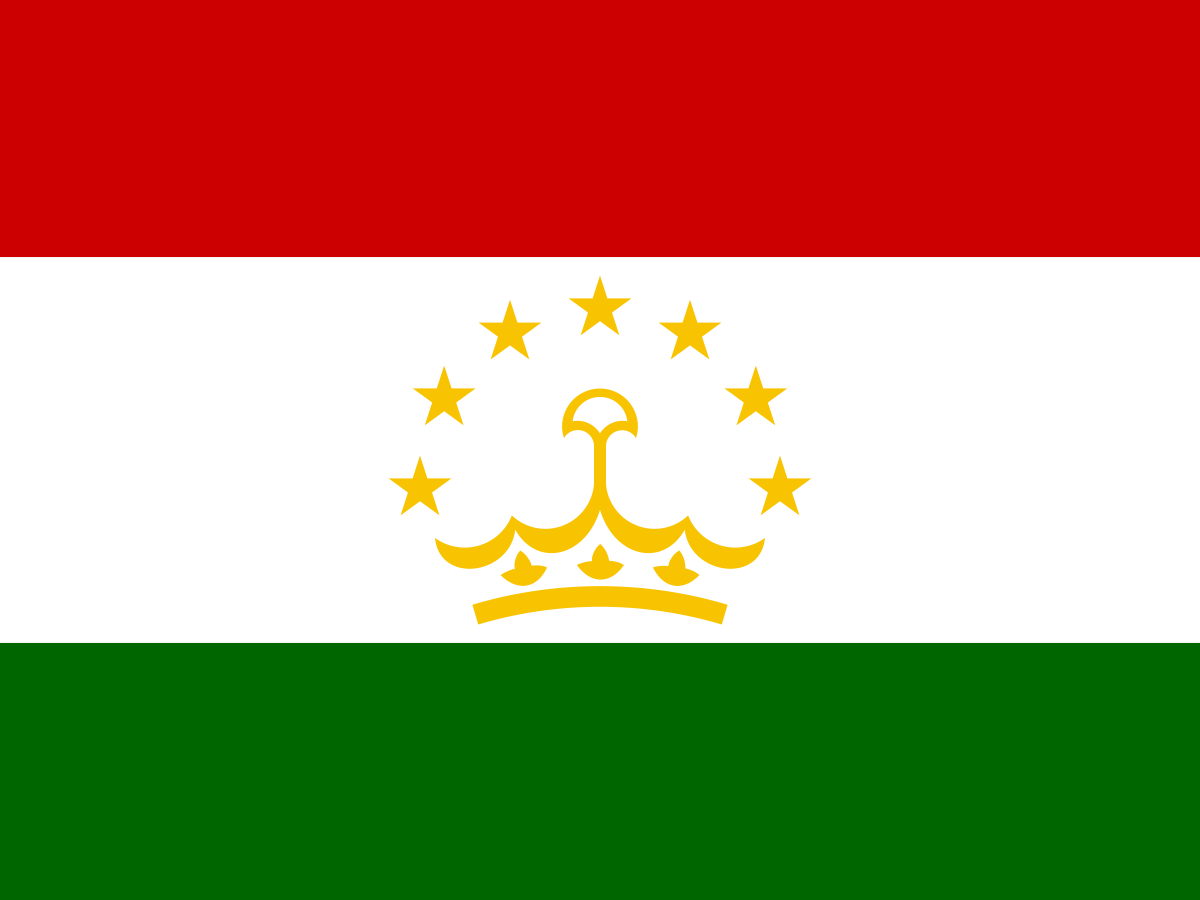
Red represents sovereignty, white symbolises cotton and mountain snow, green stands for Islam and fertile valleys. The crown and seven stars represent unity of the nation's workers.
Capital
Dushanbe
Continent
Asia
Population
9.9 million
Development indicators
GDP per capita
$1,100
USD per year (approx. 2023)
Human Development Index
0.685
Medium development
World Bank income classification
Lower-Middle Income (LMIC)
LMIC
🌡️ Climate: Continental / Alpine
Flag symbolism
Red represents sovereignty, white symbolises cotton and mountain snow, green stands for Islam and fertile valleys. The crown and seven stars represent unity of the nation's workers.
crown
Did you know?
More than 90% of Tajikistan is covered by mountains.
Test your knowledge
Think you know your world flags? Try the FlagAtlas daily challenge, speed quiz, or explore all Asia flags.
📚 Revising for GCSE Geography? Visit our free revision page →
About Tajikistan
Tajikistan is a mountainous, landlocked country in Central Asia. It is known for the Pamir Mountains, Silk Road history and a culture with deep Persian roots.
CapitalDushanbe
RegionCentral Asia
CurrencySomoni
LanguageTajik
Independence1991
Highest pointIsmoil Somoni Peak
The Tajikistan flag
The flag has three horizontal bands of red, white and green, with a gold crown and seven gold stars in the centre of the white band.
Flag colours and symbols
Red is associated with courage and national unity. White represents purity, snow and the country's mountains. Green represents nature, fertile valleys and prosperity. The crown and seven stars are important national symbols, with seven traditionally regarded as significant in Tajik culture.
Flag history
The current flag was adopted in 1992, after Tajikistan became independent from the Soviet Union. It replaced the Soviet-era design and introduced symbols reflecting Tajik national identity.
A short history
Tajikistan's history stretches back thousands of years and includes Iranian-speaking civilisations, Persian cultural influence and the great trading networks of Central Asia. The region later came under Russian and Soviet rule before declaring independence in 1991.
History timeline
Ancient periodThe region was home to Iranian-speaking peoples and became part of successive Central Asian states and empires.
7th–8th centuries — Islamic conquestIslam spread through the region and became a major influence on society.
9th–10th centuries — Samanid eraThe Samanids made Bukhara and Samarkand major centres of Persian culture; this period remains important to Tajik national identity.
13th century — Mongol conquestThe region was incorporated into the Mongol Empire.
19th century — Russian expansionMuch of present-day Tajikistan came under Russian imperial influence.
1920s–1991 — Soviet periodTajikistan became a Soviet republic and experienced major economic and social change.
1991 — IndependenceTajikistan declared independence following the dissolution of the Soviet Union.
1992–1997 — Civil warA devastating civil war followed independence before a peace agreement ended the main fighting.
Dushanbe
Dushanbe is the capital and largest city. It is the country's main political, economic, educational and cultural centre.
The Pamir Mountains
The Pamir Mountains occupy much of eastern Tajikistan and contain some of Central Asia's highest and most remote landscapes. The region is often called the 'Roof of the World'.
Ismoil Somoni Peak
Ismoil Somoni Peak rises to 7,495 metres and is Tajikistan's highest mountain. It is named after the Samanid ruler Ismail Samani.
Geography
Tajikistan is one of the world's most mountainous countries. It borders Afghanistan, China, Kyrgyzstan and Uzbekistan.
Rivers and lakes
The Vakhsh, Panj and Zeravshan are among its major rivers, while Lake Karakul is a famous high-altitude lake in the Pamirs.
Climate
Tajikistan has a strongly continental climate. Low valleys can have very hot summers, while high mountain areas have long, cold winters and permanent snow and ice.
Wildlife
Mountain habitats support snow leopards, Marco Polo sheep, ibex, wolves, brown bears and golden eagles.
The Silk Road
Tajikistan lay along important routes linking China, Persia and other parts of Central Asia. Trade helped spread languages, religions, technologies and ideas.
Culture and language
Tajik culture has strong Persian roots. Tajik is the official language and is closely related to Persian and Dari; Russian is also widely understood.
Nowruz
Nowruz, the Persian New Year around the spring equinox, is an important cultural festival associated with renewal, spring, family gatherings and traditional food.
Food
Tajik cuisine includes plov, qurutob, sambusa, mantu, laghman and traditional breads. Rice, meat, vegetables and dairy products are common ingredients.
Economy
The economy includes agriculture, mining, aluminium production, hydropower and remittances. Hydroelectricity is especially important because of the country's mountain rivers.
Hydropower
Tajikistan has enormous hydropower potential. The Nurek Dam is one of the country's major hydroelectric projects.
Sport
Football and wrestling are popular, while judo has produced internationally successful Tajik athletes.
Why is Tajikistan’s flag interesting?
Tajikistan's flag is distinctive because of its central gold crown and seven stars, combining modern national identity with symbols rooted in Tajik cultural history.