Asia
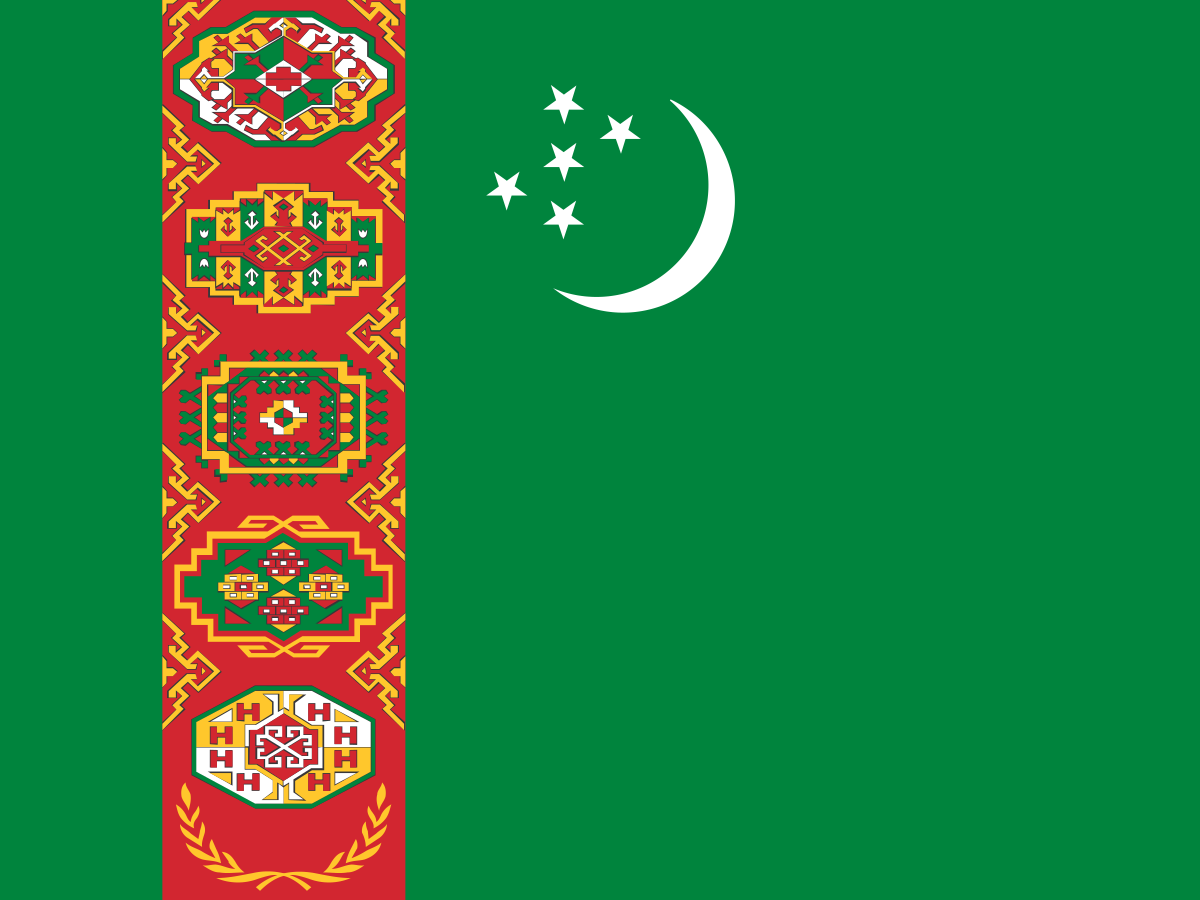
Turkmenistan Flag
Green is the sacred colour of Islam. The stripe on the left contains five carpet guls (traditional patterns) representing the five main Turkmen tribes, making it one of the most complex flag designs.
Capital
Ashgabat
Continent
Asia
Population
6.0 million
Development indicators
GDP per capita
$7,200
USD per year (approx. 2023)
Human Development Index
0.745
High development
World Bank income classification
Upper-Middle Income (UMIC)
UMIC
🌡️ Climate: Arid / Desert
Flag symbolism
Green is the sacred colour of Islam. The stripe on the left contains five carpet guls (traditional patterns) representing the five main Turkmen tribes, making it one of the most complex flag designs.
crescentstarspattern
Did you know?
Turkmenistan has one of the world's largest natural gas reserves and gives free gas to its citizens.
Test your knowledge
Think you know your world flags? Try the FlagAtlas daily challenge, speed quiz, or explore all Asia flags.
📚 Revising for GCSE Geography? Visit our free revision page →
About Turkmenistan
Turkmenistan is a Central Asian country dominated by the vast Karakum Desert. It is famous for its distinctive national flag, ancient Silk Road cities, Akhal-Teke horses and huge natural gas reserves.
CapitalAshgabat
RegionCentral Asia
CurrencyManat
LanguageTurkmen
Independence1991
Major seaCaspian Sea
The Turkmenistan flag
Turkmenistan's flag is a green field with a vertical red carpet stripe near the hoist. The stripe contains five carpet guls, olive branches, and a crescent and five stars. It is one of the most detailed national flags in the world.
Flag colours and symbolism
Green and the crescent are associated with Islam and Turkmen identity. The red carpet stripe represents the country's traditional carpet-making heritage. The five carpet patterns represent the country's five major tribal groups, while the olive branches symbolise neutrality and peace. The five stars represent the country's five provinces.
Flag history
The current national flag was adopted after independence in 1991, following the dissolution of the Soviet Union. It has been modified over time, including changes to the arrangement and symbolism of the stars and carpet motifs, but the green, red carpet stripe and detailed national symbolism have remained central.
A short history
The territory of modern Turkmenistan has been shaped by ancient Iranian and Central Asian civilisations, the Silk Road, Turkic migrations and Islamic empires. It became part of the Russian Empire in the 19th century and later the Soviet Union before declaring independence in 1991.
History timeline
Ancient era — Oasis civilisationsSettlements developed around the fertile oases of the region, including the area around the ancient Merv.
6th–4th centuries BCE — Persian empiresThe territory was incorporated into successive Iranian imperial systems.
Ancient and medieval Silk Road — MervMerv became one of the great cities of Central Asia and an important centre of trade, scholarship and culture.
7th–8th centuries — Arab conquestIslam spread through the region following Arab expansion into Central Asia.
11th–12th centuries — Seljuk periodThe Seljuks established a major empire, with Merv becoming one of its important centres.
1221 — Mongol conquestMerv was devastated during the Mongol invasions led by Genghis Khan.
16th–18th centuries — Turkmen tribal confederationsTurkmen communities developed across the region while the area was influenced by neighbouring Persian, Central Asian and khanate states.
1881 — Battle of Geok TepeRussian forces defeated Turkmen defenders at Geok Tepe, leading to Russian control over the region.
1925 — Turkmen Soviet Socialist RepublicTurkmenistan became a constituent republic of the Soviet Union.
1991 — IndependenceTurkmenistan declared independence from the Soviet Union on 27 October 1991.
1995 — Permanent neutralityThe United Nations recognised Turkmenistan's permanent neutrality.
2000s–present — Gas economyNatural gas exports have become central to the country's economy and international relationships.
Ashgabat
Ashgabat is Turkmenistan's capital and largest city. It is famous for monumental white-marble buildings, broad avenues and grand public spaces, creating one of the world's most unusual modern capital-city landscapes.
Karakum Desert
The Karakum Desert covers most of Turkmenistan and is one of the largest sandy deserts in the world. Its name means 'Black Sand' in Turkic languages.
Darvaza gas crater
The Darvaza gas crater, often nicknamed the 'Door to Hell', is a large burning natural-gas crater in the Karakum Desert. It became famous internationally because of its long-running flames and remote desert setting.
Merv
Ancient Merv was one of the great cities of the medieval Islamic world. Its ruins reflect thousands of years of settlement and its importance on the Silk Road.
Köneürgenç
Köneürgenç was an important medieval centre of Khwarazm. Its surviving monuments include mausoleums, minarets and other Islamic architectural remains.
Caspian Sea
Turkmenistan has a coastline on the Caspian Sea. The port of Türkmenbaşy provides an important link between the country and maritime trade routes across the Caspian.
Geography
Turkmenistan borders Kazakhstan, Uzbekistan, Afghanistan and Iran, with the Caspian Sea to the west. Most of the country is desert, while the Kopet Dag mountains rise along the southern border.
Climate
Turkmenistan has a strongly continental desert climate. Summers can be extremely hot and dry, while winters can be cold, particularly away from the southern coast.
Wildlife
Desert and mountain habitats support goitered gazelles, saiga, wild sheep, wolves, foxes and many desert birds. Conservation is particularly important for species adapted to the country's arid landscapes.
Akhal-Teke horses
The Akhal-Teke is a famous Turkmen horse breed prized for its endurance, speed and distinctive metallic-looking coat. It is an important national symbol and part of Turkmen cultural heritage.
Turkmen carpets
Traditional Turkmen carpets are among the country's best-known cultural products. Their geometric patterns and tribal guls are so important that carpet motifs appear directly on the national flag.
Turkmen language
Turkmen is a Turkic language closely related to Turkish and Azerbaijani. The language was written using several scripts during the 20th century and now uses a Latin-based alphabet.
Religion
The majority of Turkmenistan's population is Muslim, predominantly Sunni. Islam is an important part of cultural identity, although the state maintains a strongly secular political system.
Food
Turkmen cuisine reflects Central Asian traditions and commonly includes plov, manty, kebab, flatbreads, soups and dishes based on lamb and vegetables. Tea is an important everyday drink.
Culture
Turkmen cultural traditions include horse breeding, carpet weaving, music, oral storytelling and distinctive national dress. Hospitality and respect for elders are important social values.
Economy
Turkmenistan's economy is heavily dependent on natural gas, with significant petroleum, chemical and agricultural sectors as well. The country has some of the world's largest natural-gas reserves.
Natural gas
Large gas fields, particularly in the east of the country, have made Turkmenistan a major energy producer. Gas exports are an important source of government revenue and foreign currency.
Agriculture
Despite its desert environment, irrigation allows agriculture to flourish in selected areas. Important products include cotton, wheat, melons and livestock. The Karakum Canal is a major irrigation project.
Permanent neutrality
Turkmenistan is unusual because it has a formal policy of permanent neutrality. The United Nations recognised this status in 1995, and neutrality remains a central feature of the country's foreign policy.
Why is the flag interesting?
Turkmenistan has one of the world's most detailed national flags. The vertical carpet stripe incorporates five traditional carpet guls, olive branches, a crescent and five stars, combining national, cultural and political symbolism in a single design.
Explore Turkmenistan on FlagAtlas