Europe
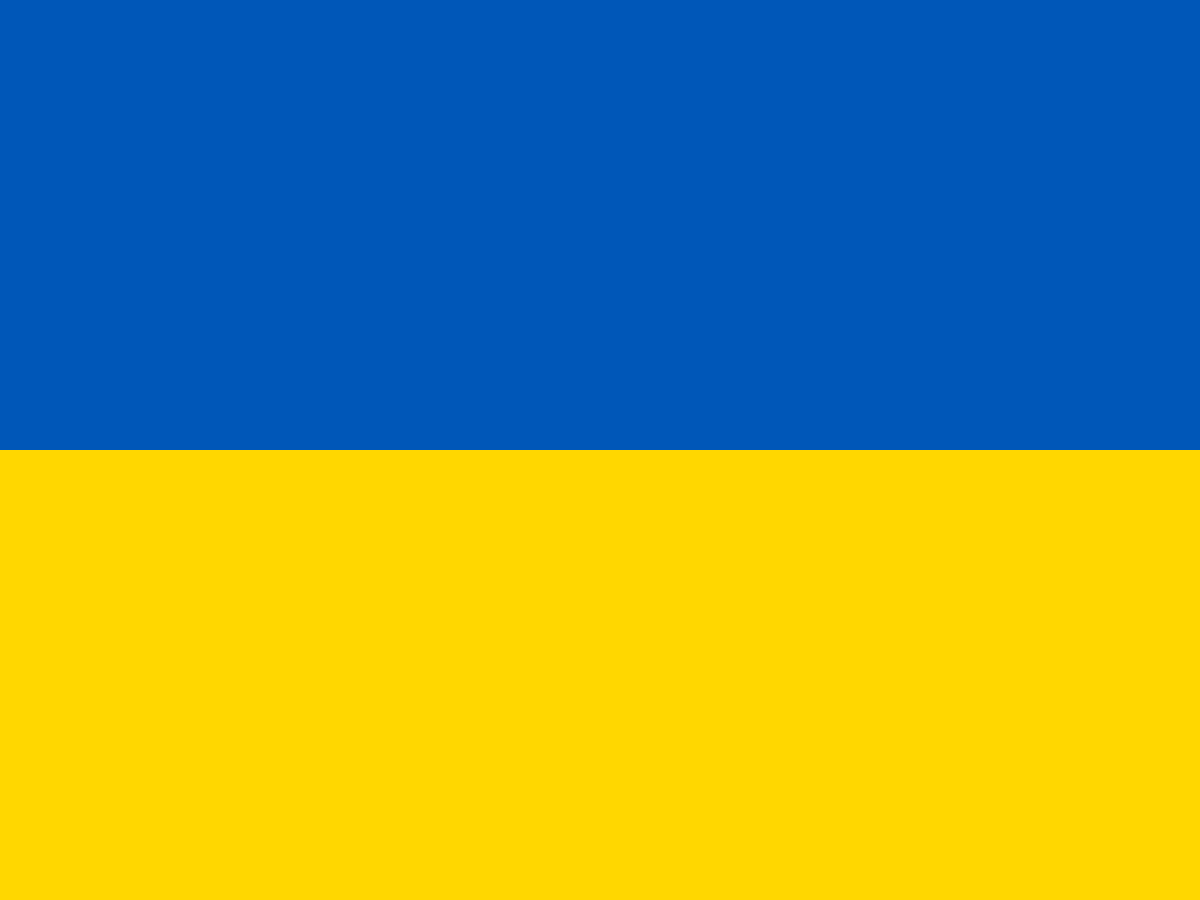
Ukraine Flag
Blue represents the sky and peaceful rivers; yellow symbolises the golden wheat fields that cover much of the country.
Capital
Kyiv
Continent
Europe
Population
44.0 million
Development indicators
GDP per capita
$4,500
USD per year (approx. 2023)
Human Development Index
0.734
High development
World Bank income classification
Lower-Middle Income (LMIC)
LMIC
🌡️ Climate: Temperate continental
Flag symbolism
Blue represents the sky and peaceful rivers; yellow symbolises the golden wheat fields that cover much of the country.
bicolour
Did you know?
Ukraine is the largest country entirely within Europe.
Test your knowledge
Think you know your world flags? Try the FlagAtlas daily challenge, speed quiz, or explore all Europe flags.
📚 Revising for GCSE Geography? Visit our free revision page →
About Ukraine
Ukraine is a large country in Eastern Europe, stretching from the Carpathian Mountains to the Black Sea. It has a long and complex history shaped by Kyivan Rus', the Polish-Lithuanian Commonwealth, the Cossacks, the Russian and Austro-Hungarian empires, the Soviet Union and its independence in 1991.
Ukraine is known for its fertile plains, historic cities, Black Sea coastline, Carpathian Mountains and rich cultural traditions. Kyiv is the capital and largest city.
Ukraine at a glance
Capital: Kyiv · Region: Eastern Europe · Currency: Ukrainian hryvnia (UAH) · Language: Ukrainian · Independence: 1991
The flag of Ukraine
Ukraine's national flag consists of two equal horizontal bands of blue over yellow. The modern national flag was restored and officially adopted following Ukraine's independence from the Soviet Union in 1991.
The familiar interpretation connects the blue with the sky and the yellow with Ukraine's golden wheat fields. These colours have become one of the strongest visual symbols of Ukrainian national identity.
Why are the colours blue and yellow?
The blue-and-yellow combination has deep historical roots in Ukrainian national movements. The colours are also commonly associated with the country's landscape: blue skies above golden agricultural fields. The symbolism is especially powerful because Ukraine has some of Europe's most fertile agricultural land.
Ukraine's flag history
1918 — Ukrainian People's RepublicBlue and yellow were used prominently by the Ukrainian People's Republic during the struggle for independence following the Russian Revolution.
Soviet periodUkraine became a Soviet republic and the blue-and-yellow national flag was suppressed in favour of Soviet designs.
1990 — Flag restored in western UkraineBlue and yellow flags reappeared publicly as the Soviet system began to weaken.
1991 — IndependenceUkraine declared independence on 24 August 1991. The blue-and-yellow flag became the national flag of the independent state.
TodayThe flag is a major symbol of Ukrainian sovereignty, independence and national identity.
A short history of Ukraine
The history of Ukraine reaches back to Kyivan Rus', a medieval East Slavic state centred on Kyiv. Later, Ukrainian lands came under Lithuanian, Polish, Cossack, Russian and Austro-Hungarian rule. Ukraine experienced revolution, famine, occupation and war during the twentieth century before becoming independent in 1991.
History timeline
882 — Kyiv becomes a political centrePrince Oleg established Kyiv as the centre of the emerging Kyivan Rus' state.
988 — Christianisation of Kyivan Rus'Grand Prince Volodymyr adopted Christianity, a defining event in the history of the region.
11th century — Golden age of Kyivan Rus'Kyiv became a major political, religious and cultural centre in Eastern Europe.
1240 — Mongol invasion of KyivThe Mongol conquest devastated Kyiv and transformed the political landscape.
14th–16th centuries — Lithuanian and Polish ruleLarge parts of Ukrainian territory became incorporated into the Grand Duchy of Lithuania and later the Polish-Lithuanian Commonwealth.
16th–17th centuries — Rise of the CossacksUkrainian Cossacks developed powerful military and political communities centred on the Dnieper region.
1648 — Khmelnytsky uprisingBohdan Khmelnytsky led a major Cossack revolt against Polish rule.
18th century — Russian and Habsburg ruleMost Ukrainian territory gradually came under the Russian Empire, while western regions were incorporated into the Habsburg Empire.
1917–1921 — Ukrainian independence movementsRevolution and civil war produced competing Ukrainian governments before Soviet control was established over most of the territory.
1922 — Ukrainian SSRThe Ukrainian Soviet Socialist Republic became one of the founding republics of the Soviet Union.
1932–1933 — HolodomorA catastrophic famine caused by Soviet policies resulted in millions of deaths in Ukraine.
1941–1944 — Nazi occupationNazi Germany occupied most of Ukraine during the Second World War, with enormous civilian and military losses.
1986 — Chernobyl disasterThe explosion at the Chernobyl nuclear power plant became the world's worst nuclear power accident at the time.
1991 — IndependenceUkraine declared independence on 24 August 1991. A December referendum strongly confirmed independence.
2004–2005 — Orange RevolutionMass protests challenged a disputed presidential election.
2013–2014 — EuromaidanLarge protests led to major political change and became a defining moment in modern Ukrainian history.
2014 — Crimea and war in DonbasRussia annexed Crimea, which Ukraine and most of the international community regard as Ukrainian territory, while fighting began in eastern Ukraine.
2022 — Full-scale Russian invasionRussia launched a full-scale invasion of Ukraine on 24 February 2022.
Today — Defence and reconstructionUkraine continues to defend its sovereignty while dealing with the enormous human, economic and infrastructure consequences of the war.
Kyiv
Kyiv is Ukraine's capital and largest city. Situated on the Dnieper River, it has been a major political, religious and cultural centre for more than a millennium and was the heart of medieval Kyivan Rus'.
Lviv
Lviv in western Ukraine is known for its historic architecture and Central European cultural influences. Its historic centre reflects centuries of Polish, Austro-Hungarian and Ukrainian cultural connections.
The Dnieper River
The Dnieper is one of Europe's major rivers and flows through Kyiv before reaching the Black Sea. It has played an enormous role in Ukraine's settlement, transport, agriculture and energy.
The Black Sea
Ukraine has a coastline on the Black Sea, historically important for trade, fishing and ports. Odesa is one of the country's best-known Black Sea cities.
The Carpathian Mountains
The Ukrainian Carpathians contain forests, mountain valleys and traditional villages. Hoverla, at 2,061 metres, is Ukraine's highest mountain.
Chernobyl
The Chernobyl nuclear disaster occurred on 26 April 1986 when reactor 4 exploded during a test. The accident released radioactive material across large areas and led to the evacuation of Pripyat and surrounding communities.
Geography and climate
Ukraine has extensive fertile plains, forests, wetlands, mountains and steppe. Its climate is mostly temperate continental, with colder winters inland and warmer conditions towards the south and Black Sea.
Wildlife
Ukraine's habitats support wolves, lynx, deer, wild boar, brown bears in the Carpathians, steppe species and many migratory birds. Forests, wetlands and protected areas are important for biodiversity.
The Ukrainian language
Ukrainian is the official language and is an East Slavic language closely related to Belarusian and Russian. It uses a version of the Cyrillic alphabet and has a rich literary tradition.
Religion
Ukraine has a diverse religious heritage, with Eastern Orthodox and Greek Catholic traditions particularly important. Other Christian communities, Muslims, Jews and people with no religious affiliation are also part of Ukrainian society.
Ukrainian cuisine
Well-known Ukrainian foods include borscht, varenyky, holubtsi, deruny and pampushky. Wheat, potatoes, beetroot and cabbage feature prominently in traditional cooking.
Ukrainian culture
Ukrainian culture includes distinctive embroidery, folk music, dance, pysanky decorated eggs, ceramics and traditional dress. The vyshyvanka embroidered shirt is a strong symbol of Ukrainian identity.
Agriculture
Ukraine has exceptionally fertile soils, including large areas of chernozem, or black earth. It has long been a major producer and exporter of wheat, maize, sunflower oil and other agricultural products.
The Cossacks
The Ukrainian Cossacks were semi-autonomous military communities central to Ukrainian history and identity. The Cossack Hetmanate existed as a major political entity in the seventeenth and eighteenth centuries.
The Holodomor
The Holodomor was the devastating famine of 1932–33 in Soviet Ukraine. Millions died amid forced collectivisation, grain requisitioning and severe repression. It remains one of the most painful events in Ukrainian historical memory.
Ukraine today
Ukraine's modern identity has been strongly shaped by its independence, democratic movements and resistance to Russian aggression. The country continues to defend its territorial sovereignty while facing the human, economic and infrastructure consequences of the war.
Explore Ukraine on FlagAtlas
Continue exploring Ukraine and the world's flags with these FlagAtlas resources.
Sources & further reading
This page combines the original FlagAtlas Ukraine page with additional country and historical context. Statistics such as population, GDP and development indicators are dated because they can change over time.
Encyclopaedia Britannica — Ukraine ·
World Bank — Ukraine data