Asia
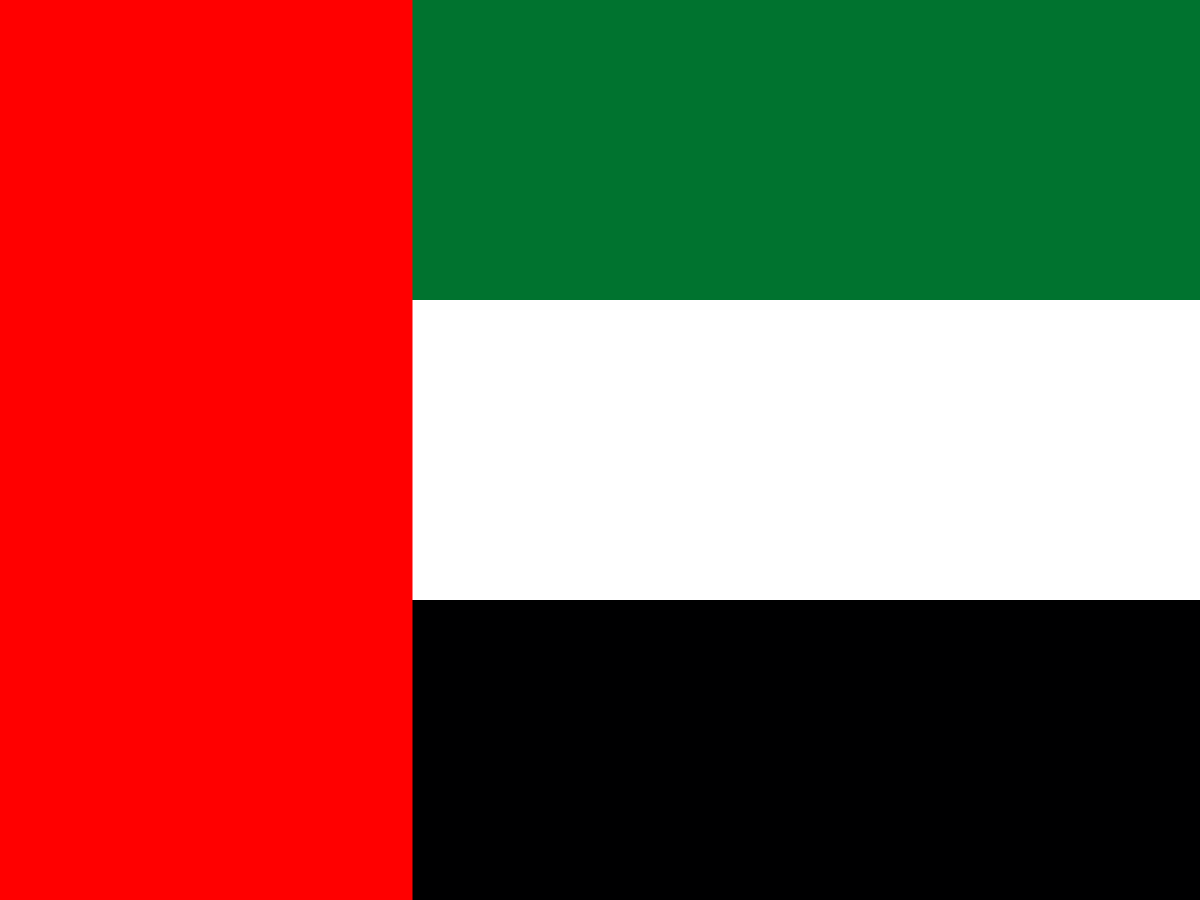
United Arab Emirates Flag
Green represents fertility, white stands for neutrality and peace, black symbolises oil, and red is the colour of the UAE and other Arab nations.
Capital
Abu Dhabi
Continent
Asia
Population
9.9 million
Development indicators
GDP per capita
$44,700
USD per year (approx. 2023)
Human Development Index
0.937
Very High development
World Bank income classification
High Income (HIC)
HIC
🌡️ Climate: Arid / Hot desert
Flag symbolism
Green represents fertility, white stands for neutrality and peace, black symbolises oil, and red is the colour of the UAE and other Arab nations.
pan-arab
Did you know?
The UAE is home to the world's tallest building — the Burj Khalifa at 828 metres.
Test your knowledge
Think you know your world flags? Try the FlagAtlas daily challenge, speed quiz, or explore all Asia flags.
📚 Revising for GCSE Geography? Visit our free revision page →
About the United Arab Emirates
The United Arab Emirates (UAE) is a federation of seven emirates on the eastern side of the Arabian Peninsula. It has coastlines on the Persian Gulf and borders Saudi Arabia and Oman.
The seven emirates are Abu Dhabi, Dubai, Sharjah, Ajman, Umm Al Quwain, Fujairah and Ras Al Khaimah. Abu Dhabi is the federal capital, while Dubai is the country's largest city and a major international business and tourism centre.
United Arab Emirates at a glance
Capital: Abu Dhabi · Region: Arabian Peninsula / Gulf · Currency: UAE dirham (AED) · Official language: Arabic · Federation: 1971
The flag of the UAE
The UAE flag consists of a vertical red band at the hoist and three horizontal bands of green, white and black. The four colours are known as the Pan-Arab colours and have strong historical associations across the Arab world.
Flag colours and symbolism
Green is commonly associated with fertility and prosperity, while white is associated with peace and purity. Black has been associated with strength and, in some modern explanations of the UAE flag, the country's oil resources. Red is a traditional Arab colour and is also associated with courage and strength.
The exact meanings attributed to individual colours can vary between explanations. The most important point is that the four colours together form part of a wider Pan-Arab visual tradition.
Flag history
1916–1918 — Arab Revolt coloursThe red, green, white and black combination became closely associated with Arab nationalism during the Arab Revolt and subsequently influenced many Arab national flags.
2 December 1971 — UAE federationThe United Arab Emirates was formed from six emirates. Ras Al Khaimah joined the federation in February 1972.
1971 — National flag adoptedThe present red, green, white and black design became the national flag of the new federation.
TodayThe flag represents the federation and the shared national identity of the seven emirates.
The seven emirates
The UAE is made up of Abu Dhabi, Dubai, Sharjah, Ajman, Umm Al Quwain, Fujairah and Ras Al Khaimah. Abu Dhabi is the largest emirate by area and contains the federal capital. Dubai is internationally famous for its skyline, business sector and tourism.
A short history of the UAE
The region has been inhabited for thousands of years and was historically connected to maritime trade, fishing, pearling and caravan routes. Before the federation, the emirates were separate sheikhdoms along the Gulf coast, often referred to collectively as the Trucial States.
The discovery and development of oil transformed the economies of the emirates during the twentieth century. Sheikh Zayed bin Sultan Al Nahyan and other leaders worked towards federation, which was established on 2 December 1971.
History timeline
Ancient times — Early settlementsArchaeological evidence shows that people lived and traded in the area thousands of years ago.
7th century — Islam reaches the regionThe communities of the Arabian Peninsula became part of the rapidly developing Islamic world.
16th–17th centuries — European maritime influencePortuguese forces established a presence in parts of the Gulf as European powers competed for control of regional trade routes.
18th–19th centuries — Maritime and pearling economyCoastal communities developed strong links to fishing, pearling, shipping and regional trade.
1820 — General Maritime TreatyBritain and the Gulf sheikhdoms entered agreements that helped establish the political framework later known as the Trucial States.
1892 — Exclusive agreementsThe rulers of the Trucial States entered agreements giving Britain responsibility for their external relations while preserving local rule.
1930s–1950s — Oil explorationOil exploration expanded and the foundations were laid for the major economic transformation that followed.
1958 — Oil discovered at Abu DhabiCommercial quantities of oil were discovered, with exports beginning in 1962.
1960s — Federation discussionsBritain announced plans to end its treaty arrangements in the Gulf, encouraging local rulers to consider closer cooperation and federation.
2 December 1971 — United Arab Emirates foundedAbu Dhabi, Dubai, Sharjah, Ajman, Umm Al Quwain and Fujairah formed the United Arab Emirates.
1972 — Ras Al Khaimah joinsRas Al Khaimah became the seventh emirate in the federation.
1970s–2000s — Rapid developmentOil revenues were invested in infrastructure, education, healthcare, transport and economic diversification.
21st century — Global business and tourism centreThe UAE developed major aviation, finance, technology, tourism, logistics and real-estate sectors.
Today — Diversification and innovationThe UAE continues to invest in sectors beyond oil while maintaining its position as a major regional economic and transport hub.
Abu Dhabi
Abu Dhabi is the federal capital and the largest of the seven emirates. It is the centre of the UAE's federal government and has major oil, finance, cultural and energy industries. The emirate includes extensive desert areas and numerous islands.
Dubai
Dubai is the UAE's largest city and one of the world's best-known modern urban centres. It has become a major hub for aviation, tourism, finance, trade and real estate. The Burj Khalifa, at 828 metres, is the world's tallest building.
Sharjah
Sharjah is known for its museums, cultural institutions and universities. It was designated UNESCO Cultural Capital of the Arab World in 1998 and has a particularly strong emphasis on arts and heritage.
Fujairah and the Hajar Mountains
Fujairah is the only emirate whose main territory lies entirely on the eastern coast of the UAE, facing the Gulf of Oman. The dramatic Hajar Mountains run through parts of the eastern UAE and northern Oman.
The desert
Much of the UAE is desert, including vast areas of the Arabian Desert. Sand dunes, gravel plains and rocky mountains create a striking landscape. The Empty Quarter, or Rub' al Khali, extends across southern parts of the Arabian Peninsula.
Climate
The UAE has a hot desert climate. Summers are extremely hot and humid, particularly along the coast, while winters are generally warm and more comfortable. Rainfall is low and irregular, with somewhat greater amounts in the mountains.
Wildlife
Despite the harsh environment, the UAE supports wildlife including Arabian oryx, gazelles, Arabian tahr, foxes, sea turtles and many species of migratory birds. Conservation programmes have helped protect several important species.
The Arabic language
Arabic is the official language of the UAE. English is also extremely widely used in business, tourism, education and everyday life, reflecting the country's large international population.
Religion and culture
Islam is the official religion and has an important influence on UAE culture and public life. The country also has large communities from many parts of the world, making the UAE one of the most internationally diverse societies in the region.
Traditional culture
Traditional Emirati culture includes falconry, camel racing, dhow sailing, pearl diving, poetry, music and hospitality. The UAE has invested heavily in museums, heritage villages and cultural institutions to preserve this history alongside its modern development.
Economy
Oil and gas remain important, particularly in Abu Dhabi, but the UAE has built a highly diversified economy. Major sectors include tourism, aviation, logistics, finance, construction, real estate, technology and renewable energy.
Oil and economic transformation
The discovery of oil changed the UAE dramatically during the twentieth century. Oil revenues funded roads, ports, airports, schools, hospitals and other infrastructure, helping transform small coastal communities into modern cities.
Space and technology
The UAE has developed an ambitious space programme. The Hope Probe entered orbit around Mars in 2021, making the UAE one of a small number of countries to successfully reach Mars.
Why is the UAE flag interesting?
The UAE flag combines the four Pan-Arab colours into a distinctive design that reflects both Arab heritage and the unity of the seven emirates. It has remained unchanged since the federation was established in 1971.
Explore the UAE on FlagAtlas
Continue exploring the United Arab Emirates and the world's flags with these FlagAtlas resources.