Asia
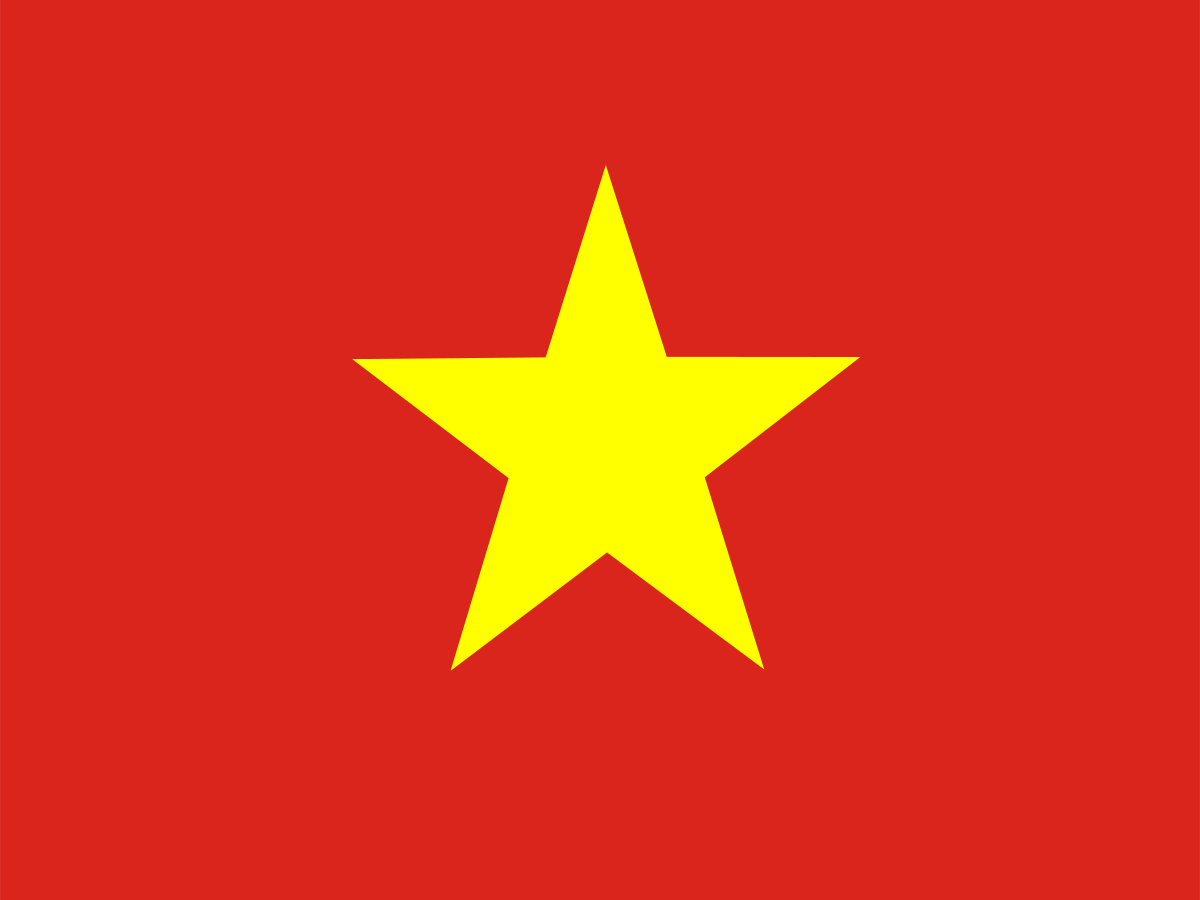
Vietnam Flag
Red represents the revolution and the blood of those who died fighting for independence. The yellow star represents the five main social classes: workers, peasants, intellectuals, traders, and military.
Capital
Hanoi
Continent
Asia
Population
97.0 million
Development indicators
GDP per capita
$3,760
USD per year (approx. 2023)
Human Development Index
0.726
High development
World Bank income classification
Lower-Middle Income (LMIC)
LMIC
🌡️ Climate: Tropical / Subtropical
Flag symbolism
Red represents the revolution and the blood of those who died fighting for independence. The yellow star represents the five main social classes: workers, peasants, intellectuals, traders, and military.
star
Did you know?
Vietnam is the world's largest exporter of cashew nuts and the second-largest exporter of coffee.
Test your knowledge
Think you know your world flags? Try the FlagAtlas daily challenge, speed quiz, or explore all Asia flags.
📚 Revising for GCSE Geography? Visit our free revision page →
About Vietnam
Vietnam is a long, narrow country on the eastern side of mainland Southeast Asia, with a coastline stretching along the South China Sea. It borders China to the north and Laos and Cambodia to the west.
Hanoi is the capital, while Ho Chi Minh City is the country's largest city and a major commercial centre. Vietnam is known for its rice terraces, tropical landscapes, busy cities, long coastline and distinctive cuisine.
Vietnam at a glance
Capital: Hanoi · Region: Southeast Asia · Currency: Vietnamese đồng (VND) · Official language: Vietnamese · Independence: 1945
The flag of Vietnam
Vietnam's national flag is a plain red field with a large yellow five-pointed star in the centre. The design is simple and highly recognisable.
The red background is closely associated with revolution and the struggle for independence, while the yellow star represents the unity of the country's main social groups.
Flag symbolism
Red represents the revolution and the blood of those who fought and died for independence. The central yellow star represents the unity of five main social classes: workers, peasants, intellectuals, traders and soldiers.
The five-pointed star
The five points of the star are traditionally associated with the five social groups brought together by the Vietnamese revolutionary movement. The large central position of the star emphasises national unity.
Flag history
1940 — Red flag with yellow starThe design was first associated with the Vietnamese revolutionary movement during the uprising in southern Vietnam.
1945 — Democratic Republic of VietnamThe red flag with the yellow star became the national flag of the newly proclaimed Democratic Republic of Vietnam.
1954 — Vietnam dividedAfter the First Indochina War, Vietnam was divided into North and South, with different political systems and flags.
1955 — Star proportions changedThe design of the yellow star was modified to give it its familiar proportions.
1976 — ReunificationNorth and South Vietnam were formally reunified as the Socialist Republic of Vietnam, and the red flag with the yellow star became the flag of the whole country.
TodayThe red flag and yellow star remain the national symbols of the Socialist Republic of Vietnam.
A short history of Vietnam
Vietnam has a long history stretching back thousands of years. Ancient Vietnamese societies developed around the Red River delta, while successive Chinese dynasties exerted strong political and cultural influence over northern Vietnam for long periods.
Vietnam later developed independent dynasties, expanded southwards and came under French colonial rule. The twentieth century was dominated by the struggle for independence, the First Indochina War, the Vietnam War and eventual reunification in 1976.
History timeline
c. 7th century BC — Early Vietnamese statesEarly states such as Văn Lang developed in the Red River region and form an important part of Vietnamese historical tradition.
111 BC — Chinese rule beginsThe Han dynasty incorporated much of northern Vietnam into the Chinese imperial system.
939 — Independence restoredNgô Quyền defeated the Southern Han at the Battle of Bạch Đằng, beginning a long period of independent Vietnamese dynasties.
11th–18th centuries — Vietnamese dynastiesDynasties including the Lý, Trần, Lê and Nguyễn shaped the country's political and cultural development.
1802 — Nguyễn dynastyGia Long established the Nguyễn dynasty and unified Vietnam under imperial rule.
1858 — French conquest beginsFrench forces attacked Đà Nẵng, beginning the process of French colonial expansion in Vietnam.
1880s — French IndochinaVietnam became part of French Indochina alongside Cambodia and Laos.
1940 — Japanese occupationJapan occupied French Indochina during the Second World War while the French colonial administration initially remained in place.
1945 — Declaration of independenceHo Chi Minh proclaimed the Democratic Republic of Vietnam following Japan's defeat.
1946–1954 — First Indochina WarVietnamese forces fought the French colonial authorities in a major war for independence.
1954 — Battle of Điện Biên PhủThe decisive Vietnamese victory led to the end of French colonial rule and the division of Vietnam.
1954–1975 — North and South VietnamThe country was divided between the communist North and the anti-communist South, with the conflict becoming increasingly internationalised.
1960s–1970s — Vietnam WarFighting intensified and the United States became heavily involved in support of South Vietnam.
1975 — Fall of SaigonNorth Vietnamese forces captured Saigon, bringing the war to an end.
1976 — ReunificationThe Socialist Republic of Vietnam was formally established.
1986 — Đổi Mới reformsVietnam introduced major economic reforms, moving towards a more market-oriented economy.
1995 — ASEAN membershipVietnam joined the Association of Southeast Asian Nations, strengthening its regional economic and diplomatic links.
Today — Rapidly developing economyVietnam is an increasingly important manufacturing, trade and tourism centre in Southeast Asia.
Hanoi
Hanoi is Vietnam's capital and one of the country's most historic cities. It is known for its Old Quarter, lakes, French colonial architecture, temples and political institutions.
Ho Chi Minh City
Ho Chi Minh City, formerly Saigon, is Vietnam's largest city and its major commercial hub. It is a centre for finance, manufacturing, technology, trade and tourism.
Geography
Vietnam stretches for more than 1,600 kilometres from north to south. Its geography includes the Red River Delta in the north, the mountains of the north and west, the narrow central coast and the fertile Mekong Delta in the south.
Ha Long Bay
Ha Long Bay is famous for its hundreds of limestone islands and dramatic karst formations rising from the sea. It is one of Vietnam's best-known natural landmarks and a major tourist destination.
The Mekong Delta
The Mekong Delta is one of the world's great agricultural regions. A dense network of rivers and canals supports rice cultivation, fruit growing, fishing and large communities in southern Vietnam.
Rice and agriculture
Rice has been central to Vietnamese agriculture and culture for centuries. The country's fertile river deltas support intensive cultivation, while terraced rice fields in mountainous areas have become famous for their spectacular landscapes.
Climate
Vietnam has a varied tropical and subtropical climate. The north has cooler winters and more distinct seasonal changes, while the south remains tropical for most of the year. Monsoon rains and tropical storms can strongly affect different regions.
Wildlife and nature
Vietnam contains tropical forests, wetlands, mountains, limestone karsts and coastal ecosystems. Wildlife includes Asian elephants, primates, bears, pangolins, hornbills and many other species, although several are threatened by habitat loss and illegal wildlife trade.
People and language
Vietnamese is the official language and is spoken by the great majority of the population. Vietnam is also home to numerous ethnic minority communities, particularly in the northern and central highlands, each with their own languages and traditions.
Culture and traditions
Vietnamese culture has been influenced by indigenous traditions as well as centuries of contact with China, Southeast Asia and Europe. Tết, the Vietnamese Lunar New Year, is the country's most important traditional celebration.
Vietnamese food
Vietnam is famous for its fresh and varied cuisine. Well-known dishes include phở, bánh mì, bún chả, spring rolls and bánh xèo. Rice, noodles, herbs, vegetables and fish sauce are important ingredients in many regional dishes.
Economy
Vietnam has transformed its economy rapidly since the Đổi Mới reforms of 1986. Manufacturing, electronics, textiles, agriculture, tourism and services have become major parts of the economy, with Vietnam increasingly integrated into global supply chains.
Vietnam and coffee
Vietnam is one of the world's major coffee producers and is particularly well known for robusta coffee. Coffee production is concentrated especially in the Central Highlands, and Vietnamese coffee culture is distinctive for drinks made with strong coffee and condensed milk.
Vietnam and cashew nuts
Vietnam is a major global centre for cashew processing and exports. The country's cashew industry is an important part of its agricultural and food-processing economy, and cashews are one of Vietnam's notable agricultural export products.
Why is Vietnam's flag interesting?
Vietnam's flag is striking because of its extreme simplicity: a single red field and one large yellow star. Unlike many national flags, there are no borders, stripes, shields or multiple symbols. The design places almost all of its meaning into the colour red and the central five-pointed star.
Vietnam and the Vietnam War
The Vietnam War remains one of the most important events in modern Vietnamese history. The conflict caused enormous loss of life and destruction, and its effects were felt well beyond Vietnam. Reunification in 1976 created the modern Vietnamese state.
Explore Vietnam on FlagAtlas
Continue exploring Vietnam and the world's flags with these FlagAtlas resources.