Africa
Zambia Flag
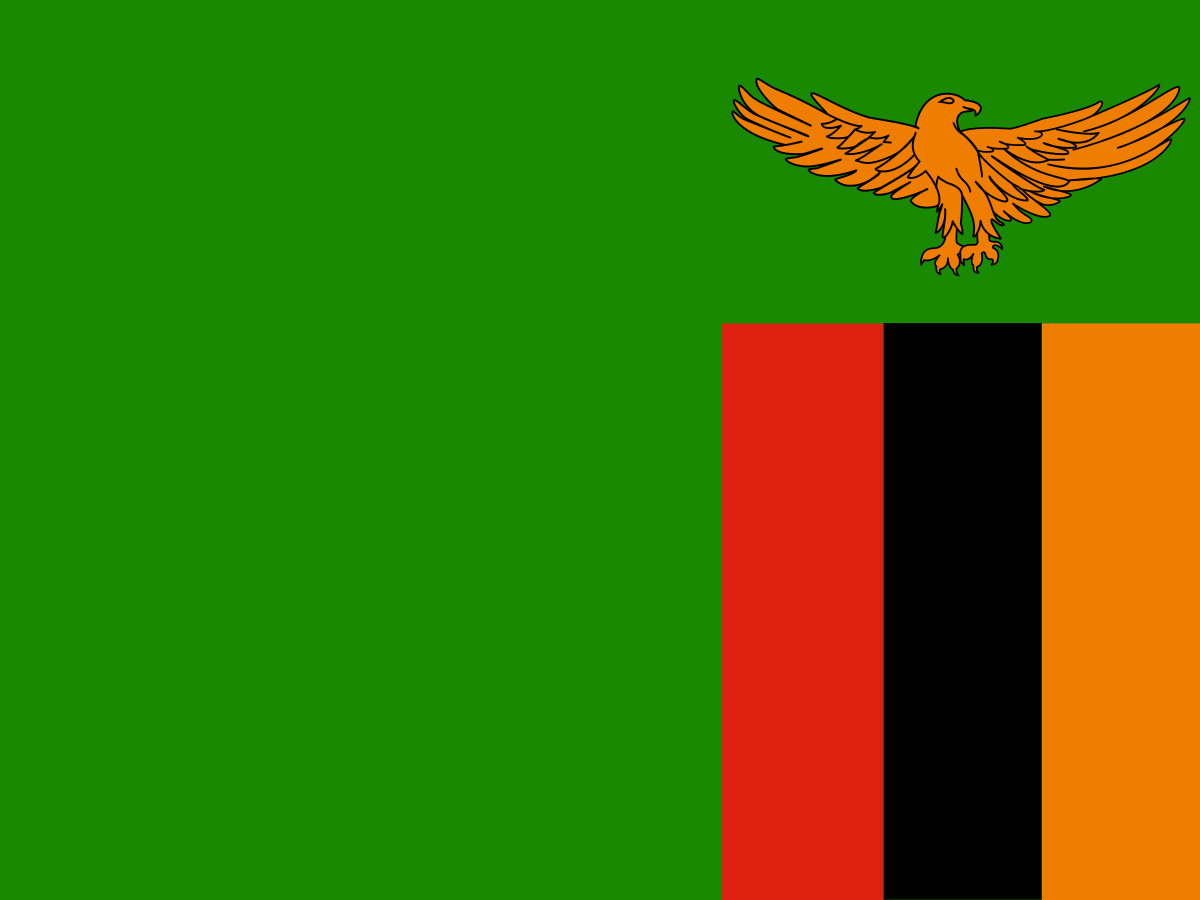
Green represents the land, red stands for the struggle for freedom, black represents the people, and orange symbolises Zambia's copper wealth. The eagle represents the ability to rise above problems.
CapitalLusaka
ContinentAfrica
Population19.0 million
Development indicators
GDP per capita
$1,300
USD per year (approx. 2023)
Human Development Index
0.569
Medium development
World Bank income classification
Lower-Middle Income (LMIC)
LMIC
🌡️ Climate: Tropical / Savanna
Flag symbolism
Green represents the land, red stands for the struggle for freedom, black represents the people, and orange symbolises Zambia's copper wealth. The eagle represents the ability to rise above problems.
eagle
Did you know?
Zambia and Zimbabwe share Victoria Falls — one of the world's greatest waterfalls, known locally as Mosi-oa-Tunya, meaning "The Smoke That Thunders".
Test your knowledge
Think you know your world flags? Try the FlagAtlas daily challenge, speed quiz, or explore all Africa flags.
About Zambia
Zambia is a landlocked country in south-central Africa, bordered by the Democratic Republic of the Congo, Tanzania, Malawi, Mozambique, Zimbabwe, Botswana, Namibia and Angola.
The capital is Lusaka. Zambia is known for Victoria Falls, the Zambezi River, extensive wildlife areas and its important copper-mining industry.
The flag of Zambia
Zambia's national flag has a green field with three vertical stripes of red, black and orange near the lower-right corner. An orange eagle flies above the stripes.
Explore Zambia on FlagAtlas
🎨 Zambia flag colouring page · 🌍 Explore all country flags · 📅 Daily challenge · ⚡ Flag quiz
Sources & further reading
This page combines the original FlagAtlas Zambia content with additional historical, geographical and cultural context. Statistics such as population, GDP and development indicators are dated because they can change over time.
Encyclopaedia Britannica — Zambia · World Bank — Zambia data · UNESCO — Mosi-oa-Tunya / Victoria Falls
About Zambia
Zambia is a landlocked country in south-central Africa, known for its spectacular waterfalls, wildlife, rivers and vast areas of wilderness. It takes its name from the Zambezi River, one of Africa's great rivers.
Lusaka is the capital and largest city. Zambia is famous for Victoria Falls, which it shares with Zimbabwe, as well as national parks such as South Luangwa, Kafue and Lower Zambezi.
Zambia at a glance
Capital: Lusaka · Region: Southern Africa · Currency: Zambian kwacha (ZMW) · Official language: English · Independence: 1964
The flag of Zambia
Zambia's national flag has a green field with three vertical stripes of red, black and orange near the lower-right corner. An orange eagle flies above the stripes.
The unusual position of the emblem makes the Zambian flag stand out from many other national flags. Green dominates the design, while the eagle and coloured stripes are grouped towards the fly end.
Flag symbolism
Green represents the country's rich natural resources and vegetation. Red represents the struggle for freedom, black represents the people of Zambia, and orange represents the country's mineral wealth.
The eagle represents the people's ability to rise above the country's difficulties and challenges.
The eagle and the colours
The eagle is placed above the three coloured stripes rather than in the centre of the flag. This gives Zambia one of Africa's most distinctive national flag designs. The combination of green, red, black and orange also reflects the country's natural wealth, people, independence struggle and mineral resources.
Flag history
1964 — IndependenceZambia became independent from British colonial rule on 24 October 1964 and adopted its distinctive green flag with an eagle.
1964 onward — National symbolsThe flag's colours and eagle became closely associated with the new independent Zambian state.
1997 — Minor design changesThe proportions and appearance of some flag elements were adjusted, while the basic design remained unchanged.
TodayThe green flag with the orange eagle and three stripes remains the national flag of Zambia.
A short history of Zambia
The region of modern Zambia has been inhabited for thousands of years by communities with diverse languages and cultures. During the nineteenth century, European explorers and missionaries increasingly travelled through the area, including David Livingstone.
The territory later became part of British colonial rule as Northern Rhodesia. Nationalist movements grew after the Second World War, leading to independence in 1964 under President Kenneth Kaunda.
History timeline
Early history — Indigenous societiesMany communities developed across the region, with farming, fishing, hunting, ironworking and long-distance trade forming important parts of life.
17th–19th centuries — Expanding kingdoms and tradeKingdoms and chiefdoms developed across the region while trade routes connected central and southern Africa.
1850s — David LivingstoneThe Scottish explorer and missionary travelled through the region and became closely associated with the Zambezi and Victoria Falls.
1890s — British influence expandsThe British South Africa Company expanded its influence over the territory that became Northern Rhodesia.
1911 — Northern RhodesiaThe territory was formally known as Northern Rhodesia under British administration.
1920s — Copper discoveries and developmentLarge copper deposits helped transform the northern part of the territory and laid the foundations for Zambia's modern mining economy.
1953 — Federation of Rhodesia and NyasalandNorthern Rhodesia became part of a federation with Southern Rhodesia and Nyasaland.
1963 — Federation endsThe federation was dissolved amid growing nationalist pressure.
24 October 1964 — IndependenceNorthern Rhodesia became the independent Republic of Zambia, with Kenneth Kaunda as its first president.
1970s–1980s — Economic difficultiesFalling copper prices and wider economic pressures created major challenges for the new country.
1991 — Multi-party democracyAfter decades of one-party rule, Zambia returned to multi-party politics and Frederick Chiluba became president.
2000s — Economic growthHigher copper prices and increased investment supported stronger economic growth, although dependence on mining remained a major issue.
2010s–2020s — Debt and economic challengesZambia experienced serious debt and fiscal difficulties while continuing efforts to diversify its economy.
Today — Resource-rich landlocked nationZambia remains an important producer of copper and a major wildlife and tourism destination in southern Africa.
Lusaka
Lusaka is Zambia's capital and largest city. It is the country's political, commercial and transport centre and has grown rapidly as Zambia's population and economy have expanded.
Victoria Falls
Victoria Falls, known locally as Mosi-oa-Tunya or 'The Smoke That Thunders', lies on the Zambezi River on the border between Zambia and Zimbabwe. It is one of the world's most spectacular waterfalls and a UNESCO World Heritage Site.
The Zambezi River
The Zambezi is one of Africa's great rivers and forms an important part of Zambia's geography. It flows through or along several countries before reaching the Indian Ocean in Mozambique.
Geography
Zambia is largely made up of elevated plateau country with broad river valleys and woodland. Major waterways include the Zambezi, Kafue and Luangwa rivers, while Lake Tanganyika lies along part of the country's northern border.
Climate
Zambia has a tropical seasonal climate with a wet season and a dry season. Temperatures vary with altitude, and the dry winter months are particularly important for wildlife viewing because animals often gather around water sources.
Wildlife
Zambia is one of Africa's outstanding wildlife destinations. Its protected areas support elephants, lions, leopards, hippos, crocodiles, buffalo, wild dogs, giraffes and numerous antelope species.
South Luangwa National Park
South Luangwa National Park is famous for its wildlife and walking safaris. The Luangwa River provides an important water source and supports large populations of hippos, elephants and other animals.
Kafue National Park
Kafue National Park is one of Africa's largest national parks. Its huge area includes woodland, floodplains and wetlands and supports an exceptionally wide range of wildlife.
Lower Zambezi
The Lower Zambezi region is known for its beautiful river scenery and wildlife. Canoeing and boating on the Zambezi offer visitors a different way to experience elephants, hippos and other animals.
People and language
Zambia is home to many ethnic groups and languages. English is the official language and is widely used in government, education and business, while Bemba, Nyanja, Tonga, Lozi and many other local languages are widely spoken.
Culture and traditions
Zambian culture is highly diverse, with traditional ceremonies playing an important role in many communities. The Kuomboka ceremony of the Lozi people is particularly famous and marks the seasonal movement of the Litunga from the Barotse floodplain to higher ground.
Food
A staple of Zambian cuisine is nshima, a thick maize meal commonly eaten with vegetables, beans, meat or fish. Maize is an important part of everyday food and agriculture across the country.
Economy
Zambia's economy has long depended heavily on copper mining. Agriculture, energy, construction, manufacturing, services and tourism are also important, with diversification remaining a major economic goal.
Zambia and copper
Zambia is one of Africa's major copper producers. The Copperbelt in the north has been central to the country's industrial development and remains one of the most important mining regions in Africa.
A landlocked country
Zambia has no coastline, but its rivers and lakes give it extensive freshwater resources. Its central location means it shares borders with eight countries: Tanzania, Malawi, Mozambique, Zimbabwe, Botswana, Namibia, Angola and the Democratic Republic of the Congo.
Why is Zambia's flag interesting?
Zambia's flag is unusual because almost all of its design is concentrated towards the fly end rather than the centre. The orange eagle appears above the three vertical stripes, while the large green field represents Zambia's natural environment.
Explore Zambia on FlagAtlas
Continue exploring Zambia and the world's flags with these FlagAtlas resources.