๐Ÿ“œ Flag History Africa Post-colonialDemocracy1994
South Africa flag today

From Apartheid to Rainbow Nation

How South Africa's flag was designed in seven days

South Africa's current flag is one of the most celebrated national symbols in the world โ€” a six-colour design representing reconciliation after apartheid. What most people don't know is that it was designed in a single week, intended as a temporary solution, and only became permanent because the public loved it too much to change.

๐Ÿ“‹ 3 major flag changes
Timeline
1910โ€“1928
South Africa Red Ensign 1910
The Union Jack Years
When the Union of South Africa was formed on 31 May 1910 โ€” merging the Cape Colony, Natal, Transvaal and Orange River Colony โ€” it inherited the British Red Ensign defaced with the South African coat of arms. The Union Jack was technically the official national flag. This flag was deeply unpopular with Afrikaner South Africans, who had fought and lost the Boer War against the British only eight years earlier. It was also contested by English-speakers, who felt it failed to represent their heritage adequately. Neither community had a flag they truly owned.
1928โ€“1994
South Africa flag 1928 to 1994
The Orange, White and Blue
After years of heated political debate โ€” Natal Province threatened to secede from the Union if the Union Jack was removed โ€” a compromise was reached in 1927 and the new flag was first hoisted on 31 May 1928. Based on the Dutch Prince's Flag (the Prinsenvlag), it incorporated miniature flags of the Union Jack, the Orange Free State, and the South African Republic as a central badge โ€” another compromise. Known informally as the "oranje-blanje-blou" (orange, white and blue), the flag carried the Union through its declaration as a republic in 1961, but became increasingly associated with apartheid. In 2019, a South African court ruled that publicly displaying the old flag constitutes hate speech.
27 April 1994
South Africa current flag 1994
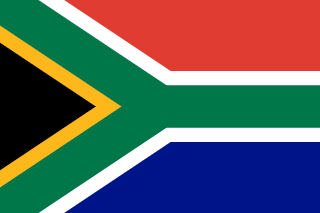
The Rainbow Flag โ€” Designed in a Week
The new flag was needed for the 1994 election โ€” South Africa's first democratic election, on 27 April 1994. A public competition received over 7,000 entries but none were suitable. With the election just weeks away, State Herald Frederick Brownell was given a week to produce a design. He submitted Proposal 4, which was approved by the Transitional Executive Council on 20 March 1994 and authorised by President F.W. de Klerk on 20 April 1994. The flag combines three colours from the old flag (red, white, blue โ€” via the Netherlands and UK) with three ANC colours (black, gold, green) in a Y-shape representing the convergence of paths. Intended as an interim flag, it proved so popular that the 1996 Constitution made it permanent. It has since been widely recognised as one of the finest national flag designs of the modern era.
๐Ÿ’ก
Did you know?
South Africa's flag has six colours โ€” the most of any national flag in the world (along with Belize and South Sudan). The Y-shape is unique among world flags.