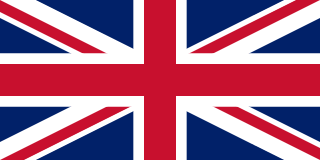
The Union Flag is three older flags stacked on top of each other. Red comes from England's St George's Cross and Ireland's St Patrick's saltire; blue comes from Scotland's flag; and white comes from the crosses' backgrounds and borders. The design was built in two stages — England and Scotland in 1606, Ireland added in 1801.
Where each colour comes from
The quickest way to understand the Union Jack's colours is to look at the three flags that were merged to make it. Between them, they supply every colour on the finished flag:
Red is supplied by two of the crosses — St George's upright cross and St Patrick's diagonal one. Blue comes from a single source: the deep blue field of Scotland's flag. And white comes from the white backgrounds of the English and Irish crosses, and the white borders (called fimbriation) that keep the red crosses from touching the blue. Put them together and you get the familiar red, white and blue.
England's red cross
England's national flag is the Cross of St George — a bold red cross on a white field, named for the country's patron saint and in use since the medieval period. It's the upright cross you see running straight up and down and across the centre of the Union Jack, and it contributes both red and white to the final design.
Scotland's white saltire
Scotland's flag is the Saltire, or Cross of St Andrew: a white diagonal cross on a blue field, and one of the oldest national flags still in use. St Andrew was martyred on an X-shaped cross, which is why his emblem is diagonal. This flag is the sole source of the Union Jack's blue, and adds more white through its saltire.
The first Union Flag, 1606
In 1603 the crowns of England and Scotland were united when James VI of Scotland also became James I of England — the Union of the Crowns. To symbolise the new shared monarchy, the two countries' crosses were combined, and in 1606 the first Union Flag was born: St George's red cross laid over St Andrew's white saltire and blue field. At this stage the flag was red, white and blue, but with only two crosses.
Ireland's red saltire and the 1801 flag
The flag took its final form nearly two centuries later. When the Act of Union merged the Kingdom of Great Britain and the Kingdom of Ireland in 1801, the saltire of St Patrick — a red diagonal cross on white — was woven into the design. This is the version we still fly today, and it's why the flag has a second, diagonal red cross alongside England's upright one.
The "right way up" — a hidden detail
Adding two diagonal crosses created a subtle problem: how do you combine Scotland's white saltire and Ireland's red saltire without one simply covering the other? The solution was to offset them, so the red saltire sits slightly to one side of the white, producing the pinwheel effect at the centre. A surprising consequence is that the Union Jack has a right way up: the broad white diagonal should be uppermost in the corner nearest the flagpole. Fly it upside-down and, technically, you've got it wrong.
Why Wales isn't represented
A question that comes up constantly: where's Wales? The Union Flag combines the crosses of three kingdoms — England, Scotland and Ireland — but by the time the flag was created, Wales had long been legally part of the Kingdom of England, so it was never given a separate element. That's a whole story in itself, which we tell in why isn't Wales on the Union Jack?
Union Flag or Union Jack?
Finally, the name. A jack is a small flag flown from the jackstaff at the bow of a ship, and the Union Flag flown in that position came to be called the Union Jack. Purists sometimes argue the name "Union Jack" only strictly applies at sea, but in everyday use both names are perfectly accepted for the same flag. For the fuller history, see the story behind the Union Jack.
Frequently asked questions
Where do the colours of the Union Jack come from?
Red from the crosses of St George (England) and St Patrick (Ireland); blue from Scotland's flag (St Andrew); white from the crosses' backgrounds and borders.
When was the Union Flag created?
The first version in 1606 (England + Scotland); the current design in 1801, when St Patrick's saltire was added for Ireland.
Why does the Union Jack have two red crosses?
The upright red cross is England's St George; the diagonal red cross is Ireland's St Patrick, offset from Scotland's white saltire.
Is there a right way up for the Union Jack?
Yes — the broad white diagonal should be uppermost in the corner nearest the flagpole.
Why is it called the Union Jack?
A "jack" is a small flag flown at a ship's bow; the Union Flag flown there became the Union Jack, and both names are now widely used.