North Atlantic
Bermuda Flag
Explore Bermuda's flag history, symbolism, geography and facts — the red ensign with the Union Jack and a coat of arms showing the wreck of the Sea Venture, on a group of islands far out in the North Atlantic.
Capital
Hamilton
Region
North Atlantic
Population
64,000
Status & key facts
Political status
Overseas Territory
Self-governing internally
Currency
Bermudian dollar
Pegged 1:1 to US$
Sovereign state
United Kingdom
British Overseas Territory
🌡️ Climate: Subtropical — mild and humid, warmed by the Gulf Stream, with a risk of hurricanes in late summer and autumn
Flag symbolism
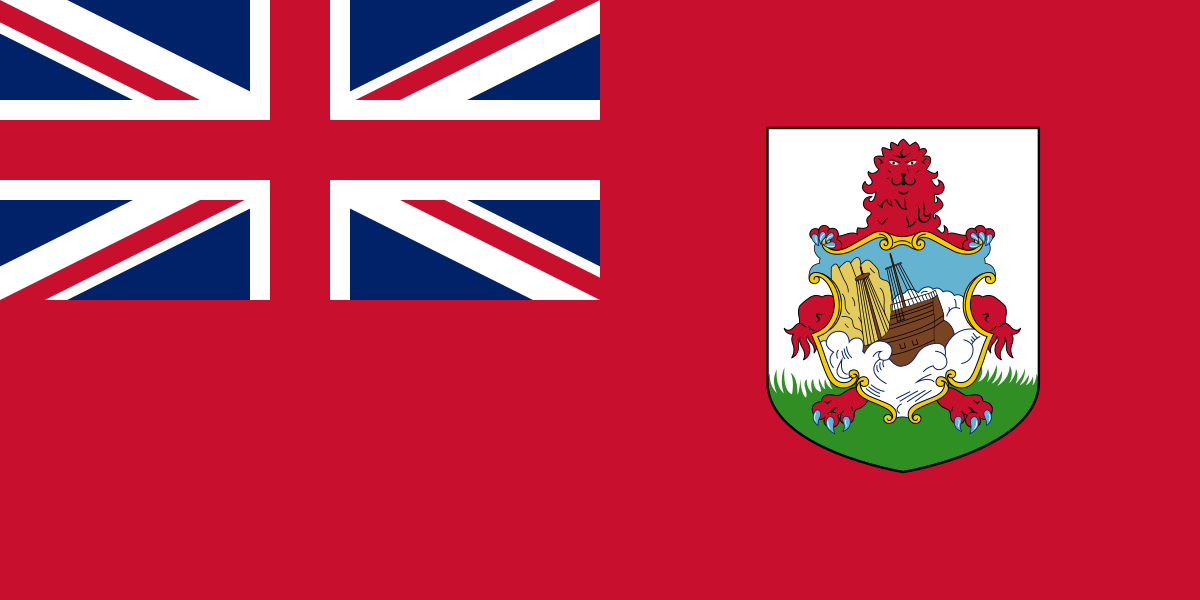
A red "ensign" with the Union Jack in the upper hoist and the coat of arms of Bermuda in the fly. The arms show a red lion holding a shield on which the ship Sea Venture is wrecked on rocks — the event that led to Bermuda's settlement.
red ensignSea Venturelion
Did you know?
Bermuda's flag is one of the few British flags based on the red ensign rather than the blue — and despite its palm trees and beaches, Bermuda sits in the North Atlantic, not the Caribbean, around 1,000 km off the coast of the United States.
Test your knowledge
Think you know your world flags? Try the FlagAtlas daily challenge, speed quiz, or explore all the territory flags.
📚 Revising for GCSE Geography? Visit our free revision page →
About Bermuda
Bermuda is a British Overseas Territory in the North Atlantic Ocean, lying around 1,000 kilometres east of the coast of the United States. Despite its subtropical climate and beaches, it is not in the Caribbean. It is made up of a chain of around 180 small islands, the largest of which are joined by bridges and causeways.
Hamilton is the capital. Bermuda is self-governing in its internal affairs, with the reigning British monarch as head of state represented by a Governor, while the United Kingdom is responsible for defence and foreign affairs. Its currency, the Bermudian dollar, is pegged one-to-one to the US dollar.
CapitalHamilton
RegionNorth Atlantic
PopulationAbout 64,000
Area54 km²
CurrencyBermudian dollar (= US$)
LanguageEnglish
The flag of Bermuda
Bermuda's flag is a British Red Ensign — a red field with the Union Jack in the canton — defaced in the fly with the territory's coat of arms. Most British territories use a blue ensign, which makes Bermuda's red one unusual.
What the arms show.
A red lion, standing upright, holds a shield depicting the Sea Venture foundering on rocks. The scene records the 1609 shipwreck that led directly to the settlement of the islands.
The Red Ensign with the Bermuda arms was adopted in 1910 and has represented the territory ever since.
The wreck of the Sea Venture
In 1609 the Sea Venture, the flagship of a fleet carrying settlers to the English colony at Jamestown in Virginia, was caught in a storm and deliberately run onto Bermuda's reefs to save those on board. The survivors spent months on the uninhabited islands before building new vessels and continuing to Virginia.
Reports of the wreck and the "still-vexed Bermoothes" are widely believed to have inspired William Shakespeare's play The Tempest. The shipwreck also opened the way to permanent English settlement, and the ship on Bermuda's coat of arms commemorates it.
A short history of Bermuda
Bermuda had no native population. The islands were sighted by the Spanish navigator Juan de Bermúdez in the early sixteenth century, and take their name from him, but were not settled at the time.
The wreck of the Sea Venture in 1609 led to permanent English settlement from 1612, making Bermuda one of the oldest English — later British — overseas possessions. Its parliament, established in 1620, is among the oldest legislatures in the world.
Over the following centuries Bermuda developed as a maritime and, later, tourism and financial centre, and today it is a prosperous, self-governing British Overseas Territory.
The Bermuda flag's history
Bermuda's flag follows the British ensign tradition, distinguished by its red field and the shipwreck arms.
British colonial eraBermuda used British ensigns as part of the wider colonial flag tradition.
1910 — the red ensignThe Red Ensign defaced with Bermuda's coat of arms was adopted as the territory's flag.
TodayThe red ensign with the shipwreck arms remains the flag of Bermuda.
Geography of Bermuda
Bermuda is one of the most isolated inhabited places on Earth, with the nearest land — Cape Hatteras in North Carolina — about 1,000 kilometres away. The islands are the tops of an ancient underwater volcano, capped with limestone, and are ringed by coral reefs that are among the northernmost in the world.
Bermuda's setting
The territory is famous for its pink-tinted sand beaches and turquoise water, and it lends its name to the so-called "Bermuda Triangle" of Atlantic folklore. The warm Gulf Stream keeps the climate mild for its latitude.
People, language and culture
English is the official language, and there is a long-established Portuguese-speaking community descended from Azorean immigrants. Bermudian culture blends British, African and Portuguese influences, seen in its music, food and the colourful Gombey dancers.
Bermuda has given the world the "Bermuda shorts," worn with jackets and knee socks as smart business dress on the islands — a distinctive local custom.
Bermuda today
Bermuda governs its own domestic affairs through its parliament, with a Governor representing the Crown. It is one of the world's leading centres for international insurance and reinsurance, and this — together with tourism — underpins one of the highest income levels of any territory.
As a British Overseas Territory, Bermuda remains under UK sovereignty for defence and foreign affairs while running its internal affairs itself.
Explore Bermuda on FlagAtlas
Continue exploring Bermuda and the world's flags with these FlagAtlas resources.
Sources & further reading
This page combines the information already present on the FlagAtlas Bermuda page with additional context. Statistics such as population and area are dated because they can change over time.
Encyclopaedia Britannica — Bermuda