Southern Europe
Gibraltar Flag
Explore Gibraltar's flag history, symbolism, geography and facts — the white and red banner with its three-towered red castle and golden key, flown over the famous Rock at the gateway to the Mediterranean.
Capital
Gibraltar
Region
Southern Europe
Population
32,000
Status & key facts
Political status
Overseas Territory
Self-governing internally
Currency
Gibraltar pound
At par with £ sterling
Sovereign state
United Kingdom (claimed by Spain)
British Overseas Territory
🌡️ Climate: Mediterranean — mild, wet winters and warm, dry summers
Flag symbolism
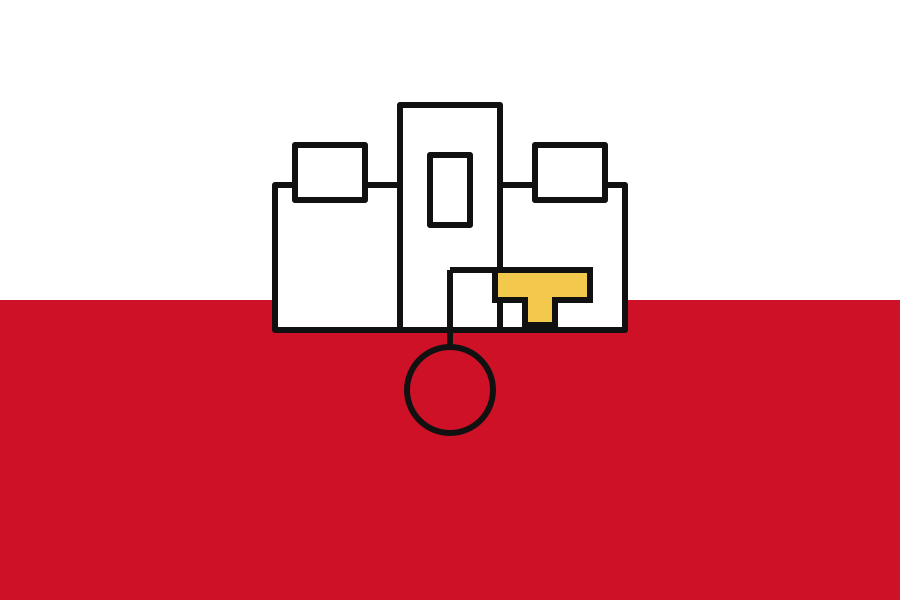
Two horizontal bands — a wider white above a narrower red — with a red three-towered castle on the white band and a golden key hanging below it. The design is the banner of Gibraltar's coat of arms.
castlekeybanner of arms
Did you know?
Unlike most British territories, Gibraltar does not fly a defaced ensign — its flag is the banner of its own coat of arms, and that design was originally granted by Queen Isabella I of Castile in 1502, long before British rule.
Test your knowledge
Think you know your world flags? Try the FlagAtlas daily challenge, speed quiz, or explore all the territory flags.
📚 Revising for GCSE Geography? Visit our free revision page →
About Gibraltar
Gibraltar is a British Overseas Territory at the southern tip of the Iberian Peninsula, guarding the narrow strait where the Atlantic Ocean meets the Mediterranean Sea. It is dominated by the Rock of Gibraltar, a great limestone headland, and consists essentially of a single densely built-up town at the Rock's foot. To the north it shares a land border with Spain.
Gibraltar is self-governing in its internal affairs, with the reigning British monarch as head of state represented by a Governor, while the United Kingdom is responsible for defence and foreign affairs. English is the official language and the Gibraltar pound circulates at par with pound sterling.
StatusBritish Overseas Territory
RegionSouthern Europe
PopulationAbout 32,000
Area6.7 km²
CurrencyGibraltar pound (= GBP)
LanguageEnglish (Spanish widely spoken)
The flag of Gibraltar
Gibraltar's flag has two horizontal bands — a broad white stripe above a narrower red one — charged with a red castle with three towers and, hanging from it, a golden key. It is a "banner of arms," meaning the flag is simply the territory's coat of arms stretched to fill a flag.
Unusual for a British territory.
Most British Overseas Territories fly a blue or red ensign with a badge. Gibraltar is one of the few that instead flies the banner of its own arms — which is why it looks so different from the others.
The castle is often taken to stand for the fortress of Gibraltar, and the key for its role as the "key" that locks or unlocks the gateway between the Atlantic and the Mediterranean.
The castle and key of Isabella
The castle-and-key design is much older than British rule. It comes from a coat of arms granted to Gibraltar by a Royal Warrant of Queen Isabella I of Castile in 1502, when the territory was under Spanish control.
When Gibraltar decided to adopt an official flag of its own in 1982, it chose to fly this historic banner of arms rather than design something new — giving it a flag with roots reaching back more than five centuries.
A short history of Gibraltar
Gibraltar takes its name from the Arabic Jabal Tariq, "the Mountain of Tariq," after the commander Tariq ibn Ziyad, who landed there in 711 during the Muslim conquest of Iberia. After centuries of Moorish and then Castilian rule, Gibraltar was captured by an Anglo-Dutch force in 1704 during the War of the Spanish Succession.
By the Treaty of Utrecht in 1713, Gibraltar was ceded to Britain. It withstood several sieges — most famously the Great Siege of 1779–1783 — and became a vital British naval base guarding the entrance to the Mediterranean.
The United Kingdom holds sovereignty over Gibraltar today, while Spain also claims it. In referendums held in 1967 and 2002, Gibraltarians voted overwhelmingly to remain British; FlagAtlas notes the competing positions without taking a side.
The Gibraltar flag's history
Gibraltar's flag brings a centuries-old coat of arms into modern use.
1502 — the arms are grantedQueen Isabella I of Castile grants Gibraltar its castle-and-key coat of arms.
1713 — ceded to BritainGibraltar becomes British under the Treaty of Utrecht.
1982 — official flagThe banner of the coat of arms is adopted as Gibraltar's official flag.
TodayThe white-and-red castle-and-key flag flies across the territory.
Geography of Gibraltar
Gibraltar is tiny — under seven square kilometres — and almost entirely occupied by the Rock of Gibraltar, a steep limestone ridge rising to over 400 metres. Its position controls the Strait of Gibraltar, the narrow channel just 14 kilometres wide at its narrowest, which separates Europe from Africa.
Gibraltar's neighbours
To the north, across a narrow isthmus, lies Spain and the town of La Línea. Across the strait to the south is Morocco and the continent of Africa. The meeting of the Atlantic and the Mediterranean makes the waters around Gibraltar some of the busiest shipping lanes in the world.
People, language and culture
English is the official language, but most Gibraltarians also speak Spanish, and many use Llanito, a distinctive local vernacular that mixes Andalusian Spanish and English. Gibraltarian culture blends British, Spanish, Genoese, Maltese and other Mediterranean influences.
Gibraltar is famous for its Barbary macaques — the only wild monkeys in Europe — which live on the upper Rock. A well-known legend holds that Gibraltar will remain British only as long as the macaques stay.
Gibraltar today
Gibraltar governs its own domestic affairs through an elected parliament and government, with a Governor representing the Crown. Its economy is built on financial services, shipping and bunkering (refuelling ships), tourism and online gaming, helped by its strategic position at the mouth of the Mediterranean.
As a British Overseas Territory, Gibraltar runs its internal affairs itself while the United Kingdom handles its defence and foreign relations.
Explore Gibraltar on FlagAtlas
Continue exploring Gibraltar and the world's flags with these FlagAtlas resources.
Sources & further reading
This page combines the information already present on the FlagAtlas Gibraltar page with additional context. Statistics such as population and area are dated because they can change over time.
Encyclopaedia Britannica — Gibraltar