Crown Dependency
Jersey Flag
Explore Jersey's flag history, symbolism, geography and facts — the red saltire on white, the shield of three golden lions beneath a crown, and the largest of the Channel Islands off the coast of France.
Capital
Saint Helier
Region
Channel Islands
Population
103,000
Status & key facts
Political status
Crown Dependency
Self-governing
Currency
Jersey pound
At par with £ sterling
Relationship to the UK
Not part of the UK; UK handles defence & foreign affairs
British Crown Dependency
🌡️ Climate: Temperate maritime — mild and among the sunniest places in the British Isles
Flag symbolism
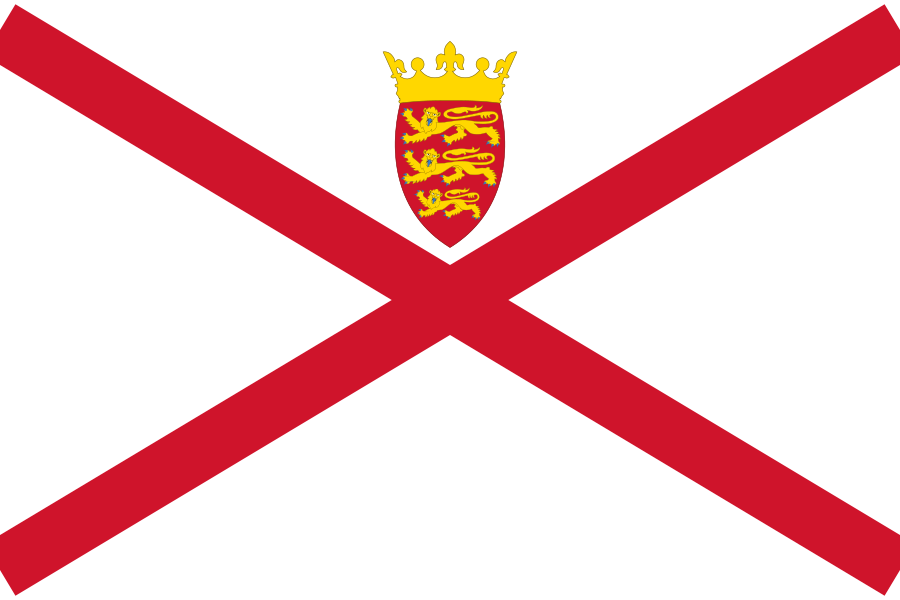
A white field crossed by a diagonal red saltire, with the badge of Jersey at the top: a red shield bearing three golden lions, topped by a gold "Plantagenet" crown. The badge was added in 1981.
saltirethree lionscrown
Did you know?
Jersey lies much closer to France than to Britain — only about 22 km from the Normandy coast. Islanders traditionally toast the monarch as "The King, our Duke," recalling the island's origins in the medieval Duchy of Normandy.
Test your knowledge
Think you know your world flags? Try the FlagAtlas daily challenge, speed quiz, or explore all the territory flags.
📚 Revising for GCSE Geography? Visit our free revision page →
About Jersey
Jersey is the largest of the Channel Islands, lying in the English Channel in the Bay of Saint-Malo, just off the coast of Normandy in France. It is a British Crown Dependency — self-governing, and not part of the United Kingdom or the European Union — with its own parliament, laws and taxes.
Saint Helier is the capital. The reigning British monarch is head of state, and the United Kingdom is responsible for the island's defence and foreign affairs. Jersey issues its own currency, the Jersey pound, which circulates at par with pound sterling.
CapitalSaint Helier
RegionChannel Islands
PopulationAbout 103,000
Area118 km²
CurrencyJersey pound (= GBP)
LanguageEnglish; Jèrriais
The flag of Jersey
Jersey's flag is a white field with a diagonal red saltire (a diagonal cross reaching corner to corner). In the upper part sits the badge of Jersey: a red shield with three golden lions, one above another, ensigned with a yellow crown.
The badge is a modern addition.
For a long time Jersey's flag was simply the plain red saltire on white. The shield of three lions and the crown were added by Royal Warrant in 1981 to distinguish it clearly as the flag of Jersey.
The three lions echo the traditional arms of Jersey, which are closely related to the historic royal arms of England and Normandy.
The red saltire and the three lions
The origin of Jersey's red saltire is not certain. One long-standing explanation is that it grew out of confusion with the cross of Saint Patrick used in the Union Flag; whatever its beginnings, the plain red-on-white saltire had become established as Jersey's flag by the eighteenth and nineteenth centuries.
The three golden lions are the same charge found on the arms of Jersey and are shared with the historic arms of the English crown and the Dukes of Normandy — a reminder of the island's deep links to both. Adding the crowned shield in 1981 gave Jersey a flag that could not be mistaken for any other.
A short history of Jersey
Jersey was part of the Duchy of Normandy, and when Duke William conquered England in 1066 the island came under the same ruler as England. In 1204, when King John lost mainland Normandy to the King of France, the Channel Islands chose to remain loyal to the English crown — and they have been attached to it ever since as the last remnant of the medieval duchy.
Over the centuries Jersey developed its own institutions and a large degree of self-government. During the Second World War the Channel Islands were occupied by German forces from 1940 to 1945 — the only part of the British Isles to be occupied.
Today Jersey is a prosperous, self-governing Crown Dependency, best known internationally as a financial centre.
The Jersey flag's history
Jersey's flag developed from a plain saltire into the crowned-badge design used today.
18th–19th centuryThe plain red saltire on a white field becomes established as Jersey's flag.
1979–1981A distinctive design is agreed, adding the island's badge to the saltire.
1981 — official flagThe red saltire with the crowned shield of three lions is confirmed by Royal Warrant.
TodayThe crowned-saltire flag is flown across the island.
Geography of Jersey
Jersey is a small island of about 118 square kilometres, tilted to catch the sun, with a plateau that slopes from higher ground in the north down to sandy bays in the south. Its large tidal range is among the greatest in the world, uncovering vast expanses of beach and rock at low tide.
Jersey's neighbours
The coast of Normandy, France, lies only about 22 km to the east, while Great Britain is roughly 160 km to the north. The other Channel Islands — including Guernsey, Alderney and Sark — lie to the north-west.
People, language and culture
English is the main language today, but Jersey's historic language is Jèrriais, a form of Norman French, and French long held an official role in the island's law and government. Place-names and family names across the island reflect this Norman heritage.
Jersey is known for its agricultural exports — the early "Jersey Royal" potato and the fawn-coloured Jersey breed of dairy cattle — as well as its role as an international finance centre.
Jersey today
Jersey governs itself through the States of Jersey, its parliament, and manages its own domestic affairs. Its economy is dominated by financial services, alongside tourism, agriculture and digital industries.
As a Crown Dependency, Jersey is neither part of the United Kingdom nor a member of the European Union, but maintains a close relationship with both.
Explore Jersey on FlagAtlas
Continue exploring Jersey and the world's flags with these FlagAtlas resources.
Sources & further reading
This page combines the information already present on the FlagAtlas Jersey page with additional context. Statistics such as population and area are dated because they can change over time.
Encyclopaedia Britannica — Jersey