Western Pacific
Northern Mariana Islands Flag
Explore the Northern Mariana Islands flag history, symbolism, geography and facts — the white star on an ancient latte stone, wreathed in a Carolinian flower garland, on the deep blue of the Pacific.
Capital
Saipan
Region
Western Pacific
Population
47,000
Status & key facts
Political status
US Commonwealth
In political union with the US
Currency
US Dollar
USD ($)
Sovereign state
United States
Commonwealth of the United States
🌡️ Climate: Tropical — warm and humid year-round, with a rainy season and a risk of typhoons
Flag symbolism
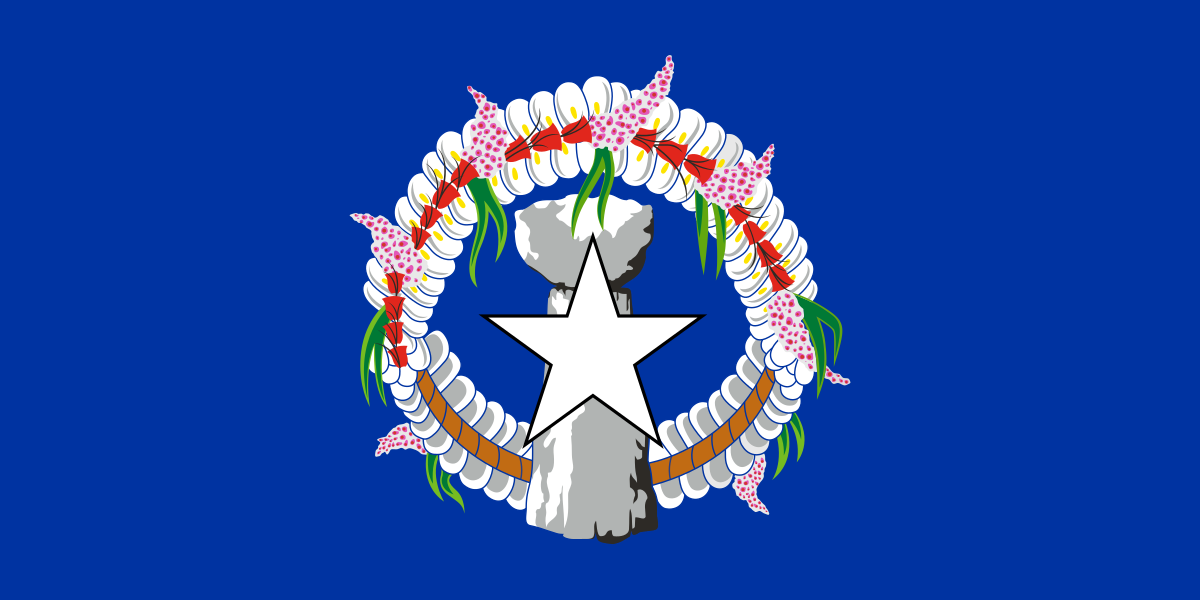
A deep blue field for the Pacific Ocean, with a white star set on a grey latte stone — an ancient Chamorro pillar — the whole encircled by a mwarmwar, a traditional Carolinian garland of flowers and shells.
latte stonestarmwarmwar
Did you know?
The flag honours the islands' two indigenous peoples at once: the latte stone stands for Chamorro heritage, and the flower-and-shell garland around it for the Carolinians who also call the islands home.
Test your knowledge
Think you know your world flags? Try the FlagAtlas daily challenge, speed quiz, or explore all the territory flags.
📚 Revising for GCSE Geography? Visit our free revision page →
About the Northern Mariana Islands
The Northern Mariana Islands are a commonwealth of the United States in the western Pacific Ocean, part of the region known as Micronesia. They form the northern part of the Mariana Islands chain; the large island of Guam, at the southern end of the same chain, is a separate US territory. The main inhabited islands are Saipan, Tinian and Rota.
Formally the Commonwealth of the Northern Mariana Islands (CNMI), the territory is in political union with the United States: its people are US citizens, the US President is head of state, and it has its own governor and legislature. Saipan is the seat of government, the US dollar is the currency, and English, Chamorro and Carolinian are all official languages.
CapitalSaipan
RegionMicronesia / W. Pacific
PopulationAbout 47,000
Area464 km²
CurrencyUS Dollar (USD)
LanguageEnglish, Chamorro, Carolinian
The flag of the Northern Mariana Islands
The flag is a plain blue field, for the surrounding Pacific, with a central emblem: a white five-pointed star resting on a grey latte stone, framed by a circular mwarmwar garland.
Two cultures on one flag.
The latte stone — a pillar of the kind that supported ancient Chamorro buildings — represents the Chamorro people, while the mwarmwar, a head-garland of flowers and shells, represents the Carolinian people. The star stands for the commonwealth itself.
The star and latte stone were adopted in the 1970s; the mwarmwar garland was added in 1989 so that both of the islands' indigenous peoples would be represented.
The latte stone and the mwarmwar
Latte stones are among the most striking remains of the ancient Marianas: two-part stone pillars — a tapering shaft topped by a cup-shaped capstone — that once held up the houses of the Chamorro. Standing rows of them can still be seen across the islands, and they have become a defining symbol of Chamorro identity.
The mwarmwar is a woven garland worn on the head, made from flowers, leaves and shells, and is characteristic of Carolinian culture. By placing the garland around the latte stone and star, the flag brings the islands' two main peoples together in a single emblem.
A short history of the Northern Mariana Islands
The Marianas were settled by the seafaring Chamorro more than three thousand years ago, making them among the earliest inhabited islands of the remote Pacific. In 1521 Ferdinand Magellan's expedition reached the Marianas, the first European contact, and Spain later colonised the islands, naming them Las Marianas in 1668 after the Spanish queen Mariana of Austria.
After the Spanish–American War, Spain sold the northern Marianas to Germany in 1899; Japan took them during the First World War and administered them until the Second World War, when Saipan and Tinian saw heavy fighting in 1944.
After the war the islands were placed under a United States trusteeship. In 1975 their people voted to become a commonwealth in union with the United States, an arrangement that took full effect by 1978 and continues today.
The flag's history
The flag grew over time to represent both of the islands' indigenous peoples.
1970s — star and latte stoneThe white star on a latte stone, on a blue field, was adopted as the emblem of the islands.
1989 — the mwarmwar addedThe Carolinian flower-and-shell garland was added around the star and latte stone.
TodayThe blue flag with the star, latte stone and garland represents the commonwealth.
Geography of the Northern Mariana Islands
The Northern Mariana Islands stretch in a long arc across the western Pacific. The southern islands, including Saipan, Tinian and Rota, are older limestone islands with beaches and cliffs, while the northern islands are younger and volcanic, some of them still active. Together they cover only a small land area but are spread over a great expanse of ocean.
The islands' setting
Guam lies just to the south, and to the east runs the Mariana Trench — home to the Challenger Deep, the deepest known point in any ocean on Earth. The islands sit far out in the Pacific, closer to Asia than to any part of the American mainland.
People, language and culture
The islands are home to two main indigenous peoples: the Chamorro, native to the Marianas, and the Carolinians, who settled from islands to the south. English, Chamorro and Carolinian are all official languages, and the population also includes many residents of Filipino and other Asian heritage.
Traditional culture — canoe-building and navigation, weaving, dance and the making of mwarmwar garlands — remains strong, alongside the influences of the islands' Spanish, German, Japanese and American past.
The Northern Mariana Islands today
The commonwealth governs its own local affairs through an elected governor and legislature, and sends a non-voting delegate to the United States Congress. Tourism is the mainstay of the economy, with many visitors arriving from East Asia, drawn by the islands' beaches, diving and wartime history.
As a US commonwealth, the Northern Mariana Islands remain in political union with the United States, sharing US citizenship and defence while running their internal affairs themselves.
Explore the Northern Mariana Islands on FlagAtlas
Continue exploring the Northern Mariana Islands and the world's flags with these FlagAtlas resources.
Sources & further reading
This page combines the information already present on the FlagAtlas Northern Mariana Islands page with additional context. Statistics such as population and area are dated because they can change over time.
Encyclopaedia Britannica — Northern Mariana Islands