Asia
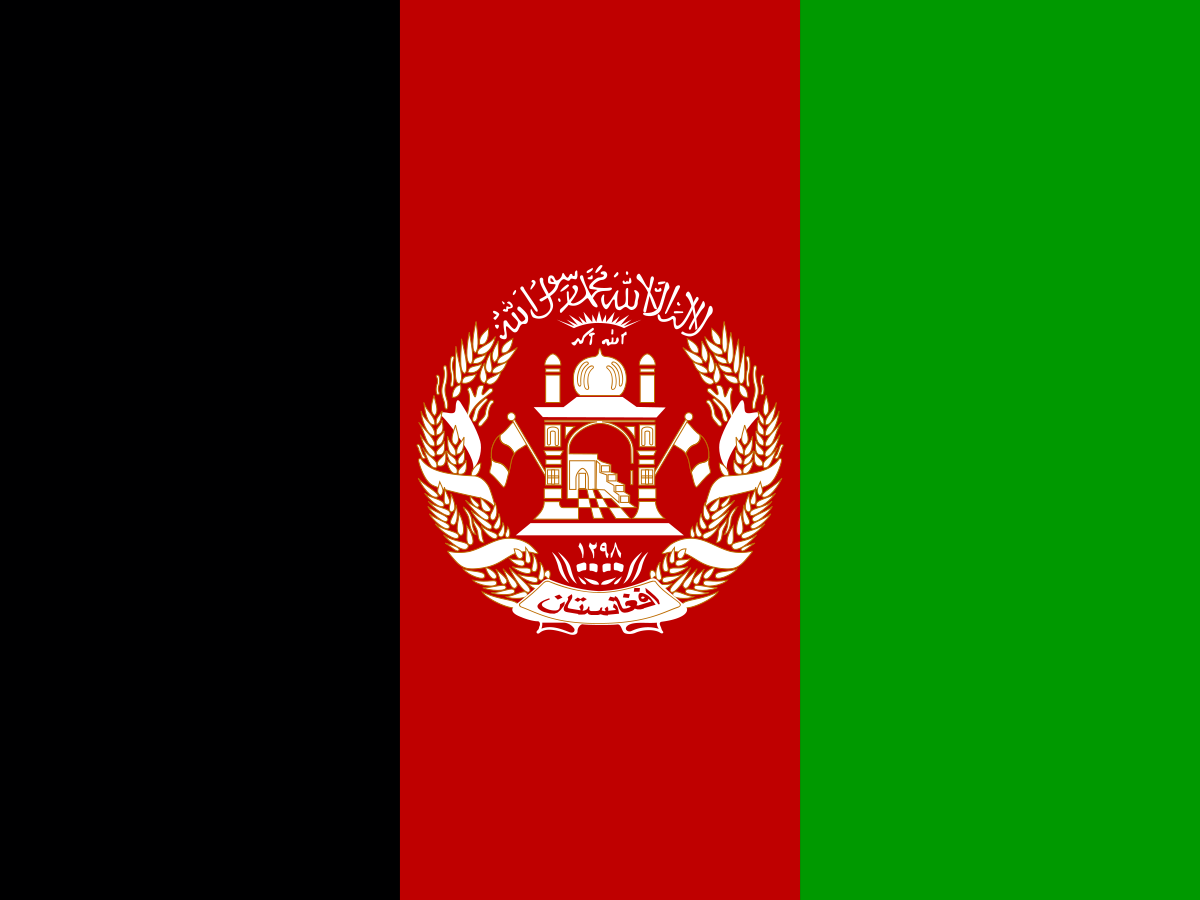
Afghanistan Flag
Afghanistan is a landlocked country at the crossroads of Central and South Asia. This page shows the black-red-green tricolour used by the Islamic Republic of Afghanistan from 2004 to 2021, with the national emblem centred on the red band. Since August 2021, the Taliban authorities have used a different white flag.
Capital
Kabul
Continent
Asia
Population
42.6 million
Development indicators
GDP per capita
$417
USD per year (World Bank, 2024)
Human Development Index
0.462
Low development
World Bank income classification
Low Income (LIC)
LIC
🌡️ Climate: Arid / Semi-arid
Flag symbolism
Black represents the dark past, red represents blood shed for independence, and green represents hope for the future. The central emblem features a mosque.
mosque
Did you know?
Afghanistan has changed its national flag many times during the modern era, reflecting repeated changes of monarchy, republic, communist government, Taliban rule and the post-2001 Islamic Republic.
Test your knowledge
Think you know your world flags? Try the FlagAtlas daily challenge, speed quiz, or explore all Asia flags.
📚 Revising for GCSE Geography? Visit our free revision page →
About Afghanistan
Afghanistan is a landlocked country positioned between Central and South Asia. Its location has made it a meeting point for trade routes, cultures and empires for centuries. The country is dominated by rugged mountain landscapes, particularly the Hindu Kush, with drier plains and desert areas elsewhere.
Kabul is the capital and largest city. Afghanistan shares borders with Pakistan, Iran, Turkmenistan, Uzbekistan, Tajikistan and China. Dari and Pashto are the two official languages named in the 2004 Constitution.
CapitalKabul
RegionCentral / South Asia
Population42.6m (2024)
Surface area652,870 km²
CurrencyAfghani (AFN)
Official languagesDari & Pashto
Afghanistan flag: an important note
Which Afghanistan flag is shown here?
The image on FlagAtlas is the black-red-green tricolour associated with the Islamic Republic of Afghanistan and specified in the 2004 Constitution. The Islamic Republic collapsed in August 2021. Since then, the Taliban authorities have used a white flag bearing the shahada. Flag references can therefore differ depending on whether they describe the former republic, the current de facto authorities, or international contexts.
Keeping that distinction clear is particularly important for Afghanistan because its flag has changed repeatedly as governments and political systems have changed.
What is on the black-red-green Afghanistan flag?
Article 19 of Afghanistan’s 2004 Constitution described three equal vertical sections of black, red and green. In the centre was the national insignia in white.
The constitutional description of the emblem included a mosque and pulpit, two small flags, Islamic inscriptions, rays of a rising sun, the year 1919 and the word Afghanistan surrounded by sheaves of wheat.
What do the colours mean?
Popular explanations often link black with Afghanistan’s past, red with struggle or sacrifice, and green with hope, prosperity or Islam. These interpretations are widely repeated, but Article 19 specified the colours and emblem without assigning those three simple meanings.
Why has Afghanistan had so many flags?
Afghanistan’s unusually changeable flag history reflects its turbulent modern political history. Monarchies, republics, communist governments, mujahideen administrations, Taliban rule and the Islamic Republic have all used different national symbols.
1919 — independence eraAfghanistan regained control of its foreign affairs after the Third Anglo-Afghan War. The year 1919 later appeared within the republic-era emblem.
20th century — repeated redesignsChanges of ruler and political system produced a succession of flags, including black standards, tricolours and designs with changing state emblems.
1990s — civil war and Taliban ruleCompeting governments and movements used different flags. The Taliban eventually adopted a predominantly white design with an Islamic declaration of faith.
2001–2021 — Islamic Republic eraBlack-red-green returned after the fall of the first Taliban government. The 2004 Constitution formally described the vertical tricolour and central national insignia.
Since August 2021The Taliban returned to power and its white flag became the flag used by the de facto authorities, while the former republic tricolour has continued to appear in other contexts.
Geography of Afghanistan
Afghanistan has no coastline. Much of the country is mountainous, and the Hindu Kush runs across a large part of its central and north-eastern territory. The climate is generally arid to semi-arid, with large differences caused by altitude.
Afghanistan's neighbours
Afghanistan borders six countries: Pakistan, Iran, Turkmenistan, Uzbekistan, Tajikistan and China. Its short border with China lies at the end of the narrow Wakhan Corridor in the north-east.
A short history of Afghanistan
The territory of modern Afghanistan has been influenced by many civilisations and empires. Its position on historic routes between Persia, Central Asia and the Indian subcontinent made it strategically important long before the creation of the modern Afghan state.
The Durrani Empire, founded in the eighteenth century under Ahmad Shah Durrani, is commonly associated with the emergence of modern Afghanistan. During the nineteenth century, Afghanistan became caught between British India and the expanding Russian Empire.
After the Third Anglo-Afghan War in 1919, Afghanistan gained control over its foreign affairs. The twentieth century then brought monarchy, a republic, communist rule, Soviet intervention, civil war and the rise of the Taliban.
Following the US-led intervention in 2001, Afghanistan was governed as the Islamic Republic of Afghanistan. In August 2021 the Taliban retook Kabul as international forces withdrew, ending the republic and beginning the present period of de facto Taliban rule.
Afghanistan today: population and economy
World Bank data puts Afghanistan’s population at about 42.6 million in 2024 and GDP per capita at roughly US$417 for 2024. Statistics can differ across sources and years, so FlagAtlas labels dated figures rather than presenting them as timeless facts.
Agriculture remains important to livelihoods, while trade, construction and services also contribute to the economy. Geography, infrastructure, political uncertainty and decades of conflict have constrained development.
Explore Afghanistan on FlagAtlas