Oceania
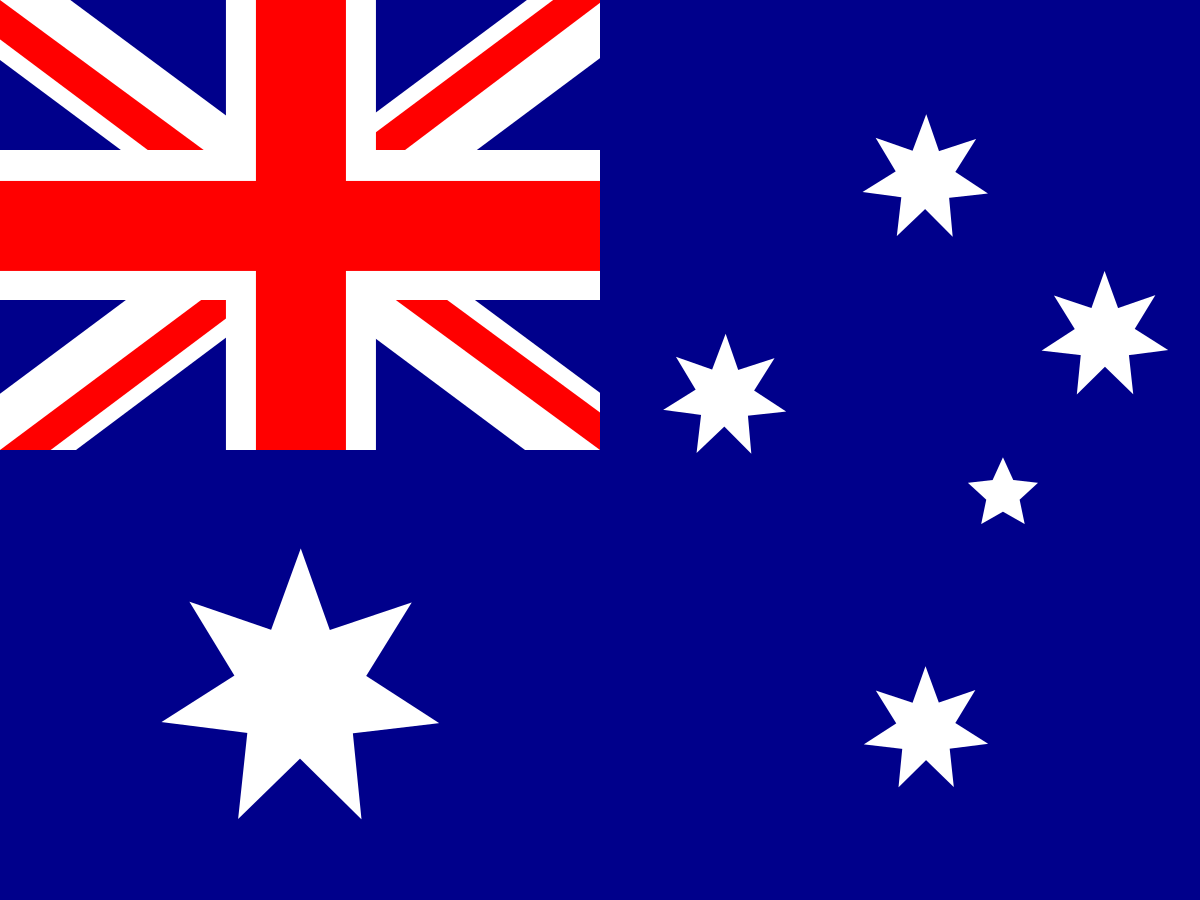
Australia Flag
Australia is a vast country and continent in the Southern Hemisphere. Its blue flag combines the Union Jack, the seven-pointed Commonwealth Star and the Southern Cross, linking Australia's history, federation and place in the southern sky.
Capital
Canberra
Continent
Oceania
Population
26.0 million
Development indicators
GDP per capita
$64,800
USD per year (approx. 2023)
Human Development Index
0.946
Very High development
World Bank income classification
High Income (HIC)
HIC
🌡️ Climate: Arid / Mediterranean / Tropical
Flag symbolism
The Union Jack represents historical ties with Britain. The Commonwealth Star has seven points representing the six states and territories. The Southern Cross constellation is visible from the Southern Hemisphere.
southern crossunion jackstars
Did you know?
Australia is both a country and a continent. It is the sixth-largest country in the world by area and is home to an extraordinary range of landscapes, from tropical rainforests to deserts and alpine mountains.
Test your knowledge
Think you know your world flags? Try the FlagAtlas daily challenge, speed quiz, or explore all Oceania flags.
📚 Revising for GCSE Geography? Visit our free revision page →
About Australia
Australia is a country and continent in the Southern Hemisphere, surrounded by the Indian and Pacific Oceans. It is the world's sixth-largest country by area and has one of the most varied natural environments on Earth.
Canberra is the capital, while Sydney, Melbourne, Brisbane, Perth and Adelaide are among the country's largest cities. Australia is a federal parliamentary constitutional monarchy and a member of the Commonwealth.
CapitalCanberra
RegionOceania
PopulationAbout 27m
Area7,688,287 km²
CurrencyAustralian dollar
Official languageNo official federal language
The flag of Australia
Australia's national flag has a dark blue field. The Union Jack appears in the upper hoist corner, the large seven-pointed Commonwealth Star is below it, and five stars representing the Southern Cross appear on the right.
Three parts tell three different stories.
The Union Jack reflects Australia's historical British connection, the Commonwealth Star represents the federation of Australia and its states and territories, while the Southern Cross reflects Australia's location in the Southern Hemisphere.
The flag was chosen following a competition held in 1901, the year Australia became a federation. Although the design has remained broadly consistent, the number of points on the Commonwealth Star was changed from six to seven in 1908 to include Australia's territories.
What do the stars on Australia's flag mean?
The large Commonwealth Star beneath the Union Jack has seven points. Six points originally represented Australia's six states, while the seventh was added to represent Australia's territories and the Commonwealth as a whole.
The five stars on the right form the Southern Cross, a constellation that is prominent in the southern sky and has long been used as a symbol of Australia's geographical location.
A short history of Australia
Australia has been home to Aboriginal and Torres Strait Islander peoples for at least 65,000 years, making Indigenous Australian cultures among the oldest continuing cultures in the world.
European contact began with Dutch voyages in the seventeenth century, followed by British exploration and settlement. In 1788 the First Fleet established a British penal colony at Sydney Cove.
Six British colonies developed on the continent and gradually gained greater self-government. On 1 January 1901, the colonies federated to form the Commonwealth of Australia.
Australia's twentieth-century history included two world wars, major immigration programmes and major social and political changes. Indigenous rights and recognition have also become increasingly important parts of the national conversation.
Australia's flag history
The current flag emerged during the federation period. A competition was held in 1901 to find a design for the new Commonwealth, attracting thousands of entries.
1901 — federationThe six Australian colonies federated and a national flag competition was held.
1901 — winning designA design incorporating the Union Jack, Commonwealth Star and Southern Cross was selected.
1908 — seven-pointed Commonwealth StarThe star gained a seventh point to represent Australia's territories as well as its six states.
1954 — Flags ActThe Australian National Flag received formal legislative recognition.
TodayThe blue ensign remains Australia's national flag and is used by the federal government and citizens.
Why is the Union Jack on Australia's flag?
The Union Jack reflects Australia's history as a group of British colonies. British settlement, institutions and migration had a profound influence on the development of modern Australia.
Its presence is also one reason Australia shares visual similarities with several other national flags that use the Union Jack, including New Zealand and Fiji.
Australia is now an independent sovereign country, but the Union Jack remains part of the national flag and is a visible reminder of that historical connection.
Geography of Australia
Australia contains an enormous range of landscapes. The interior includes large arid and semi-arid areas, while the eastern coast contains major cities, fertile regions and mountain ranges. Tropical environments occur in the north and alpine conditions occur in the Australian Alps.
Australia's neighbours
Australia is separated by sea from all other countries. Its nearest neighbours include Indonesia, Papua New Guinea, Timor-Leste and New Zealand.
The Great Barrier Reef lies off the north-eastern coast and is one of Australia's best-known natural features.
States and territories
Australia is a federation made up of six states and several territories. The six states are New South Wales, Queensland, South Australia, Tasmania, Victoria and Western Australia.
The two major mainland territories are the Northern Territory and the Australian Capital Territory. The seventh point on the Commonwealth Star reflects Australia's territories as part of the federation.
People, language and culture
Australia has a highly multicultural population shaped by Indigenous heritage, British settlement and immigration from Europe, Asia and many other parts of the world.
English is the main language used in public life, although Australia has no official federal language. More than 300 languages are spoken in Australian homes, reflecting the country's cultural diversity.
Australian culture is associated with sport, outdoor life, music, film, literature and a strong connection with the coast and natural environment.
Indigenous Australia
Aboriginal and Torres Strait Islander peoples have lived across Australia for tens of thousands of years. Their cultures include hundreds of distinct language groups, traditions, communities and connections to Country.
Indigenous art, storytelling, music and knowledge are an important part of Australia's cultural heritage. The history of colonisation and its continuing effects are also central to understanding modern Australia.
Australia's economy
Australia has a high-income, diversified economy. Services account for a large share of economic activity, while mining and natural resources are also major contributors to exports.
Australia is a significant producer and exporter of iron ore, coal, natural gas and agricultural products. Education and tourism are also important industries, particularly in major cities and coastal regions.
Australia's unique wildlife
Australia is famous for wildlife found nowhere else in the world. Kangaroos, koalas, wombats, platypuses and many other species evolved in relative isolation for millions of years.
The country's unique wildlife is closely connected with its national identity, but many species face pressures from habitat loss, introduced species, climate change and other environmental challenges.
Australia today
Modern Australia is a federal parliamentary constitutional monarchy. The King is Australia's head of state, represented domestically by the Governor-General, while the elected government is led by the Prime Minister.
Australia maintains close relationships across the Asia-Pacific region while retaining historical links with the United Kingdom and wider Commonwealth.
Why is Australia's flag blue?
The Australian National Flag is based on a British Blue Ensign rather than a plain blue field chosen to represent the ocean. The blue background therefore has a strong historical and heraldic connection to the flag's design.
The Southern Cross and Commonwealth Star then transform the design into a specifically Australian national symbol.
Explore Australia on FlagAtlas
Continue exploring Australia and the world's flags with these FlagAtlas resources.