About Dominica
Dominica is a mountainous Caribbean island nation between Guadeloupe and Martinique. It is often called the Nature Island because of its dense rainforests, rivers, waterfalls, volcanic landscapes and rich wildlife.
Roseau is the capital and largest city. Unlike the Dominican Republic, Dominica is a small English-speaking Caribbean country whose culture reflects Indigenous Kalinago heritage, African ancestry, European history and wider Caribbean traditions.
CapitalRoseau
RegionCaribbean
PopulationAbout 72,000
CurrencyEast Caribbean dollar
Official languageEnglish
Highest pointMorne Diablotins
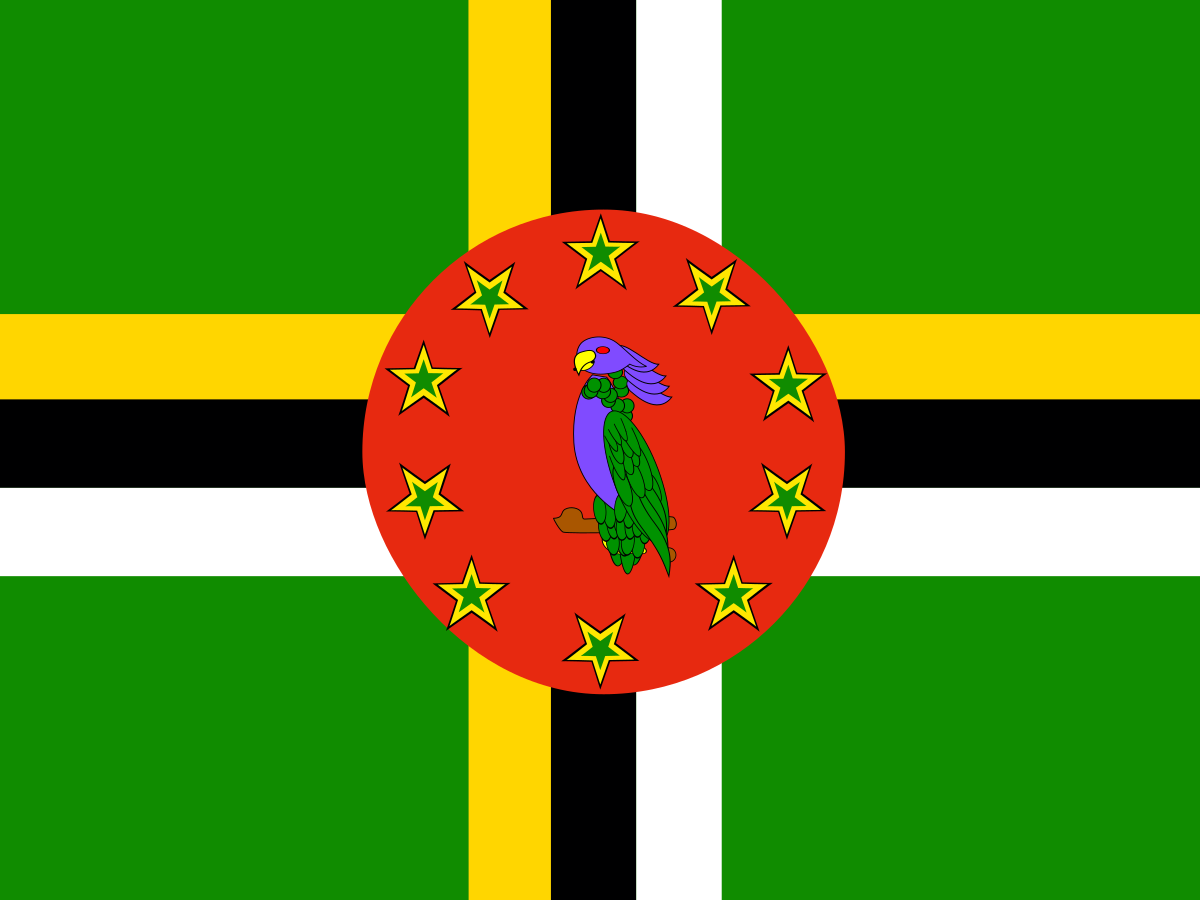
The flag of Dominica
The Dominica flag has a green background crossed by a triple-colour cross in yellow, black and white. At its centre is a red disc carrying ten green stars around a Sisserou parrot.
Dominica's flag is unusually detailed.
It combines a Christian cross, the island's lush vegetation, its national bird and ten stars representing the country's ten administrative parishes.
The flag was adopted in its present basic form in 1978, shortly after independence, and has been modified slightly over time.
What do the colours mean?
The green field represents the island's lush vegetation. The triple-colour cross is made from yellow, black and white.
Yellow is associated with sunshine, citrus and the Indigenous and African heritage of Dominica. Black represents the rich black soil and African heritage, while white represents pure water, the island's rivers and waterfalls and the aspirations of its people.
The Sisserou parrot
At the centre of the flag is the Sisserou parrot (Amazona imperialis), Dominica's national bird. It is endemic to Dominica, meaning it is naturally found nowhere else in the world.
The parrot is an important symbol of national pride and the protection of Dominica's natural environment. It is also one of the reasons the country's flag is so distinctive.
The ten green stars
Ten green five-pointed stars surround the parrot on the red disc. The stars represent the country's ten administrative parishes.
The green colour of the stars reinforces the island's natural identity, while their arrangement around the bird emphasises national unity.
The cross on the flag
The triple-colour cross reflects Dominica's Christian traditions. The three colours are yellow, black and white, with the white cross edged by yellow and black.
The cross also gives the flag a visual connection with other Christian and Caribbean traditions while remaining uniquely Dominican because of the parrot and ten stars at its centre.
A short history of Dominica
The island was inhabited by Indigenous peoples long before European arrival. The Kalinago developed a distinctive culture and maintained a presence on the island through the period of European colonisation.
Dominica changed hands between France and Britain during the colonial era. Britain eventually established lasting control, and the island became part of the British West Indies.
Dominica became fully independent on 3 November 1978, remaining a member of the Commonwealth.
Flag history timeline
Before European colonisationKalinago communities lived on the island and developed a distinctive Caribbean culture.
17th–18th centuriesFrance and Britain competed for control of Dominica during the colonial period.
1763 — British controlDominica was formally assigned to Britain following the Seven Years' War.
1978 — independenceDominica became an independent state on 3 November.
1978 — national flagThe distinctive green, cross, stars and parrot design was adopted after independence.
TodayThe flag remains a strong symbol of Dominica's natural environment and national identity.
Roseau — the capital
Roseau is Dominica's compact capital on the southwest coast. It is the country's main administrative, commercial and cultural centre.
The city contains historic buildings, markets, churches and waterfront areas and provides a base for exploring Dominica's mountainous interior.
The Kalinago people
The Kalinago are the Indigenous people of Dominica. A territory on the island's east coast is home to a significant Kalinago community.
Kalinago culture, crafts, traditions and history are an important part of Dominica's national identity and distinguish the island from many other Caribbean countries.
The Kalinago Territory
The Kalinago Territory covers part of Dominica's eastern coastline and provides a place where Kalinago communities maintain cultural traditions and local institutions.
Visitors can learn about traditional crafts, food, architecture and the history of the Indigenous population.
Dominica's volcanic landscape
Dominica is one of the most mountainous islands in the Caribbean and has a volcanic origin. Several peaks rise above the forest, including Morne Diablotins, the highest point.
Volcanic activity has created hot springs, fumaroles, crater lakes and other unusual geological features across the island.
Boiling Lake
Dominica is home to Boiling Lake, one of the world's largest hot lakes. It is located in Morne Trois Pitons National Park and is heated by geothermal activity beneath the surface.
The lake's temperature and appearance can vary, but the water is extremely hot and the site is surrounded by dramatic volcanic scenery.
Morne Trois Pitons National Park
Morne Trois Pitons National Park protects a large area of Dominica's volcanic interior. It includes rainforest, lakes, hot springs, waterfalls and volcanic features.
The park is a UNESCO World Heritage Site and is central to Dominica's reputation as the Nature Island.
Rainforests and rivers
Dominica receives substantial rainfall and has extensive tropical rainforest. Hundreds of streams and rivers cross the island's steep terrain.
Waterfalls, freshwater pools and forest trails are major attractions. The Waitukubuli National Trail runs through much of the island and highlights its varied landscapes.
Dominica's wildlife
Dominica's forests support many species of birds, reptiles, amphibians and insects. The Sisserou parrot is the most famous, but the island's biodiversity extends far beyond its national bird.
The surrounding Caribbean waters also support dolphins, whales, sea turtles and coral reef ecosystems.
The Caribbean Sea and marine life
Dominica's steep volcanic coastline drops into deep offshore waters. This creates opportunities for diving, snorkelling and whale watching.
Sperm whales and other marine mammals can be found in waters around the island, while reefs and rocky coastal habitats support a wide variety of marine life.
Climate
Dominica has a warm tropical climate with a pronounced wet environment, especially in the mountainous interior. Rainfall helps maintain its dense forests and rivers.
The island is also exposed to Atlantic hurricanes. Hurricane Maria in 2017 caused catastrophic damage, destroying homes, infrastructure and large areas of vegetation.
Hurricane Maria
On 18 September 2017, Hurricane Maria struck Dominica as a powerful Category 5 hurricane. The storm caused enormous damage to buildings, electricity networks, roads, communications and agriculture.
Recovery became a major national project and highlighted the vulnerability of small Caribbean island states to extreme weather and climate-related risks.
Dominica's economy
Dominica's economy includes tourism, agriculture, services and construction. Bananas and other agricultural products have historically been important, while nature tourism has become increasingly significant.
The island has also invested in geothermal energy because of its volcanic geology and abundant underground heat.
Diving and ecotourism
Dominica attracts visitors interested in hiking, rainforest, diving, hot springs and wildlife rather than mass beach tourism. Its steep volcanic coastline and protected natural areas create a distinctive ecotourism experience.
Nature-based tourism is closely linked to the country's international image as the Nature Island of the Caribbean.
Food and culture
Dominican cuisine combines Caribbean, African, Indigenous and European influences. Fresh fish, root vegetables, plantains, fruit and local spices are common ingredients.
The island's cultural life includes music, dance and festivals, with Carnival and World Creole Music Festival among important events.
Languages of Dominica
English is the official language, while Dominican Creole French and other forms of Creole are also spoken. The island's language heritage reflects centuries of French and British influence.
Language is an important part of Dominica's wider Caribbean identity and its connections with neighbouring French-speaking islands.
Dominica and the Caribbean
Dominica is part of the eastern Caribbean island chain known as the Lesser Antilles. Its nearest neighbours include the French overseas territories of Guadeloupe to the north and Martinique to the south.
The country is a member of regional organisations including the Organisation of Eastern Caribbean States and uses the East Caribbean dollar.
Dominica today
Dominica is a parliamentary republic and a member of the Commonwealth. Protecting its natural environment is central to national policy and the country's tourism identity.
The island continues to rebuild resilience after major hurricanes while developing renewable energy, sustainable tourism and other areas of the economy.
Why is Dominica's flag interesting?
Dominica's flag is one of the world's most detailed national flags. It combines a cross, a parrot, ten stars and several colours, each with connections to the island's history, people or natural environment.
It is especially interesting for flag studies because the Sisserou parrot makes the design immediately recognisable and ties the national symbol directly to a species found only on Dominica.
Explore Dominica on FlagAtlas
Continue exploring Dominica and the world's flags with these FlagAtlas resources.