About the Dominican Republic
The Dominican Republic occupies the eastern part of the island of Hispaniola in the Caribbean. It shares the island with Haiti and is one of the Caribbean's larger and more populous countries.
Santo Domingo is the capital and largest city. The country is known for beaches, mountains, tropical forests, historic cities, baseball, merengue and bachata, and a long history shaped by Indigenous, African and European influences.
CapitalSanto Domingo
RegionCaribbean
PopulationAbout 11 million
CurrencyDominican peso
Official languageSpanish
Highest pointPico Duarte
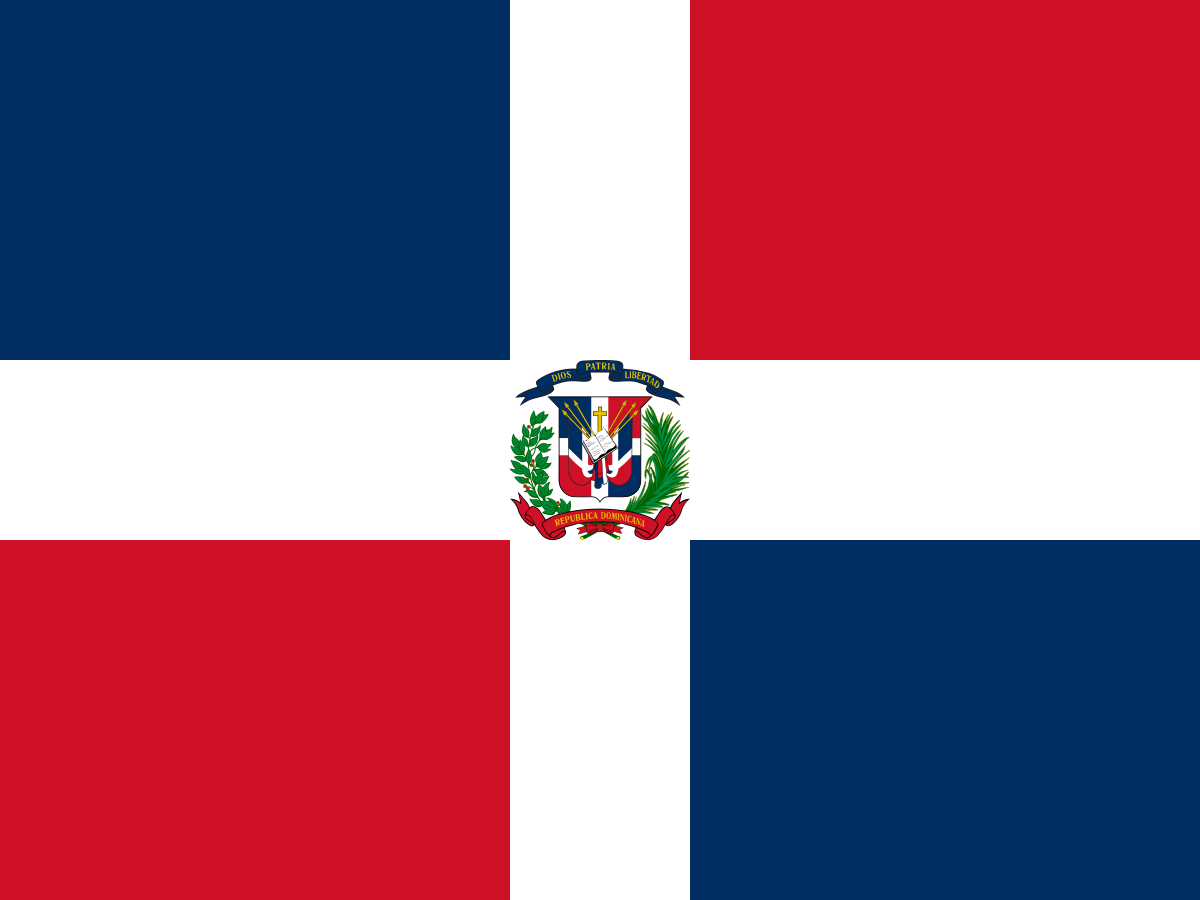
The flag of the Dominican Republic
The Dominican Republic flag is divided into four quarters by a bold white cross. The upper hoist and lower fly quarters are blue, while the other two quarters are red.
The coat of arms sits directly in the centre of the cross.
It includes a Bible, a golden cross, national flags, a red ribbon bearing the national motto and a blue ribbon with the country's name.
The design makes the Dominican Republic one of the countries with a particularly detailed national flag.
What do the colours mean?
The blue is traditionally associated with liberty and protection, while red represents the blood and sacrifice associated with the struggle for independence. The white cross represents peace and the sacrifices made for national independence.
The exact wording used to explain the colours can vary between sources, but the broad themes of liberty, sacrifice and peace are central to the flag's symbolism.
The white cross
The white cross is the defining feature of the Dominican Republic flag. It divides the flag into four quarters and links the design to the country's Christian and historical traditions.
The cross also connects the flag to the national coat of arms, which contains another cross alongside a Bible and other symbols.
The coat of arms
The Dominican Republic has a remarkably detailed coat of arms at the centre of its flag. A Bible is open at a passage traditionally identified with John 8:32, alongside a golden cross.
Six national flags are shown around the central elements. A red ribbon carries the motto “Dios, Patria, Libertad” — “God, Fatherland, Liberty” — while a blue ribbon names the country.
Why is there a Bible on the flag?
The open Bible is a distinctive feature of the Dominican Republic coat of arms. It reflects the country's Christian heritage and forms part of the national emblem placed at the centre of the flag.
This makes the Dominican Republic flag particularly unusual because the central emblem contains text, a book, a cross and several smaller symbols rather than a simple geometric design.
A short history of the Dominican Republic
The island of Hispaniola was inhabited by Indigenous Taíno communities before European arrival. Christopher Columbus reached the island in 1492, and Santo Domingo became an important early centre of Spanish colonial activity.
The eastern part of Hispaniola eventually developed as the Dominican Republic. The country declared independence from Haitian rule in 1844 and has since experienced periods of political instability, dictatorship, occupation and democratic government.
Flag history timeline
Before 1492Taíno communities lived throughout Hispaniola and developed complex societies and trading networks.
1492 — Columbus arrivesEuropean colonisation begins, with Hispaniola becoming one of Spain's first major centres in the Americas.
1795–1809 — French and Spanish ruleControl of the island changed during the period of European wars and revolution.
1822–1844 — Haitian ruleThe whole island was unified under Haitian government.
1844 — independenceThe Dominican Republic declared independence on 27 February.
1863–1865 — Restoration WarDominican forces fought to restore independence after Spanish annexation.
TodayThe flag remains a major symbol of Dominican independence and national identity.
The Dominican War of Independence
The Dominican Republic declared independence from Haitian rule on 27 February 1844. The independence movement was led by the group known as La Trinitaria, associated particularly with Juan Pablo Duarte, Francisco del Rosario Sánchez and Matías Ramón Mella.
The date is commemorated every year as Dominican Independence Day and is one of the most important dates in the country's national calendar.
Juan Pablo Duarte
Juan Pablo Duarte is regarded as one of the founding fathers of the Dominican Republic. He helped establish La Trinitaria and promoted the idea of an independent Dominican nation.
Duarte's name is closely associated with Dominican independence and appears throughout national monuments, public institutions and historical education.
Santo Domingo
Santo Domingo is the capital and largest city of the Dominican Republic. Founded by Europeans in the late fifteenth century, it became one of the earliest permanent European settlements in the Americas.
The city's Ciudad Colonial contains historic streets, churches and buildings from the early Spanish colonial period and is a UNESCO World Heritage Site.
The oldest city in the Americas?
Santo Domingo is often described as the oldest continuously inhabited European-founded city in the Americas. Its colonial district contains some of the earliest surviving European buildings and institutions in the New World.
The distinction is useful when studying the Dominican Republic because the country's history is deeply connected with the earliest period of European expansion into the Americas.
Hispaniola
The Dominican Republic shares the island of Hispaniola with Haiti. The island is the second-largest island in the Caribbean after Cuba.
Its geography includes mountains, valleys, tropical forests and long coastlines. The island's political division makes Hispaniola an important example of how one island can contain two independent countries.
Pico Duarte
Pico Duarte is the highest mountain in the Dominican Republic and the highest peak in the Caribbean. It rises in the Cordillera Central mountain range.
The country's mountainous interior contrasts strongly with its famous tropical beaches and coastal resorts.
Beaches and tourism
Tourism is one of the Dominican Republic's most important industries. Punta Cana, Puerto Plata, La Romana and other coastal destinations attract visitors with beaches, warm water and resort facilities.
The country's tourism offer also includes historic cities, mountain landscapes, national parks, caves and marine activities.
Climate
The Dominican Republic has a tropical climate, although conditions vary with altitude and location. Coastal and lowland areas are generally warm throughout the year, while mountain areas can be considerably cooler.
The country lies in the Caribbean hurricane belt and can be affected by tropical storms and hurricanes, particularly during the Atlantic hurricane season.
Rainforests and national parks
The country contains tropical forests, dry forests, wetlands and protected mountain environments. National parks and protected areas help conserve forests, wildlife and important watersheds.
These environments support tourism as well as agriculture and provide habitats for many plants and animals found across Hispaniola.
Wildlife of Hispaniola
The Dominican Republic is home to wildlife that reflects Hispaniola's island environment. Examples include the Hispaniolan solenodon, a rare native mammal, and the Hispaniolan hutia.
Coastal waters support coral reefs, sea turtles and other marine life, while the island's forests provide habitats for many endemic species.
Merengue and bachata
Music is central to Dominican culture. Merengue is closely associated with the country's national identity, while bachata developed in the Dominican Republic and later became internationally popular.
Both styles have become important cultural exports and are closely linked with Dominican dance and celebrations.
Baseball in the Dominican Republic
Baseball is hugely popular in the Dominican Republic and is one of the country's most visible sporting traditions. Many Dominican players have gone on to successful careers in Major League Baseball.
The sport is played throughout the country and is an important part of community life and national sporting identity.
Food and culture
Dominican food combines Indigenous, African and Spanish influences. Popular dishes include la bandera, typically made with rice, beans and meat, as well as plantains, stewed meats and a wide range of tropical fruits.
Food, music, family celebrations and baseball all play major roles in everyday Dominican culture.
Languages
Spanish is the official and overwhelmingly dominant language of the Dominican Republic. Dominican Spanish has its own pronunciation, vocabulary and expressions.
English and other languages are also used in tourism and international business, particularly in major resort areas.
The economy
The Dominican Republic has one of the larger and more diversified economies in the Caribbean. Important sectors include tourism, manufacturing, agriculture, construction, services and remittances.
Free-trade manufacturing zones and international investment have also contributed to the country's economic development.
The Dominican Republic today
The Dominican Republic is a democratic republic with a presidential system. It is one of the Caribbean's most visited countries and has strong economic and cultural connections with the United States, Latin America and other Caribbean nations.
Alongside economic growth, the country faces challenges including inequality, environmental protection, infrastructure pressures and exposure to hurricanes and other natural hazards.
Why is the Dominican Republic flag interesting?
The Dominican Republic flag is unusual because its central coat of arms is packed with symbolism. The white cross, blue and red quarters, Bible, cross, national flags and motto make it one of the world's most detailed national flags.
It is an excellent example of how a flag can act as a compact visual record of a country's religion, independence movement, history and national identity.
Explore the Dominican Republic on FlagAtlas
Continue exploring the Dominican Republic and the world's flags with these FlagAtlas resources.