Africa
Rwanda Flag
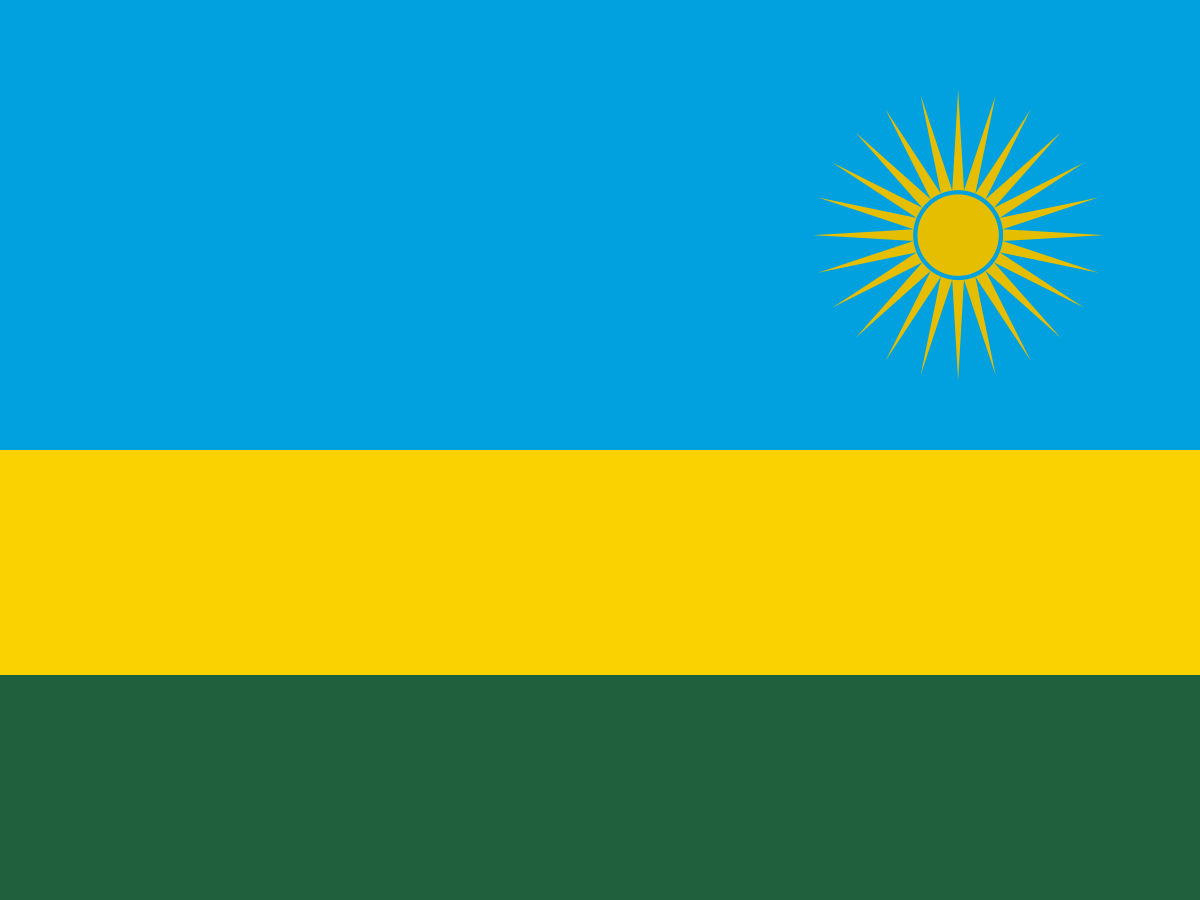
Blue represents happiness and peace, yellow stands for economic development, green represents hope and prosperity. The sun symbolises enlightenment.
Capital
Kigali
Continent
Africa
Population
13.0 million
Development indicators
GDP per capita
$930
USD per year (approx. 2023)
Human Development Index
0.534
Low development
World Bank income classification
Low Income (LIC)
LIC
🌡️ Climate: Tropical / Highland
Flag symbolism
Blue represents happiness and peace, yellow stands for economic development, green represents hope and prosperity. The sun symbolises enlightenment.
sun
Did you know?
Rwanda has more women in parliament than any other country in the world.
Test your knowledge
Think you know your world flags? Try the FlagAtlas daily challenge, speed quiz, or explore all Africa flags.
📚 Revising for GCSE Geography? Visit our free revision page →
About Rwanda
Rwanda is a small, landlocked country in East-Central Africa, famous for its mountainous landscape, rich biodiversity and remarkable recovery and development since the 1990s.
Kigali is the capital. Rwanda is often called the “Land of a Thousand Hills” because of its many green hills and highland scenery.
CapitalKigali
RegionEast-Central Africa
PopulationAbout 14 million
CurrencyRwandan franc
Official languagesKinyarwanda, English, French & Swahili
Independence1962
The Rwanda flag
Rwanda's current flag was adopted on 25 October 2001. It has horizontal blue, yellow and green sections, with a golden sun in the upper-right portion of the blue band.
The design replaced the earlier flag associated with the period before and around the 1994 genocide and was intended to represent a new national identity.
Blue
The large blue upper section represents happiness and peace, giving the flag a strong visual emphasis on a peaceful future.
Yellow
The yellow middle band represents economic development and reflects Rwanda's emphasis on rebuilding, opportunity and improving living standards.
Green
The lower green band represents hope for prosperity and the country's natural environment. Rwanda's hills, forests and agricultural landscape make green an especially fitting national colour.
The golden sun
The golden sun represents enlightenment. Its rays symbolise the light that can guide people towards unity, development and a better future.
Why did Rwanda change its flag?
Rwanda changed its flag in 2001, seven years after the 1994 genocide against the Tutsi. The new design was intended to move away from symbols associated with the country's earlier political divisions and create a more forward-looking national identity.
A short history of Rwanda
Rwanda has a long pre-colonial history and developed a centralised kingdom before European colonial rule. Germany and later Belgium controlled the territory during the colonial period.
Rwanda became independent in 1962. The country later suffered devastating ethnic violence and genocide in 1994, followed by a major period of reconstruction and political change.
History timeline
Pre-colonial period — Kingdom of RwandaA centralised Rwandan kingdom developed over centuries, with complex political, social and economic institutions.
1890s — German ruleRwanda became part of German East Africa, although German administrative control remained relatively limited.
1916–1919 — Belgian administration beginsBelgian forces took control during the First World War. Rwanda later became part of the League of Nations mandate of Ruanda-Urundi.
1959 — Social revolutionViolence and political upheaval transformed Rwanda's political system and contributed to the end of the monarchy.
1961 — Monarchy abolishedA referendum abolished the monarchy as Rwanda moved towards independence and a republic.
1962 — IndependenceRwanda became independent from Belgium on 1 July 1962.
1973 — Political changeJuvénal Habyarimana took power in a coup and established a long period of one-party rule.
1990 — Civil warThe Rwandan Patriotic Front launched an invasion from Uganda, beginning a civil war.
1993 — Arusha AccordsPeace agreements attempted to end the civil war and establish power-sharing arrangements.
1994 — Genocide against the TutsiFollowing the assassination of President Habyarimana, extremist forces and their allies carried out a genocide in which around 800,000 people were killed in roughly 100 days.
July 1994 — RPF takes KigaliThe Rwandan Patriotic Front took control of the capital and the genocide ended as the former government collapsed.
Late 1990s — ReconstructionRwanda began a major programme of rebuilding institutions, communities and the economy while pursuing justice for genocide crimes.
2001 — New flagRwanda adopted its current flag, replacing the previous design with symbols focused on peace, development, prosperity and enlightenment.
2003 — New constitutionA new constitution established a framework for the post-genocide political system.
2008 — Female parliamentary representationRwanda became internationally notable for having one of the world's highest proportions of women in parliament.
TodayRwanda is a densely populated, landlocked African country with a growing service economy, important tourism sector and strong emphasis on conservation and development.
Kigali
Kigali is Rwanda's capital and largest city. It is known for its relatively clean streets, hilly setting, rapidly developing infrastructure and growing role as a regional business and conference centre.
The Land of a Thousand Hills
Rwanda's nickname, the “Land of a Thousand Hills”, reflects its rolling highlands and steep green valleys. The country's elevation contributes to a relatively mild climate compared with many other places near the equator.
Lake Kivu
Lake Kivu lies on Rwanda's western border with the Democratic Republic of the Congo. It is one of Africa's Great Lakes and is notable for large quantities of dissolved methane gas in its deep waters.
Volcanoes National Park
Volcanoes National Park protects part of the Virunga volcanic mountain range and is famous for its population of endangered mountain gorillas. It is one of Rwanda's most important tourism destinations.
Mountain gorillas
Rwanda is one of only three countries where mountain gorillas can be seen in the wild. Carefully managed gorilla tourism provides income for conservation and local communities while helping protect the species.
Akagera National Park
Akagera National Park in eastern Rwanda contains savanna, wetlands and lakes. Conservation projects have restored populations of animals including lions and black rhinoceroses alongside elephants, buffalo and antelope.
Nyungwe Forest
Nyungwe National Park protects a large area of ancient montane rainforest. It is important for chimpanzees, colobus monkeys and many bird species and contains a famous canopy walkway.
Climate
Rwanda has a generally mild tropical highland climate. Temperatures vary with elevation, while rainfall follows seasonal patterns. The highlands are much cooler than low-lying tropical regions at similar latitudes.
Wildlife
Rwanda's wildlife includes mountain gorillas, chimpanzees, golden monkeys, lions, elephants, rhinoceroses and numerous bird species. Conservation has become a major part of the country's international identity.
Rwandan culture
Rwandan culture includes traditions of dance, drumming, storytelling, weaving and agriculture. Kinyarwanda is spoken throughout the country and forms an important part of national identity.
Traditional dance
Rwandan traditional dance is often performed in groups with distinctive movements, colourful costumes and drumming. The Intore dance tradition is particularly famous and has historical connections with the royal court.
Rwandan food
Common foods include plantains, cassava, sweet potatoes, beans, maize, sorghum and potatoes. Meat and fish are also eaten, with regional differences reflecting Rwanda's agricultural landscape.
Coffee and tea
Coffee and tea are important agricultural exports. Rwanda's high elevations and volcanic soils in some regions can produce high-quality coffee, which has become an important part of the country's international agricultural trade.
The economy
Rwanda's economy includes agriculture, services, tourism, construction, manufacturing and information technology. The country has pursued policies aimed at becoming a knowledge-based and service-oriented economy.
Gorilla tourism
Wildlife tourism is one of Rwanda's most important international industries. Gorilla trekking is carefully regulated to reduce disturbance to the animals while generating significant conservation revenue.
Environmental protection
Rwanda has placed strong emphasis on environmental protection. It became particularly well known for its plastic bag restrictions and for conservation programmes protecting forests, wetlands and wildlife.
Women in Rwanda
Rwanda has become internationally known for its high level of women's political representation. Women have held a majority of seats in the lower house of parliament for extended periods.
Rwanda and the wider world
Rwanda is a member of the United Nations, African Union, Commonwealth and East African Community. It has also become an important destination for international conferences and tourism.
Why is Rwanda's flag interesting?
Rwanda's flag is unusual because its design deliberately communicates a break with the country's troubled past. Blue, yellow, green and the golden sun focus on peace, development, prosperity and enlightenment rather than political or ethnic identity.
Explore Rwanda on FlagAtlas
Continue exploring Rwanda and the world's flags with these FlagAtlas resources.