Americas
Uruguay Flag
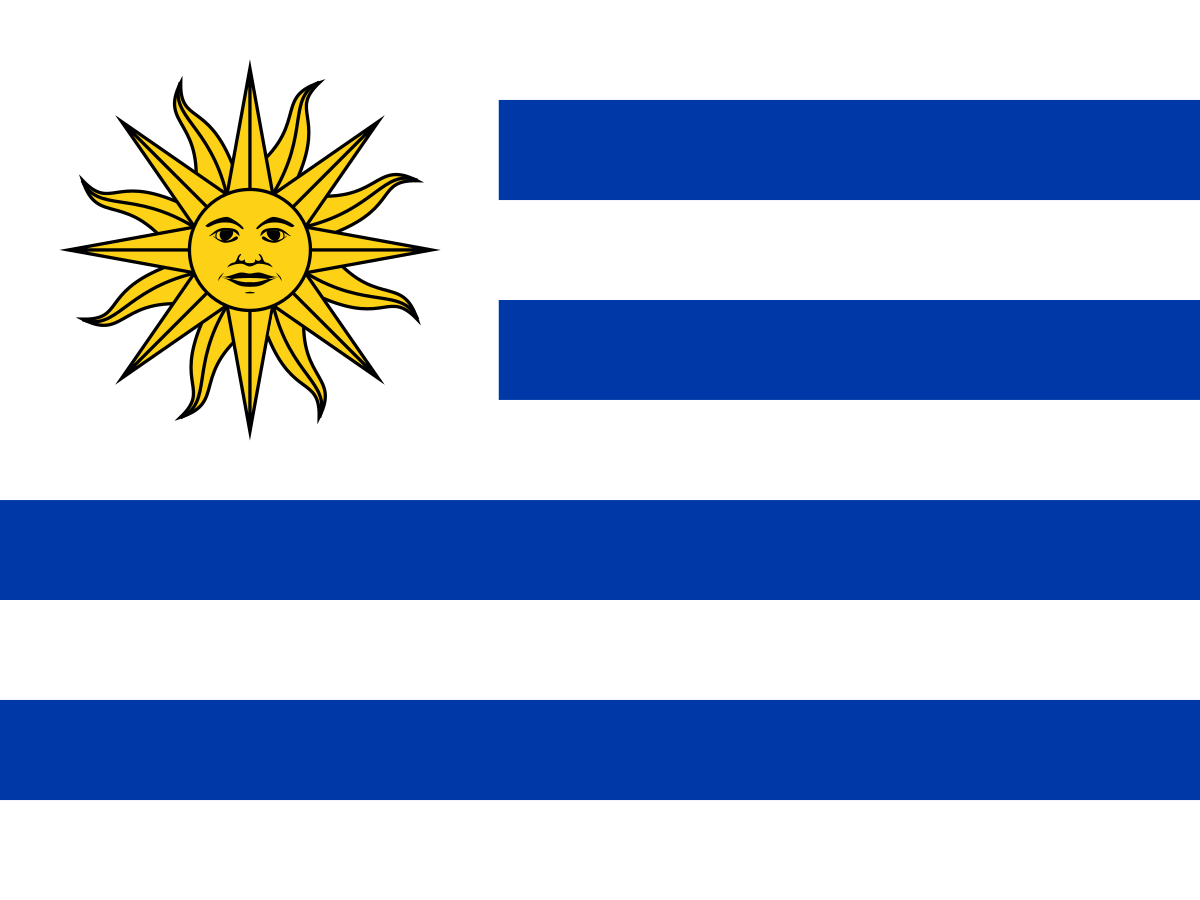
Nine horizontal stripes represent the nine departments when the flag was created. The Sun of May matches Argentina's — representing shared history. The stripes are inspired by the US flag.
Capital
Montevideo
Continent
Americas
Population
3.5 million
Development indicators
GDP per capita
$17,900
USD per year (approx. 2023)
Human Development Index
0.830
Very High development
World Bank income classification
High Income (HIC)
HIC
🌡️ Climate: Temperate
Flag symbolism
Nine horizontal stripes represent the nine departments when the flag was created. The Sun of May matches Argentina's — representing shared history. The stripes are inspired by the US flag.
sunstripes
Did you know?
Uruguay was the first country in the world to fully legalise cannabis.
Test your knowledge
Think you know your world flags? Try the FlagAtlas daily challenge, speed quiz, or explore all Americas flags.
📚 Revising for GCSE Geography? Visit our free revision page →
About Uruguay
Uruguay is a small country on the south-eastern coast of South America, bordered by Argentina to the west and Brazil to the north and east. It has a long Atlantic coastline and is known for its stable democracy, high living standards, beaches, football and distinctive Río de la Plata culture.
Montevideo is the capital and largest city. Much of the country's population lives around the capital and along the southern coast.
Uruguay at a glance
Capital: Montevideo · Region: South America · Currency: Uruguayan peso (UYU) · Official language: Spanish · Independence: 1828
The flag of Uruguay
The Uruguayan flag has nine alternating horizontal blue and white stripes and a white canton containing the Sun of May. The nine stripes originally represented the nine departments of Uruguay.
Flag symbolism
The nine stripes represented Uruguay's nine original departments. The Sun of May is a major symbol of independence in the Río de la Plata region and is also found on the flag of Argentina, reflecting shared historical traditions.
The design was influenced by the United States flag, particularly in its use of multiple horizontal stripes. The blue and white colours are strongly associated with Uruguay's national identity.
The Sun of May
The Sun of May features a face and alternating straight and wavy rays. It refers to the May Revolution of 1810, an important event in the independence movements of the Río de la Plata region. The symbol appears on both the Uruguayan and Argentine flags, although the designs differ.
Flag history
1811 — Early independence flagJosé Artigas and the revolutionary movement used distinctive blue, white and red flags during the struggle for independence.
1828 — IndependenceUruguay became an independent state following the conflict between Brazil and the United Provinces of the Río de la Plata.
1828 — First national flagThe first national flag used a design with nine blue and white stripes, representing the country's original departments.
1830 — Constitutional stateUruguay adopted its first constitution and established the foundations of its modern republic.
TodayThe flag retains the nine stripes and the Sun of May and remains one of the most recognisable flags in South America.
A short history of Uruguay
The territory of modern Uruguay was home to Indigenous peoples long before European settlement. Spanish and Portuguese powers competed for influence in the region because of its strategic position between Brazil and the Río de la Plata.
Uruguay's independence emerged from a complicated period of conflict involving Spain, Portugal, Brazil and the revolutionary forces of the Río de la Plata. The country became independent in 1828 and developed a relatively stable republican political tradition during the nineteenth and twentieth centuries.
History timeline
Before European settlement — Indigenous UruguaySeveral Indigenous peoples lived in the region, including Charrúa, Chaná and Guaraní communities.
1680 — Colonia del Sacramento foundedPortugal established Colonia del Sacramento, beginning a long period of Portuguese-Spanish rivalry in the region.
1726 — Montevideo foundedSpanish authorities established Montevideo as an important fortified port.
1811 — Artigas begins independence struggleJosé Gervasio Artigas became the leading figure of Uruguay's revolutionary movement.
1816–1820 — Portuguese invasionPortuguese forces invaded the territory and eventually incorporated it into Brazil.
1825 — Declaration of independenceThe Thirty-Three Orientals launched a campaign to end Brazilian rule and unite with the Río de la Plata provinces.
1828 — Uruguay becomes independentThe Treaty of Montevideo recognised Uruguay as an independent state.
1830 — First constitutionUruguay adopted its first constitution and became a constitutional republic.
1839–1851 — Guerra GrandeA long civil and regional conflict shaped early Uruguayan politics.
Late 19th century — Economic developmentCattle ranching, meat exports, agriculture and immigration helped transform the economy.
1903–1907 — José Batlle y OrdóñezBatlle's reforms helped establish Uruguay's reputation for progressive social and political policies.
1930 — First FIFA World CupUruguay hosted and won the first FIFA World Cup.
1973–1985 — Military dictatorshipUruguay experienced authoritarian military rule before democracy was restored.
1985 — Return to democracyA democratic civilian government returned to power.
2008 — Cannabis reform movementUruguay became internationally known for its progressive drug policy.
2013 — Cannabis legalisationUruguay became the first country to create a legal, regulated national cannabis market.
Today — Stable South American democracyUruguay continues to be regarded as one of Latin America's more politically stable and socially developed countries.
Montevideo
Montevideo is Uruguay's capital, largest city and main port. It sits on the northern shore of the Río de la Plata and is known for its waterfront, historic Ciudad Vieja, markets, cafés, music and relaxed coastal lifestyle.
Río de la Plata
The Río de la Plata is the broad estuary formed by the Paraná and Uruguay rivers. It separates Uruguay from Argentina and has played a major role in the history, trade and settlement of both countries.
Geography
Uruguay has a landscape dominated by rolling grasslands, low hills, rivers and coastal plains. Unlike many South American countries, it has no major mountain ranges. Its fertile land supports extensive cattle ranching and agriculture.
Climate
Uruguay has a temperate climate with four broadly defined seasons. Rainfall occurs throughout the year, while summers can be warm and winters are generally mild to cool.
Wildlife
Uruguay's grasslands, wetlands and coastline support wildlife including capybaras, rheas, foxes, armadillos, sea lions and many bird species. Coastal and wetland habitats are particularly important for migratory birds.
Language and culture
Spanish is the main language. Uruguayan Spanish has distinctive vocabulary and pronunciation influenced by the wider Río de la Plata region. Italian and other European influences are also visible in local culture.
Mate culture
Mate, a caffeinated herbal drink made from yerba mate, is deeply embedded in everyday Uruguayan life. It is often shared socially and is one of the clearest cultural links between Uruguay and neighbouring Argentina and southern Brazil.
Football
Football is central to Uruguayan identity. Uruguay won the first FIFA World Cup in 1930 on home soil and won the tournament again in 1950. The national team is known as La Celeste, referring to its sky-blue shirts.
Economy
Uruguay has a diversified economy based on agriculture, livestock, food processing, forestry, services, tourism, technology and renewable energy. Beef, dairy products, soybeans, rice and forestry products are important exports.
Renewable energy
Uruguay has made major progress in renewable electricity generation, particularly through wind power and hydropower. Renewable sources have become a major part of the country's electricity mix.
Society and democracy
Uruguay is a constitutional republic with a long tradition of democratic institutions. It has also introduced a number of socially progressive policies, contributing to its reputation as one of the more liberal societies in Latin America.
Why is Uruguay's flag interesting?
Uruguay's flag combines a very unusual number of horizontal stripes with a powerful regional symbol. The nine stripes, inspired partly by the US flag, represent the country's original departments, while the Sun of May connects Uruguay's flag to the wider independence history of the Río de la Plata.
Explore Uruguay on FlagAtlas
Continue exploring Uruguay and the world's flags with these FlagAtlas resources.