Americas
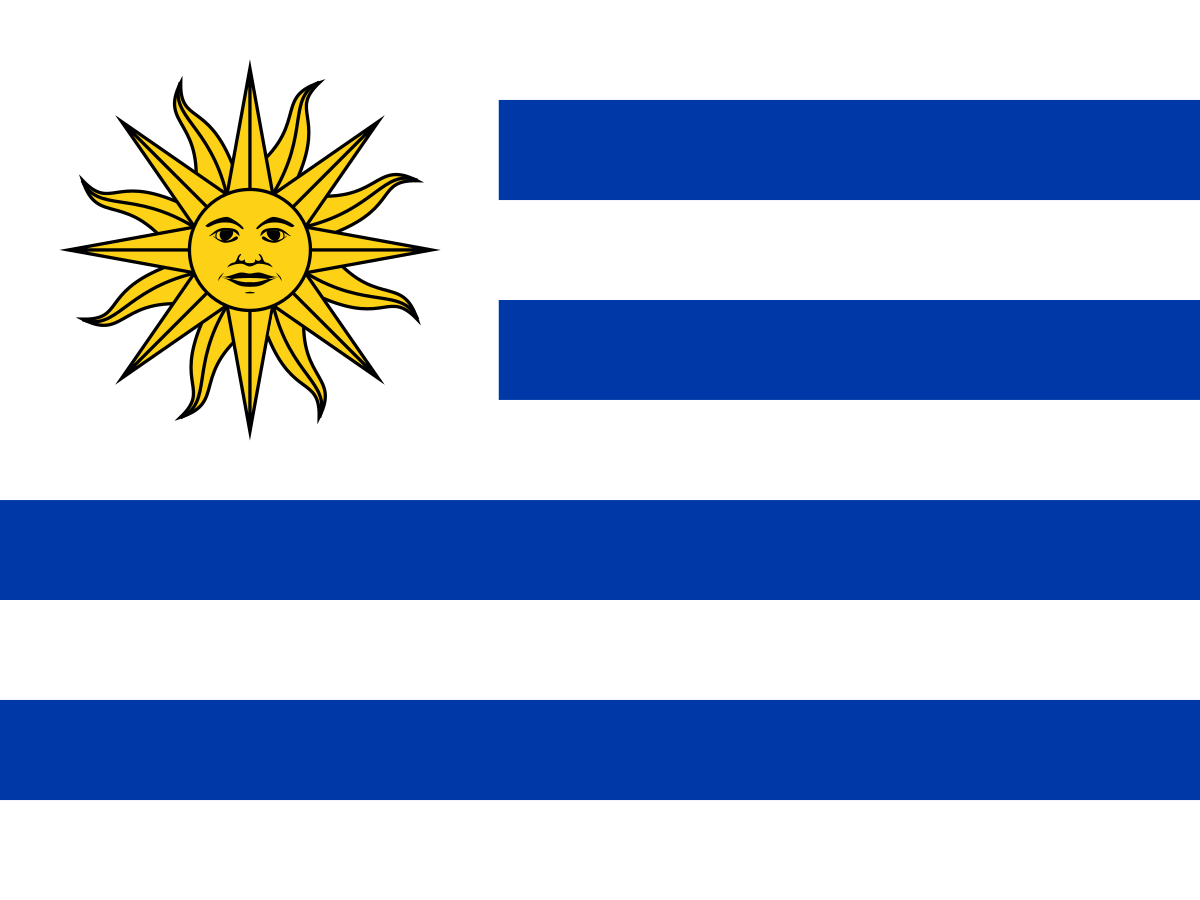
Uruguay Flag
Nine horizontal stripes represent the nine departments when the flag was created. The Sun of May matches Argentina's — representing shared history. The stripes are inspired by the US flag.
Capital
Montevideo
Continent
Americas
Population
3.5 million
Development indicators
GDP per capita
$17,900
USD per year (approx. 2023)
Human Development Index
0.830
Very High development
World Bank income classification
High Income (HIC)
HIC
🌡️ Climate: Temperate
Flag symbolism
Nine horizontal stripes represent the nine departments when the flag was created. The Sun of May matches Argentina's — representing shared history. The stripes are inspired by the US flag.
sunstripes
Did you know?
Uruguay was the first country in the world to fully legalise cannabis.
Test your knowledge
Think you know your world flags? Try the FlagAtlas daily challenge, speed quiz, or explore all Americas flags.
📚 Revising for GCSE Geography? Visit our free revision page →
About Uzbekistan
Uzbekistan is a landlocked country in Central Asia, bordered by Kazakhstan, Kyrgyzstan, Tajikistan, Afghanistan and Turkmenistan. It is one of the region's most historically important countries and sits along routes that once connected China, Persia, India and Europe through the Silk Road.
Tashkent is the capital and largest city. Uzbekistan is Central Asia's most populous country and has a rich cultural heritage shaped by Persian, Turkic, Islamic and Soviet influences.
Uzbekistan at a glance
Capital: Tashkent · Region: Central Asia · Currency: Uzbekistani soʻm (UZS) · Official language: Uzbek · Independence: 1991
The flag of Uzbekistan
The Uzbek flag consists of three horizontal bands of blue, white and green, separated by narrow red lines. In the upper hoist corner is a white crescent and twelve white stars.
Flag symbolism
Blue is associated with the sky and water and has connections with historic Turkic and Timurid traditions. White represents peace and purity, while green is associated with nature and renewal. The narrow red lines are often interpreted as representing life force and the connection between the other colours.
The crescent is associated with Uzbekistan's historical and cultural traditions, while the 12 stars have been linked to ideas including the twelve months and the ancient twelve-part divisions of the calendar and zodiac.
The twelve stars
The twelve stars are arranged in three groups and form one of the most distinctive features of the Uzbek flag. Official explanations connect them with the idea of a calendar year and the twelve months, while twelve has also had significance in Central Asian cultural traditions.
Flag history
1924 — Uzbek Soviet Socialist RepublicUzbekistan became part of the Soviet Union after a major reorganisation of Central Asian territories.
Soviet period — Changing Soviet flagsThe Uzbek SSR used several Soviet-era flag designs featuring the colours and symbols of the USSR.
31 August 1991 — Independence declaredUzbekistan declared independence as the Soviet Union was breaking apart.
18 November 1991 — Modern flag adoptedThe independent Republic of Uzbekistan formally adopted its current national flag.
TodayThe blue, white and green tricolour with the crescent and twelve stars remains the national flag of Uzbekistan.
A short history of Uzbekistan
The territory of modern Uzbekistan has been inhabited for thousands of years. Ancient settlements developed around the Amu Darya and Syr Darya river systems, while cities such as Samarkand, Bukhara and Khiva became important centres of trade, learning and culture.
The region was conquered and influenced by several major powers, including Persian empires, Alexander the Great, Arab Muslim rulers, Turkic dynasties and the Mongols. In the fourteenth and fifteenth centuries, Amir Timur and his successors made Samarkand the centre of a powerful empire and a major intellectual and architectural hub.
History timeline
Ancient period — Early Central Asian civilisationsSettled communities developed in the fertile river valleys and oases of Transoxiana.
4th century BC — Alexander the GreatAlexander conquered parts of Central Asia and established Greek influence in the region.
8th century — Arab conquestIslam spread across the region following Arab expansion into Central Asia.
9th–10th centuries — Samanid eraBukhara became a major centre of Persianate culture, science and Islamic scholarship.
13th century — Mongol invasionGenghis Khan's armies conquered Central Asia, causing major destruction but also reshaping regional trade networks.
14th–15th centuries — Timurid EmpireAmir Timur made Samarkand the capital of a powerful empire. His successors supported architecture, mathematics, astronomy and literature.
15th century — Ulugh BegTimurid ruler and astronomer Ulugh Beg built a major observatory at Samarkand and produced highly influential astronomical tables.
16th century — Uzbek dynastiesUzbek rulers established powerful khanates across much of the region.
19th century — Russian expansionThe Russian Empire conquered or dominated much of Central Asia, including the territories of the Uzbek khanates.
1924 — Uzbek SSR establishedThe Soviet Union reorganised Central Asia and created the Uzbek Soviet Socialist Republic.
1930 — Tashkent becomes capitalTashkent became the capital of the Uzbek SSR.
1966 — Tashkent earthquakeA major earthquake devastated much of the capital, which was subsequently rebuilt on a large scale.
1991 — IndependenceUzbekistan declared independence from the Soviet Union.
1991 — Modern flag adoptedThe current national flag was officially adopted in November.
2016 — Leadership transitionShavkat Mirziyoyev became president following the death of Islam Karimov.
Today — Modernising Central Asian stateUzbekistan continues economic and political reforms while maintaining its distinctive cultural identity.
Samarkand
Samarkand is one of Central Asia's most famous historic cities. It flourished under Amir Timur and his successors and is renowned for monuments such as Registan Square, the Bibi-Khanym Mosque and the Gur-e-Amir mausoleum.
Bukhara
Bukhara was a major centre of Islamic scholarship and Silk Road trade. Its historic centre contains mosques, madrasas, bazaars and other monuments reflecting centuries of Central Asian history.
Khiva
Khiva is an ancient oasis city in western Uzbekistan. Its walled old town, known as Itchan Kala, contains an extraordinary collection of historic mosques, madrasas, palaces and minarets.
Amir Timur
Amir Timur, often known in the West as Tamerlane, was a fourteenth-century conqueror who built a vast empire across Central Asia and beyond. He made Samarkand his capital and sponsored major architectural and cultural projects.
The Silk Road
Uzbekistan lies at the heart of historic Silk Road routes linking East Asia with the Middle East and Europe. The country's ancient cities became wealthy through trade in silk, spices, textiles, metals and other goods, while also exchanging ideas, religions and technologies.
Geography
Uzbekistan is mostly dry and contains extensive deserts, steppes, plains and mountains. The Kyzylkum Desert occupies much of the country's north-western area, while the east and south-east include mountain ranges and fertile valleys.
The Aral Sea
The Aral Sea, once one of the world's largest inland lakes, has suffered catastrophic shrinkage since the Soviet period because rivers feeding it were heavily diverted for irrigation. The disaster has created serious environmental, economic and public-health consequences in the surrounding region.
Climate
Uzbekistan has a strongly continental, arid climate. Summers can be extremely hot and dry, while winters can be cold, particularly in the north and mountainous areas.
Wildlife
Despite its arid landscape, Uzbekistan supports diverse wildlife including goitered gazelles, wild sheep, foxes, wolves and many migratory birds. Mountain and desert ecosystems are important habitats for rare species.
Language and culture
Uzbek is the official language and belongs to the Turkic language family. Russian remains widely used in some urban, business and inter-community contexts. Tajik is also spoken in some areas, particularly around historic cities such as Samarkand and Bukhara.
Religion
Uzbekistan has a predominantly Muslim population, with most Muslims following Sunni traditions. The country's Islamic heritage is particularly visible in its historic mosques, madrasas, libraries and architectural monuments.
Food and traditions
Uzbek cuisine is strongly associated with rice, meat, vegetables and bread. Plov, a rice dish usually cooked with meat, carrots and onions, is one of the country's best-known foods. Bread, particularly round non, is also an important part of everyday life.
Economy
Uzbekistan's economy includes agriculture, mining, natural gas, manufacturing, textiles, services and increasingly tourism. Cotton has historically been a major crop, while gold, uranium and natural gas are important natural resources.
Cotton production
Uzbekistan has historically been one of the world's major cotton producers. Large-scale irrigation during the Soviet period contributed to environmental problems, particularly the shrinking of the Aral Sea. In recent years the country has introduced reforms to its cotton sector and labour practices.
Modern Uzbekistan
Since 2016, Uzbekistan has pursued economic reforms, greater regional cooperation and increased engagement with international markets. Tourism has also expanded as the country promotes its historic cities and Silk Road heritage.
Why is Uzbekistan's flag interesting?
Uzbekistan's flag combines a modern Central Asian national design with symbols that connect the country to its ancient cultural heritage. The crescent, twelve stars, blue and green bands and narrow red lines create a distinctive design unlike any other national flag.
Explore Uzbekistan on FlagAtlas
Continue exploring Uzbekistan and the world's flags with these FlagAtlas resources.