Oceania
Vanuatu Flag
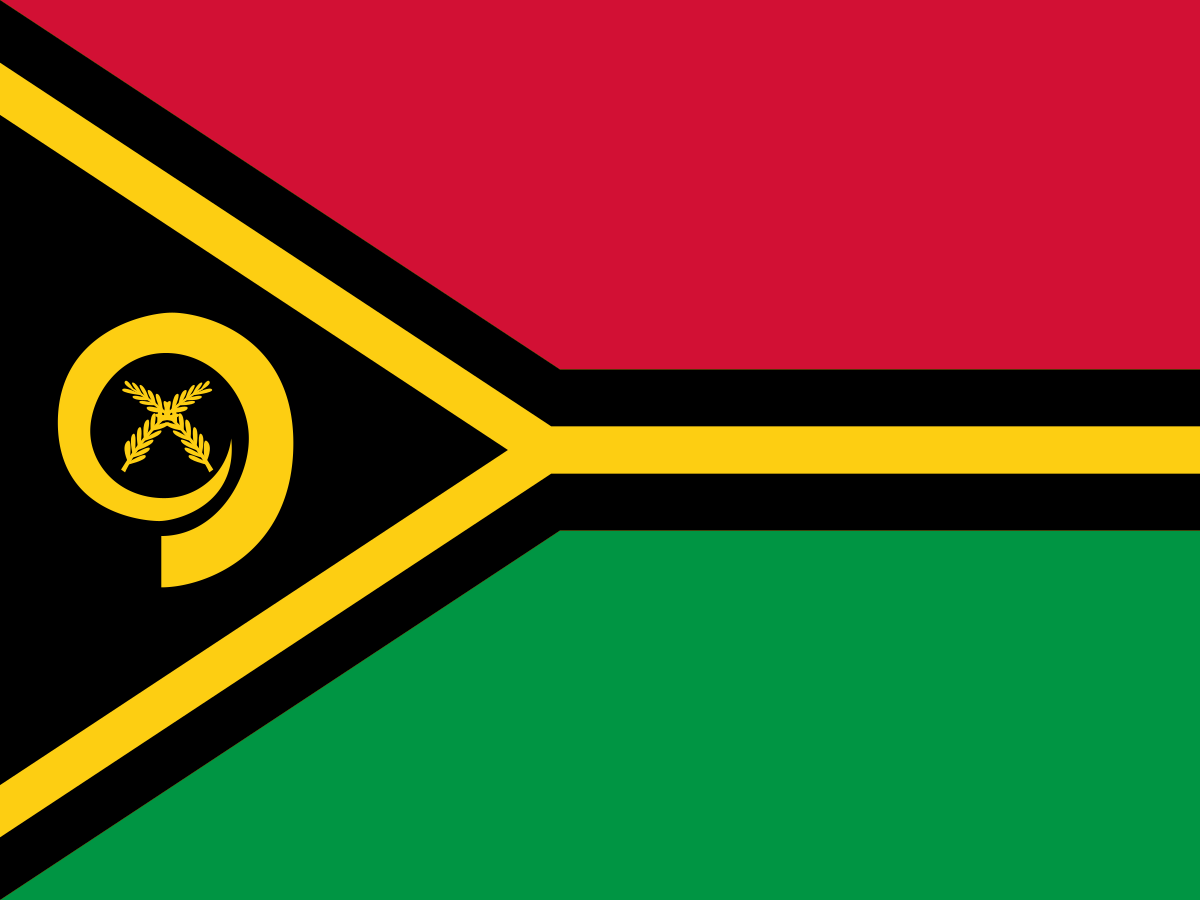
Red represents the blood of the boar (used in traditional ceremonies), green stands for the islands' richness, black is the colour of the ni-Vanuatu people, and yellow represents the light of Christianity. The boar's tusk represents prosperity.
Capital
Port Vila
Continent
Oceania
Population
320 thousand
Development indicators
GDP per capita
$3,100
USD per year (approx. 2023)
Human Development Index
0.607
Medium development
World Bank income classification
Lower-Middle Income (LMIC)
LMIC
🌡️ Climate: Tropical
Flag symbolism
Red represents the blood of the boar (used in traditional ceremonies), green stands for the islands' richness, black is the colour of the ni-Vanuatu people, and yellow represents the light of Christianity. The boar's tusk represents prosperity.
boar tusk
Did you know?
Vanuatu was voted the happiest country in the world by the Happy Planet Index.
Test your knowledge
Think you know your world flags? Try the FlagAtlas daily challenge, speed quiz, or explore all Oceania flags.
📚 Revising for GCSE Geography? Visit our free revision page →
About Vanuatu
Vanuatu is an island country in the South Pacific Ocean, made up of more than 80 islands in the Melanesian region of Oceania. It lies east of Australia and north-east of New Caledonia and is known for volcanic landscapes, tropical forests, coral reefs and distinctive Melanesian cultures.
Port Vila is the capital and largest city, on the island of Efate. Vanuatu's population is spread across many islands and communities, with traditional village life remaining an important part of the country's identity.
Vanuatu at a glance
Capital: Port Vila · Region: Melanesia / Oceania · Currency: Vanuatu vatu (VUV) · Official languages: Bislama, English and French · Independence: 1980
The flag of Vanuatu
Vanuatu's national flag has red and green horizontal fields separated by a black-edged yellow Y-shaped band. At the hoist is a black triangle containing a boar's tusk and two crossed namele fern fronds.
Flag symbolism
The colours and symbols reflect Vanuatu's natural environment, traditional culture and history. Red represents blood, including the blood of the boar used in traditional ceremonies. Green represents the richness of the islands, while black represents the ni-Vanuatu people. Yellow represents sunlight and the light of Christianity.
The boar's tusk is a traditional symbol of prosperity and is particularly important in Vanuatu's customary culture. The crossed namele leaves represent peace and have an important place in traditional symbolism.
The Y shape
The yellow Y-shaped element reflects the geography of the Vanuatu archipelago. Its three arms can be understood as representing the main island groups of the country, while the shape also connects the flag to the map and identity of the islands.
Flag history
Before independence — Local traditionsVanuatu's islands had many local symbols and customary traditions rather than a single national flag.
1977 — Independence movement flagThe Vanua'aku Pati and independence movement used a design incorporating colours and symbols that later influenced the national flag.
1980 — IndependenceThe New Hebrides became the independent Republic of Vanuatu on 30 July 1980.
1980 — National flag adoptedThe modern red, green, black and yellow flag was adopted for the new independent state.
TodayThe flag remains a strong combination of national independence, Melanesian identity and traditional symbolism.
A short history of Vanuatu
Vanuatu's islands have been inhabited for thousands of years by Melanesian peoples. European navigators reached the islands from the seventeenth century onwards, while sustained outside influence increased during the nineteenth century.
The islands became known as the New Hebrides and were administered jointly by Britain and France under an unusual Anglo-French condominium. Independence came in 1980, when the country adopted the name Vanuatu.
History timeline
c. 1100–1000 BC — Lapita settlementAncestors of many Pacific island populations settled Vanuatu as part of the wider Lapita expansion across Oceania.
1606 — European contactPedro Fernandes de Queirós reached the islands during a Pacific voyage.
1768 — BougainvilleFrench explorer Louis Antoine de Bougainville visited and charted parts of the archipelago.
1774 — Captain CookJames Cook surveyed the islands and gave them the name New Hebrides.
19th century — Missionaries and tradersChristian missionaries, traders and labour recruiters increasingly affected island communities.
1906 — Anglo-French condominiumBritain and France established joint administration over the New Hebrides.
1942–1945 — Second World WarThe islands became strategically important as Allied forces established bases in the Pacific.
1970s — Independence movementPolitical movements increasingly demanded self-government and independence.
30 July 1980 — IndependenceThe Republic of Vanuatu became independent from joint British and French rule.
1980 — Flag adoptedThe new nation adopted its distinctive national flag.
2015 — Cyclone PamSevere Tropical Cyclone Pam caused widespread destruction and highlighted the country's vulnerability to extreme weather.
2023 — Major earthquakesPowerful earthquakes struck Vanuatu, demonstrating its location within the seismically active Pacific Ring of Fire.
Today — Independent Pacific nationVanuatu remains a sovereign Melanesian state with a strong customary culture and close links to its Pacific neighbours.
Port Vila
Port Vila is Vanuatu's capital and main commercial centre. It is an important hub for government, tourism, trade and transport and sits beside a large natural harbour.
Efate
Efate is one of Vanuatu's principal islands and home to Port Vila. Its coastline contains beaches, lagoons and coral reefs, while the interior includes tropical forests and volcanic landscapes.
Geography
Vanuatu forms a long chain of volcanic and uplifted islands stretching roughly north to south. The archipelago includes active volcanoes, mountains, tropical forests, coral reefs and coastal plains.
Volcanoes
Vanuatu lies on the Pacific Ring of Fire and is one of the world's more volcanically active regions. Mount Yasur on Tanna is particularly famous for its persistent activity, while Ambrym and other islands also contain major volcanic systems.
Climate
Vanuatu has a tropical maritime climate, with warm temperatures throughout the year. Tropical cyclones can cause severe damage during the South Pacific cyclone season.
Wildlife and marine life
Vanuatu's forests, reefs and coastal waters support diverse wildlife. The surrounding seas contain coral reefs, sea turtles, dolphins, reef fish and other marine species, while the islands support many tropical birds, bats and reptiles.
People and culture
Vanuatu is culturally diverse, with many island communities maintaining distinct traditions, languages and customary practices. The country has one of the world's highest levels of linguistic diversity relative to its population, with more than 100 indigenous languages spoken across the islands.
Languages
Vanuatu has three official languages: Bislama, English and French. Bislama is a creole language widely used as a common language between communities. Indigenous languages remain central to local identity.
Custom and kastom
The concept of kastom refers broadly to traditional customs, knowledge, ceremonies and social practices. Kastom remains an important part of life in many communities and exists alongside Christianity and modern political institutions.
The boar's tusk
Boar tusks have major cultural significance in Vanuatu. Traditionally, pigs can represent wealth and social status, and a circularly curved tusk is especially valued. The symbol on the national flag therefore connects the modern state directly with traditional ni-Vanuatu culture.
Economy
Vanuatu's economy relies on agriculture, tourism, fisheries, construction and services. Subsistence farming remains important in many rural communities, while tourism is a major source of foreign income.
Tourism
Visitors are attracted by Vanuatu's tropical beaches, coral reefs, volcanoes, forests and cultural experiences. Popular activities include diving, snorkelling, hiking, kayaking and visiting traditional communities.
Climate change and natural disasters
Vanuatu is highly exposed to tropical cyclones, earthquakes, volcanic eruptions and sea-level rise. Climate change is an important national concern because many communities depend directly on coastal and agricultural environments.
Vanuatu and the Second World War
During the Second World War, the New Hebrides became an important Allied base in the Pacific. Large numbers of troops and supplies passed through the islands, leaving a lasting historical legacy.
Why is Vanuatu's flag interesting?
Vanuatu's flag is unusual because almost every part of its design carries a direct cultural or geographical meaning. The boar's tusk, namele leaves, Y-shaped band and four main colours combine traditional Melanesian symbolism with the story of national independence.
Explore Vanuatu on FlagAtlas
Continue exploring Vanuatu and the world's flags with these FlagAtlas resources.