Europe
Vatican City Flag
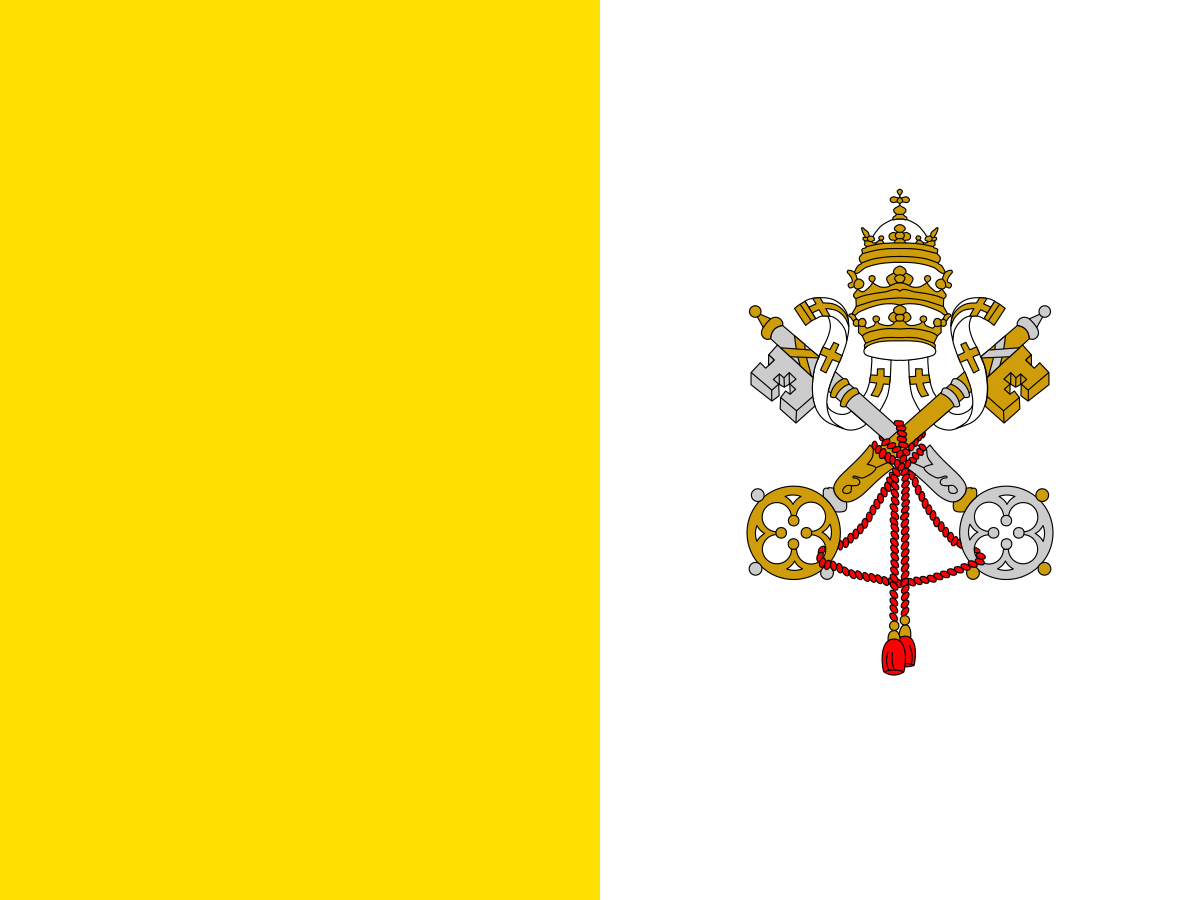
One of only two square national flags. Yellow and white represent the Pope's spiritual and earthly power. The coat of arms shows the papal tiara and crossed keys of Saint Peter.
Capital
Vatican City
Continent
Europe
Population
800
Development indicators
GDP per capita
N/A
USD per year (approx. 2023)
Human Development Index
N/A
N/A development
World Bank income classification
High Income (HIC)
HIC
🌡️ Climate: Mediterranean
Flag symbolism
One of only two square national flags. Yellow and white represent the Pope's spiritual and earthly power. The coat of arms shows the papal tiara and crossed keys of Saint Peter.
squarecoat of arms
Did you know?
Vatican City is the smallest country in the world — it could fit inside Central Park in New York.
Test your knowledge
Think you know your world flags? Try the FlagAtlas daily challenge, speed quiz, or explore all Europe flags.
📚 Revising for GCSE Geography? Visit our free revision page →
About Vatican City
Vatican City is the world's smallest independent state by both area and population. It is a sovereign enclave within Rome, Italy, and serves as the spiritual and administrative centre of the Roman Catholic Church.
Vatican City became an independent state in 1929 under the Lateran Treaty. Although tiny in size, it has enormous religious, historical and cultural importance. The Pope is the head of state.
Vatican City at a glance
Capital: Vatican City · Continent: Europe · Currency: Euro (EUR) · Official language: Italian for the state; Latin is the official language of the Holy See · Area: about 0.49 km²
The flag of Vatican City
The flag consists of two vertical halves: yellow at the hoist and white at the fly. The white half bears the crossed keys of Saint Peter beneath the Papal Tiara.
Flag symbolism
The yellow and white colours are associated with the spiritual and temporal authority of the Holy See. The two colours are also strongly connected with the papacy and the traditions of the Catholic Church.
The crossed gold and silver keys represent the Keys of Saint Peter, traditionally understood as the keys to the Kingdom of Heaven. The Papal Tiara represents the papal office and its historical authority.
The keys of Saint Peter
The two crossed keys are one of the best-known symbols associated with the papacy. According to Catholic tradition, Saint Peter was entrusted with the keys to the Kingdom of Heaven. The Vatican emblem uses one gold key and one silver key, bound together with a red cord.
Flag history
Before 1870 — Papal StatesThe popes ruled a much larger territory in central Italy, known as the Papal States, which used earlier papal symbols and banners.
1870 — End of the Papal StatesItalian unification brought the Papal States to an end. The popes continued to claim territorial sovereignty despite losing their former lands.
1929 — Lateran TreatyThe Lateran Treaty created Vatican City as an independent sovereign state and settled the long-running dispute between the Kingdom of Italy and the Holy See.
1929 — Modern flag adoptedThe distinctive yellow-and-white flag with the papal coat of arms became the flag of the new Vatican City state.
TodayThe flag remains one of the world's most recognisable religious and national flags.
A short history of Vatican City
The history of Vatican City is closely connected with the history of the papacy and Christianity in Rome. According to tradition, Saint Peter was buried in the area after his martyrdom in Rome, and the great St Peter's Basilica was later built above the traditional site of his tomb.
For centuries the popes controlled extensive territory across central Italy. Following Italian unification, the papacy lost its territorial possessions. The dispute was finally resolved by the Lateran Treaty of 1929, which established Vatican City as an independent state.
History timeline
1st century — Saint Peter in RomeChristian tradition holds that the Apostle Peter was martyred and buried in Rome, linking the area with the early history of the papacy.
4th century — First St Peter's BasilicaEmperor Constantine sponsored the construction of a major basilica over the traditional tomb of Saint Peter.
8th century — Papal territorial powerThe popes developed temporal authority over territories in central Italy, laying the foundations of the Papal States.
1377 — Papacy returns to RomeAfter the period of the Avignon Papacy, the papal court returned permanently to Rome.
1506 — New St Peter's BasilicaConstruction of the present basilica began under Pope Julius II. It became one of the greatest architectural projects of the Renaissance.
1512 — Sistine Chapel ceilingMichelangelo's famous ceiling was completed, becoming one of the world's best-known works of Renaissance art.
1870 — Italian unificationRome was incorporated into the Kingdom of Italy and the Papal States ceased to exist.
1871–1929 — Roman QuestionThe popes considered themselves effectively confined within the Vatican while negotiations continued over the status of the papacy.
11 February 1929 — Lateran TreatyItaly and the Holy See signed agreements recognising Vatican City as an independent state.
1930s onward — Modern Vatican stateThe new state developed its own institutions, communications, currency arrangements and diplomatic presence.
1984 — UNESCO World Heritage statusVatican City was recognised as a UNESCO World Heritage Site in its entirety.
Today — Sovereign city-stateVatican City remains the headquarters of the Holy See and the residence of the Pope.
St Peter's Basilica
St Peter's Basilica is one of the world's most famous churches and dominates Vatican City's skyline. The present basilica was constructed over several centuries and involved some of the leading architects and artists of the Renaissance and Baroque periods, including Michelangelo and Gian Lorenzo Bernini.
The Sistine Chapel
The Sistine Chapel is famous for its Renaissance decoration, particularly Michelangelo's ceiling and the Last Judgment. It is also where the College of Cardinals gathers for the papal conclave to elect a new Pope.
Vatican Museums
The Vatican Museums contain one of the world's greatest collections of art and historical objects. Their collections include ancient Roman and Greek works, Renaissance masterpieces, religious art and archaeological treasures gathered by generations of popes.
Geography
Vatican City occupies just 0.49 square kilometres inside the city of Rome. It is enclosed by walls and borders the Italian capital on every side. Despite its tiny area, it contains major religious and cultural landmarks including St Peter's Square, St Peter's Basilica, the Apostolic Palace and the Vatican Museums.
The Pope
The Pope is the sovereign of Vatican City and the supreme leader of the Roman Catholic Church. The Pope's role therefore combines religious leadership with the constitutional functions of the head of a sovereign state.
The Holy See and Vatican City
Vatican City and the Holy See are not exactly the same thing. Vatican City is the sovereign territory created in 1929, while the Holy See is the central governing authority of the Catholic Church and maintains diplomatic relations with countries around the world.
Government
Vatican City is an elective absolute monarchy, with the Pope as sovereign. Day-to-day administration is carried out through institutions including the Governorate of Vatican City State, while the Holy See manages the Church's wider affairs and diplomacy.
Population
Vatican City has a very small resident population, consisting largely of clergy, members of religious communities, Swiss Guards and other employees of the Holy See and Vatican institutions. Citizenship is generally connected with an official role or appointment rather than simply being born in the territory.
The Swiss Guard
The Pontifical Swiss Guard is responsible for protecting the Pope and guarding important entrances to Vatican City. Founded in 1506, it is famous for its colourful Renaissance-style uniforms and is one of the world's oldest military units still in active service.
Languages
Italian is widely used for the everyday administration of Vatican City, while Latin is the official language of the Holy See. A wide range of languages can be heard because Vatican institutions have an international workforce.
Economy and unique status
Vatican City's economy is unusual because it is not based on conventional industries. Revenue comes from sources including museums and tourism, postage and commemorative products, publications, donations and other activities connected with the Holy See.
Culture and heritage
Vatican City has an extraordinary concentration of art, architecture and religious heritage. Its buildings and collections contain works by artists including Michelangelo, Raphael, Bernini and Caravaggio, making it one of the world's most important cultural destinations.
Why is Vatican City's flag interesting?
Vatican City's flag is highly unusual because it combines the simplicity of a two-colour design with the detailed papal coat of arms. It is also one of the very few national flags to feature crossed keys and a papal tiara, directly connecting the flag to the religious authority of the state.
Explore Vatican City on FlagAtlas
Continue exploring Vatican City and the world's flags with these FlagAtlas resources.