Americas
Venezuela Flag
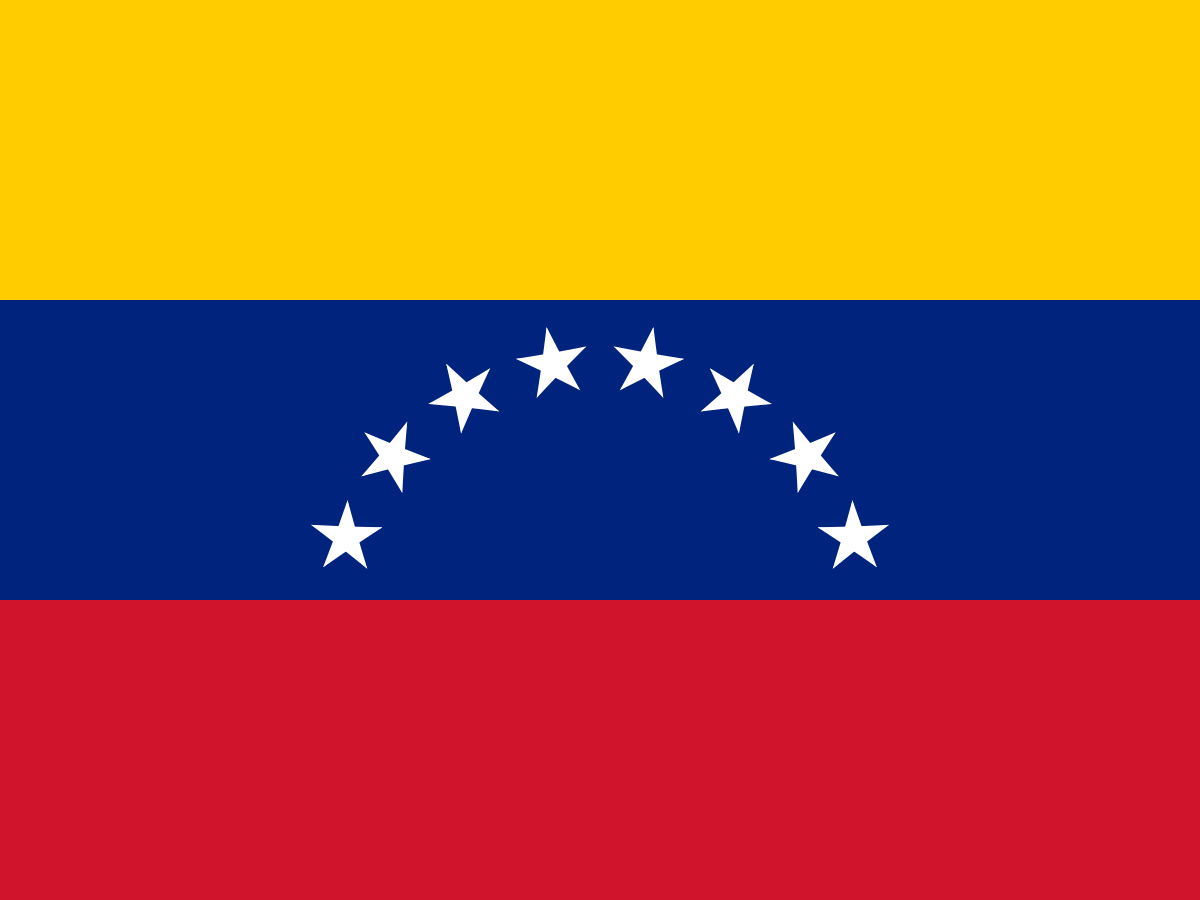
Yellow represents the wealth of Venezuela, blue stands for the sea separating it from Spain, and red symbolises the blood of those who died for independence. Eight stars represent the original eight provinces.
Capital
Caracas
Continent
Americas
Population
29.0 million
Development indicators
GDP per capita
$4,000
USD per year (approx. 2023)
Human Development Index
0.699
Medium development
World Bank income classification
Upper-Middle Income (UMIC)
UMIC
🌡️ Climate: Tropical
Flag symbolism
Yellow represents the wealth of Venezuela, blue stands for the sea separating it from Spain, and red symbolises the blood of those who died for independence. Eight stars represent the original eight provinces.
starsarc
Did you know?
Venezuela has the world's largest proven oil reserves.
Test your knowledge
Think you know your world flags? Try the FlagAtlas daily challenge, speed quiz, or explore all Americas flags.
📚 Revising for GCSE Geography? Visit our free revision page →
About Venezuela
Venezuela is a country on the northern coast of South America, facing the Caribbean Sea. It is famous for its extraordinary landscapes, including the world's highest uninterrupted waterfall, Angel Falls, the vast Orinoco River basin and the dramatic table-top mountains known as tepuis.
Caracas is the capital and largest city. Venezuela has a long history shaped by Indigenous peoples, Spanish colonial rule, independence under Simón Bolívar, and the development of one of the world's largest petroleum industries.
Venezuela at a glance
Capital: Caracas · Region: South America / Caribbean · Currency: Venezuelan bolívar (VES) · Official language: Spanish · Independence: 1811
The flag of Venezuela
Venezuela's national flag consists of three horizontal bands of yellow, blue and red. Eight white five-pointed stars form an arc across the blue band towards the hoist.
The modern flag developed from the revolutionary designs associated with Francisco de Miranda and the independence movement in Spanish America.
Flag symbolism
Yellow is traditionally associated with the country's wealth and resources. Blue represents the sea separating Venezuela from Spain, while red represents the blood shed in the struggle for independence.
The eight stars represent the eight provinces that supported Venezuela's independence in 1811. The eighth star was added in 2006 to recognise the historic province of Guayana.
Why are there eight stars?
Venezuela originally used seven stars to represent the seven provinces that declared independence. In 2006, a eighth star was added by President Hugo Chávez to represent Guayana, which had also supported the independence movement.
Flag history
1806 — Miranda's revolutionary flagFrancisco de Miranda carried a yellow, blue and red design during his attempts to promote independence in Spanish America.
1811 — First Venezuelan republicThe revolutionary tricolour became the basis of the flag of independent Venezuela.
1817 — Stars introducedStars were added to represent the provinces supporting independence.
19th century — Changing designsVenezuela used several variations of the tricolour and star arrangement during the country's turbulent political history.
1930 — Seven-star designThe familiar seven-star arrangement became established in the national flag.
2006 — Eighth star addedThe government added an eighth star to represent Guayana.
TodayThe yellow, blue and red tricolour with eight stars is the national flag of Venezuela.
A short history of Venezuela
The territory of modern Venezuela was inhabited by numerous Indigenous peoples before European arrival. Spanish explorers reached the region in the late fifteenth century, and Venezuela subsequently became part of the Spanish colonial system.
Venezuela became one of the major centres of the Spanish American independence movement. Simón Bolívar, born in Caracas, became one of the most important leaders of the wars of independence across northern South America.
History timeline
Before 1498 — Indigenous VenezuelaMany Indigenous peoples lived throughout the region, including communities with distinct languages, cultures and ways of life.
1498 — Columbus reaches the coastChristopher Columbus reached the northeastern coast of South America during his third voyage.
16th century — Spanish colonisationSpanish settlements were established and the region became part of Spain's American empire.
1777 — Captaincy General of VenezuelaThe Spanish crown created the Captaincy General of Venezuela, bringing several provinces under a more unified administration.
19 April 1810 — Independence movement beginsA political movement in Caracas challenged Spanish authority and began the process that led to independence.
5 July 1811 — Declaration of independenceVenezuela formally declared independence from Spain.
1812 — First republic collapsesA combination of military defeats and a major earthquake helped bring the first Venezuelan republic to an end.
1813 — Bolívar's campaignSimón Bolívar returned to Venezuela and led the Admirable Campaign, helping establish a second republic.
1819 — Gran ColombiaVenezuela became part of Gran Colombia alongside territories corresponding to modern Colombia, Ecuador and Panama.
1821 — Battle of CaraboboThe decisive Venezuelan victory at Carabobo greatly weakened Spanish control.
1830 — Venezuela separatesVenezuela left Gran Colombia and became a separate republic.
Late 19th century — Political instabilityCivil wars, regional rivalries and changing governments shaped Venezuelan politics.
1914 — Major oil discoveryThe discovery and development of large petroleum resources transformed Venezuela's economy.
1958 — Return to democracyThe dictatorship of Marcos Pérez Jiménez ended and Venezuela entered a prolonged period of democratic government.
1976 — Oil industry nationalisedThe petroleum industry was nationalised and the state-owned company PDVSA was established.
1999 — New constitutionHugo Chávez became president and a new constitution created the Bolivarian Republic of Venezuela.
2000s — Political and economic changeHigh oil revenues funded major government programmes, while political tensions and economic dependence on oil increased.
2010s — Economic crisisFalling oil production and prices, economic disruption and political conflict contributed to a severe national crisis.
Today — Major South American nationVenezuela remains one of South America's largest countries by area and has enormous natural resources, including petroleum, gas, minerals, forests and freshwater.
Simón Bolívar
Simón Bolívar was born in Caracas in 1783 and became the leading figure in the liberation of several South American countries from Spanish rule. He played a central role in the independence of Venezuela, Colombia, Ecuador, Peru and Bolivia, with Bolivia named in his honour.
Caracas
Caracas lies in a mountain valley near the Caribbean coast and is Venezuela's political, cultural and economic centre. The city sits below the dramatic Ávila mountain range, now protected as a national park.
Angel Falls
Angel Falls, known locally as Kerepakupai Merú, plunges from the Auyán-tepui in Venezuela's Guiana Highlands. With a total height of about 979 metres and a continuous drop of roughly 807 metres, it is widely recognised as the world's highest uninterrupted waterfall.
The tepuis
The tepuis are enormous flat-topped sandstone mountains found mainly in southern Venezuela. Their isolated summits have distinctive ecosystems, with some species found nowhere else. They helped inspire the otherworldly landscapes described in travel and adventure literature.
Geography
Venezuela covers a large area of northern South America. Its landscapes range from Caribbean beaches and coastal mountains to the vast Orinoco Llanos, the Guiana Highlands and the Amazonian forests in the south.
The Orinoco River
The Orinoco is one of South America's great rivers and is central to Venezuela's geography. Its enormous drainage basin includes wetlands, savannahs, forests and important habitats for wildlife.
Lake Maracaibo
Lake Maracaibo in north-western Venezuela is one of the country's most important geographical and economic features. The surrounding region has been a major centre of oil production for more than a century.
Wildlife
Venezuela contains an extraordinary range of habitats and wildlife. Species include jaguars, giant anteaters, capybaras, anacondas, river dolphins, harpy eagles and numerous tropical birds. Its isolated tepuis also contain highly specialised species.
Climate
Venezuela is predominantly tropical, but its climate varies considerably with altitude and geography. Lowland areas are generally warm throughout the year, while the Andes and other highlands have much cooler conditions.
People, language and culture
Spanish is Venezuela's official language, while numerous Indigenous languages are also spoken. Venezuelan culture reflects Indigenous, European and African influences and is especially well known for its music, food, festivals and baseball tradition.
Music and traditions
Joropo is one of Venezuela's best-known musical and dance traditions. It is strongly associated with the Llanos and features instruments such as the harp, cuatro and maracas. Carnival and Christmas celebrations are also important parts of Venezuelan cultural life.
Food
Venezuelan cuisine includes dishes such as arepas, cachapas and pabellón criollo. Arepas are especially important and can be filled with meat, cheese, beans, avocado and many other ingredients.
Economy
Venezuela possesses some of the world's largest proven petroleum reserves. Oil has therefore played an enormous role in the country's economy, government finances and international trade. Other important resources include natural gas, iron ore, gold and agricultural land.
Venezuela and oil
The development of the petroleum industry transformed Venezuela during the twentieth century. Oil wealth helped fund infrastructure and public services, but heavy dependence on petroleum also left the economy vulnerable to changes in production, prices and international demand.
National parks
Venezuela has extensive protected areas, including Canaima National Park, which contains Angel Falls and numerous tepuis. Canaima is recognised as a UNESCO World Heritage Site because of its exceptional landscape and ecological importance.
Why is Venezuela's flag interesting?
Venezuela's flag is one of the most recognisable independence-era tricolours in the Americas. Its yellow, blue and red colours are closely associated with the revolutionary traditions of Francisco de Miranda, while the eight stars connect the modern flag with the country's independence history.
Explore Venezuela on FlagAtlas
Continue exploring Venezuela and the world's flags with these FlagAtlas resources.