Africa
Zimbabwe Flag
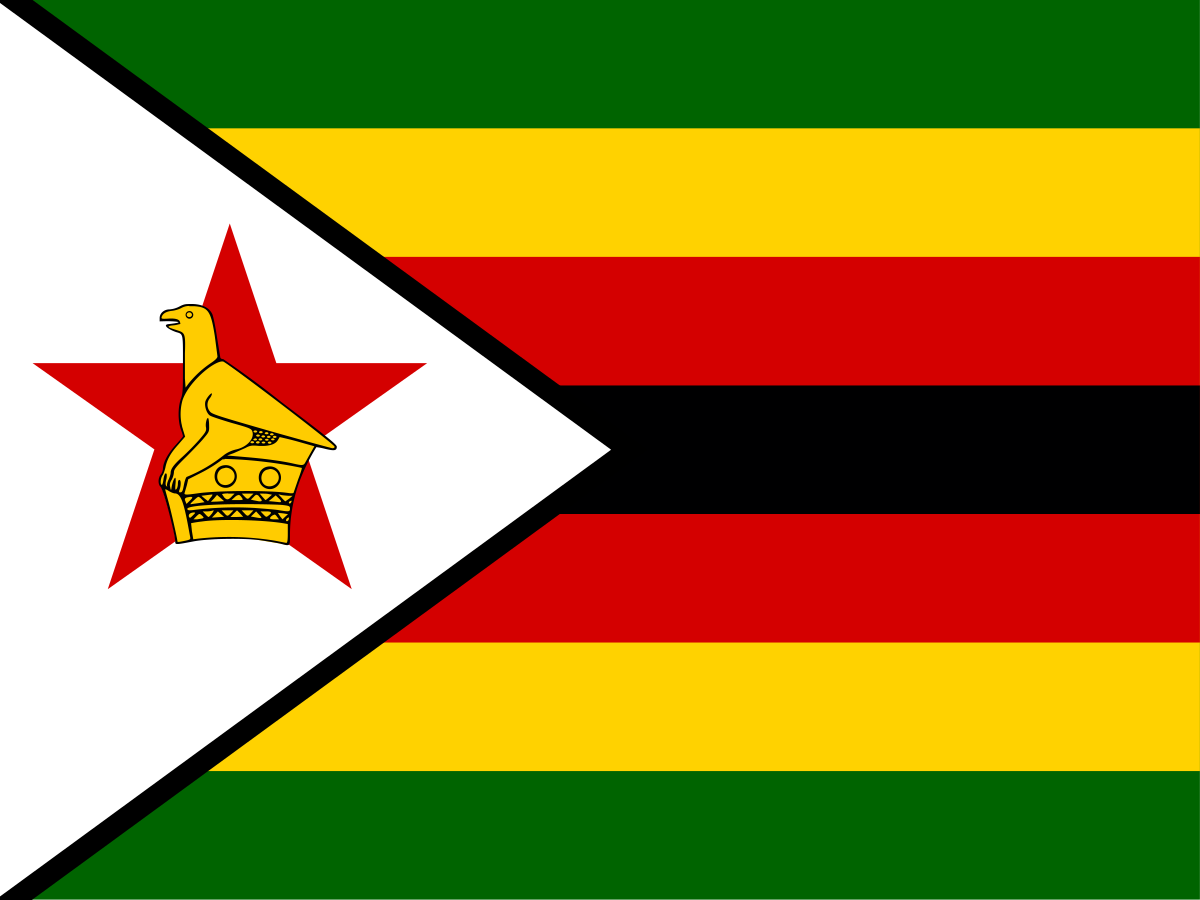
Green represents agriculture, yellow stands for mineral wealth, red symbolises the blood shed for freedom, black represents the majority population. The Zimbabwe Bird is a famous stone carving from Great Zimbabwe. The red star represents socialism.
Capital
Harare
Continent
Africa
Population
15.0 million
Development indicators
GDP per capita
$1,100
USD per year (approx. 2023)
Human Development Index
0.550
Medium development
World Bank income classification
Lower-Middle Income (LMIC)
LMIC
🌡️ Climate: Tropical / Savanna
Flag symbolism
Green represents agriculture, yellow stands for mineral wealth, red symbolises the blood shed for freedom, black represents the majority population. The Zimbabwe Bird is a famous stone carving from Great Zimbabwe. The red star represents socialism.
birdstar
Did you know?
Zimbabwe's Victoria Falls is the world's largest curtain of falling water.
Test your knowledge
Think you know your world flags? Try the FlagAtlas daily challenge, speed quiz, or explore all Africa flags.
📚 Revising for GCSE Geography? Visit our free revision page →
About Zimbabwe
Zimbabwe is a landlocked country in southern Africa, known for its dramatic landscapes, ancient stone ruins, wildlife and the Zambezi River. The country takes its modern name from Great Zimbabwe, the remarkable medieval stone city that became an important symbol of Zimbabwean national identity.
Harare is the capital and largest city. Zimbabwe shares borders with Zambia, Mozambique, South Africa and Botswana and has strong historical and cultural connections with the wider southern African region.
Zimbabwe at a glance
Capital: Harare · Region: Southern Africa · Currency: Zimbabwe Gold (ZiG) · Official languages: 16 officially recognised languages, including English, Shona and Ndebele · Independence: 1980
The flag of Zimbabwe
Zimbabwe's national flag has seven horizontal stripes of green, yellow, red, black, red, yellow and green. A white triangle at the hoist contains a red five-pointed star and the Zimbabwe Bird.
The design combines Pan-African colours with symbols of Zimbabwe's history and independence. The Zimbabwe Bird is based on a stone carving found at Great Zimbabwe and has become one of the country's best-known national symbols.
Flag symbolism
Green represents agriculture and the country's natural resources. Yellow represents mineral wealth. Red represents the blood shed during the struggle for liberation, while black represents the majority population.
The red star represents socialism and the country's revolutionary ideals. The Zimbabwe Bird represents the nation's history and cultural heritage and comes from an ancient stone sculpture associated with Great Zimbabwe.
The Zimbabwe Bird
The Zimbabwe Bird is one of the most distinctive elements of the national flag. It is based on soapstone bird sculptures discovered among the ruins of Great Zimbabwe. The original sculptures are believed to have had important religious or symbolic significance in the medieval society that built the city.
The bird has become a powerful national emblem, appearing on the flag, currency and other official symbols.
Flag history
1890s — British colonial expansionThe territory came under increasing British South Africa Company control and was subsequently known as Southern Rhodesia.
1923 — Self-governing colonySouthern Rhodesia became a self-governing British colony.
1965 — Unilateral declaration of independenceThe government of Rhodesia declared independence from Britain without British approval.
1970s — Liberation warConflict intensified between the Rhodesian government and African nationalist guerrilla movements.
1979 — Lancaster House agreementNegotiations in London helped establish the framework for internationally recognised independence.
1980 — IndependenceZimbabwe became independent on 18 April 1980 and adopted its current national flag.
TodayThe same basic flag design remains the national flag of Zimbabwe.
A short history of Zimbabwe
The territory of modern Zimbabwe has a long history of farming communities, ironworking, trade and powerful kingdoms. Great Zimbabwe flourished between approximately the eleventh and fifteenth centuries and became a major centre of trade and political power.
During the nineteenth century the region experienced major political changes and European expansion. It later became Southern Rhodesia under British colonial rule. After a prolonged liberation struggle and negotiations, Zimbabwe achieved internationally recognised independence in 1980.
History timeline
c. 11th century — Great Zimbabwe developsStone-built settlements grew into a major political and trading centre in the Zimbabwe Plateau.
13th–15th centuries — Great Zimbabwe at its heightGreat Zimbabwe controlled important regional trade networks and became one of the most significant urban centres in southern Africa.
16th–19th centuries — Successor statesPolitical power shifted between different kingdoms and communities, including the Rozvi state and later Ndebele expansion.
1890 — Pioneer ColumnThe British South Africa Company established a major colonial presence in the territory.
1898 — Southern RhodesiaThe name Southern Rhodesia became formally associated with the territory under British administration.
1923 — Self-governmentSouthern Rhodesia became a self-governing British colony.
1953 — Federation of Rhodesia and NyasalandSouthern Rhodesia joined Northern Rhodesia and Nyasaland in a federation.
1963 — Federation dissolvedThe federation ended as nationalist movements grew across the region.
1965 — Unilateral declaration of independenceRhodesia declared independence from Britain, beginning a period of international isolation.
1970s — Liberation struggleThe conflict between the Rhodesian government and nationalist forces intensified.
1979 — Lancaster House agreementPolitical negotiations produced a settlement leading towards internationally recognised independence.
18 April 1980 — Zimbabwe becomes independentThe new Republic of Zimbabwe was internationally recognised and Robert Mugabe became its first prime minister.
1980s — Nation buildingThe new government expanded education and health provision while political tensions and conflict remained serious in some regions.
1990s — Economic and political changeZimbabwe experienced significant economic and political changes, including the introduction of structural reforms.
2000s — Economic crisisLand reform, political conflict, sanctions and economic instability contributed to severe inflation and economic disruption.
2009 — Multi-currency systemZimbabwe abandoned the Zimbabwe dollar for everyday transactions and adopted a multi-currency system dominated by the US dollar.
2017 — Leadership changeRobert Mugabe resigned as president after a period of political and military pressure.
2024 — Zimbabwe GoldA new currency known as Zimbabwe Gold, or ZiG, was introduced as part of efforts to stabilise the monetary system.
Today — Resource-rich countryZimbabwe remains known for mining, agriculture, tourism, wildlife and its major historical sites.
Great Zimbabwe
Great Zimbabwe is one of Africa's most important archaeological sites. Its enormous dry-stone walls and enclosures were built without mortar and formed part of a sophisticated settlement that flourished during the medieval period.
The site is a UNESCO World Heritage Site and gave Zimbabwe its modern name. The Great Enclosure is particularly famous for its massive stone walls and distinctive architectural design.
Victoria Falls
Victoria Falls, known locally as Mosi-oa-Tunya, meaning "The Smoke That Thunders", lies on the Zambezi River on the border between Zimbabwe and Zambia. It is one of the world's greatest waterfalls and a UNESCO World Heritage Site.
The waterfall stretches for roughly 1.7 kilometres and produces an enormous cloud of spray when the Zambezi is flowing strongly.
The Zambezi River
The Zambezi is one of Africa's great rivers and forms part of Zimbabwe's northern frontier. It is central to the country's tourism, wildlife and hydroelectric power resources.
Geography
Zimbabwe is largely made up of elevated plateau country, with higher areas around the central watershed and lower landscapes towards the Zambezi Valley and Limpopo basin. The country contains rivers, grasslands, woodland, rocky hills and large areas of wilderness.
Climate
Zimbabwe has a mainly subtropical climate with distinct wet and dry seasons. Temperatures generally become cooler with altitude, while the low-lying Zambezi Valley is considerably hotter.
Wildlife
Zimbabwe has important populations of elephants, lions, leopards, buffalo, hippos, crocodiles, giraffes and many antelope species. Its national parks and wildlife areas form part of some of southern Africa's most important conservation landscapes.
Hwange National Park
Hwange National Park is Zimbabwe's largest national park and is particularly famous for its large elephant population. The park covers a vast area of woodland and grassland near the country's western border.
Mana Pools
Mana Pools National Park lies along the Zambezi and is renowned for its wildlife, river scenery and walking safaris. It forms part of a UNESCO World Heritage Site together with the Sapi and Chewore safari areas.
People and languages
Zimbabwe is culturally diverse. Shona and Ndebele are among the most widely spoken indigenous languages, while English has a major role in education, government and business. Zimbabwe recognises a broad range of official languages.
Culture and traditions
Music, dance, storytelling, sculpture and stone carving are important parts of Zimbabwean culture. The country's traditional arts include the famous Shona stone sculpture tradition, while ceremonies and community traditions remain important across many parts of the country.
Food
A staple food in Zimbabwe is sadza, a thick maize-meal dish commonly served with vegetables, meat, beans or relish. Maize is central to everyday food and agriculture, while traditional dishes vary between regions and communities.
Economy
Zimbabwe's economy includes mining, agriculture, manufacturing, services and tourism. The country has significant deposits of gold, platinum, lithium, diamonds and other minerals.
Mining and mineral wealth
Mining is particularly important to Zimbabwe's economy. Gold, platinum-group metals, lithium, diamonds and other minerals contribute significantly to exports and government revenue.
A landlocked country
Zimbabwe has no coastline. It shares borders with Zambia, Mozambique, South Africa and Botswana. Despite being landlocked, the country's rivers and its position between major southern African countries have historically made it an important regional crossroads.
Why is Zimbabwe's flag interesting?
Zimbabwe's flag is unusual because it combines seven horizontal stripes with a white triangular section containing both a star and the Zimbabwe Bird. The bird connects the modern republic directly with the medieval civilisation represented by Great Zimbabwe.
Explore Zimbabwe on FlagAtlas
Continue exploring Zimbabwe and the world's flags with these FlagAtlas resources.