Caribbean
Cayman Islands Flag
Explore the Cayman Islands flag history, symbolism, geography and facts — the blue ensign with the Union Jack and a coat of arms whose three stars stand for the three islands of the western Caribbean.
Capital
George Town
Region
Caribbean
Population
70,000
Status & key facts
Political status
Overseas Territory
Self-governing internally
Currency
Cayman Islands dollar
KYD — pegged to US$
Sovereign state
United Kingdom
British Overseas Territory
🌡️ Climate: Tropical — warm and humid year-round, with a wet season and a hurricane risk from June to November
Flag symbolism
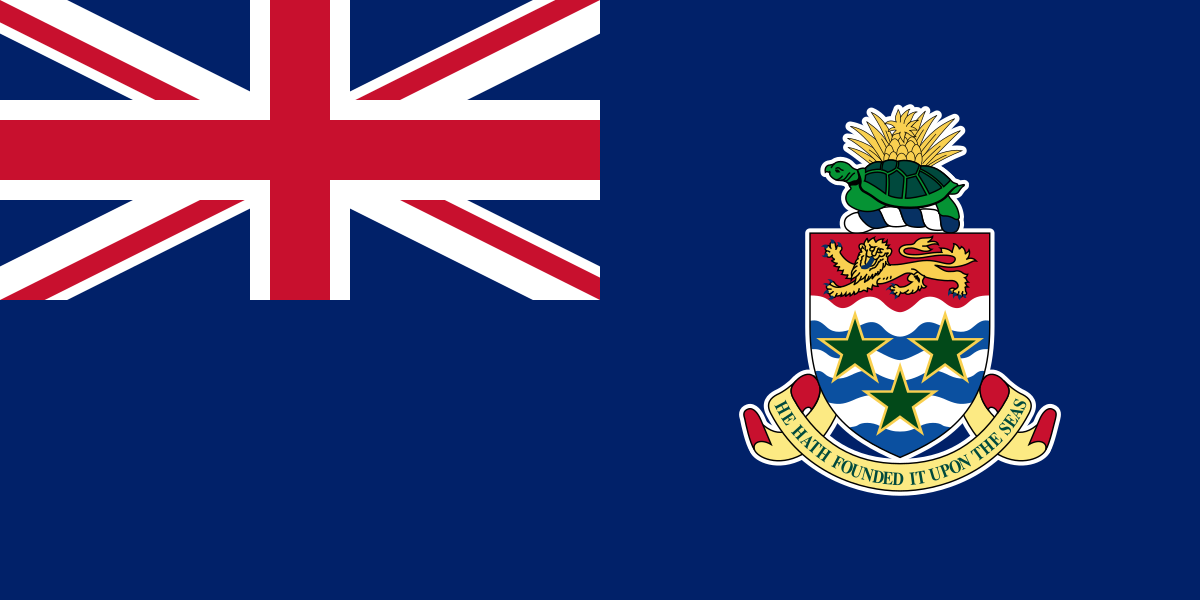
A dark blue "ensign" with the Union Jack in the upper hoist and the territory's coat of arms in the fly. On the shield, three green stars stand for the three islands, set above a wavy blue-and-white sea, beneath a gold lion.
blue ensignthree starsturtle
Did you know?
Christopher Columbus first named the islands Las Tortugas — "the turtles" — for the sea turtles he saw there, which is why a turtle sits at the top of the coat of arms on the flag.
Test your knowledge
Think you know your world flags? Try the FlagAtlas daily challenge, speed quiz, or explore all the territory flags.
📚 Revising for GCSE Geography? Visit our free revision page →
About the Cayman Islands
The Cayman Islands are a British Overseas Territory in the western Caribbean Sea, lying south of Cuba and north-west of Jamaica. The territory is made up of three islands: Grand Cayman, much the largest and home to the capital, together with the smaller Cayman Brac and Little Cayman to the north-east.
The Cayman Islands are self-governing in their internal affairs, with the reigning British monarch as head of state represented by a Governor, while the United Kingdom is responsible for defence and foreign affairs. George Town, on Grand Cayman, is the capital, and the local currency is the Cayman Islands dollar.
CapitalGeorge Town
RegionCaribbean
PopulationAbout 70,000
Area264 km²
CurrencyCayman Islands dollar (KYD)
LanguageEnglish
The flag of the Cayman Islands
The flag is a British Blue Ensign — a dark blue field with the Union Jack in the canton — defaced in the fly with the territory's coat of arms.
What the arms show.
The shield carries three green stars, one for each island, floating above wavy blue and white lines that represent the sea, with a gold lion on a red band at the top for the link with Britain. Above the shield sit a green turtle and a pineapple, and below runs the motto He hath founded it upon the seas.
The motto is taken from Psalm 24 and reflects the islands' seafaring history and their setting in the Caribbean.
The turtle, the stars and the motto
Almost every part of the arms points to the islands and the sea. The three stars are the three islands; the wavy blue and white is the Caribbean; the turtle recalls both the islands' old name, Las Tortugas, and their long history of turtling; and the pineapple reflects the historic link with Jamaica, with which the islands were once governed.
The gold lion at the top of the shield stands for the United Kingdom, while the motto He hath founded it upon the seas ties the whole design to the ocean that surrounds and sustains the islands.
A short history of the Cayman Islands
Christopher Columbus sighted the islands in 1503 and named them Las Tortugas after the many sea turtles in the surrounding waters. The name "Cayman" came later, from a word for the caiman or crocodile. The islands were uninhabited when Europeans arrived and were gradually settled, largely by people from Jamaica.
For much of their history the Cayman Islands were administered together with Jamaica. When Jamaica became independent in 1962, the Cayman Islands chose to remain under the British Crown and became a separate territory.
In the later twentieth century the islands developed into one of the world's leading offshore financial centres, and, together with tourism, this transformed them into one of the wealthier territories in the Caribbean.
The Cayman Islands flag's history
The flag follows the standard British ensign pattern, personalised with the islands' own arms.
1958 — the coat of armsThe Cayman Islands were granted their own coat of arms.
1959 — the flagThe Blue Ensign defaced with the arms came into use as the flag of the islands.
TodayThe blue ensign with the three-starred arms represents the Cayman Islands.
Geography of the Cayman Islands
The three Cayman Islands are low-lying and flat, formed from coral and limestone rather than volcanic rock. Grand Cayman is famous for Seven Mile Beach and for the shallow, clear waters that have made the territory one of the world's premier scuba-diving destinations.
The islands' neighbours
Cuba lies to the north and Jamaica to the south-east, with the deep waters of the Cayman Trench — the deepest point in the Caribbean Sea — running just to the south of the islands.
People, language and culture
English is the official language, and the population is unusually international, with a large share of residents drawn from around the world by the islands' finance and tourism industries. Traditional Caymanian culture is rooted in the sea — in fishing, turtling and boatbuilding.
The green sea turtle remains a national symbol, celebrated on the flag and cared for at the islands' turtle centre, and the surrounding reefs and wall dives draw visitors from across the globe.
The Cayman Islands today
The Cayman Islands govern their own domestic affairs through an elected parliament and government, with a Governor representing the Crown. The territory is one of the largest offshore financial centres in the world, home to many banks and investment funds, and this — with high-end tourism — underpins a high standard of living.
As a British Overseas Territory, the Cayman Islands remain under UK sovereignty for defence and foreign affairs while managing their internal affairs themselves.
Explore the Cayman Islands on FlagAtlas
Continue exploring the Cayman Islands and the world's flags with these FlagAtlas resources.
Sources & further reading
This page combines the information already present on the FlagAtlas Cayman Islands page with additional context. Statistics such as population and area are dated because they can change over time.
Encyclopaedia Britannica — Cayman Islands