South Atlantic
Falkland Islands Flag
Explore the Falkland Islands flag history, symbolism, geography and facts — the blue ensign with the Union Jack and a coat of arms showing a ram and the ship Desire, on windswept islands in the South Atlantic.
Capital
Stanley
Region
South Atlantic
Population
3,600
Status & key facts
Political status
Overseas Territory
Self-governing internally
Currency
Falkland Islands pound
At par with £ sterling
Sovereign state
United Kingdom (claimed by Argentina)
British Overseas Territory
🌡️ Climate: Cool oceanic — windy and cloudy, with mild summers and cold winters, more like Scotland than the tropics
Flag symbolism
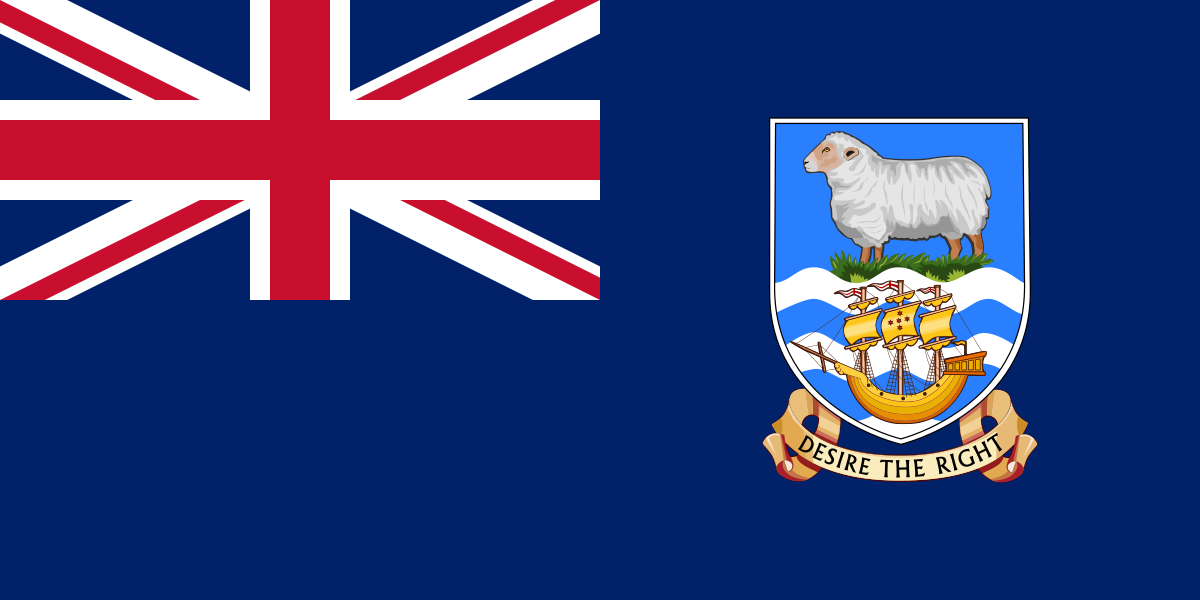
A dark blue "ensign" with the Union Jack in the upper hoist and the territory's coat of arms in the fly. The arms show a white ram above a sailing ship, the Desire, on the sea, with the motto Desire the Right below.
blue ensignramDesire the Right
Did you know?
The ram on the arms reflects the islands' sheep-farming history — for much of their modern history the Falklands had far more sheep than people — and the motto "Desire the Right" is a play on the name of the ship Desire.
Test your knowledge
Think you know your world flags? Try the FlagAtlas daily challenge, speed quiz, or explore all the territory flags.
📚 Revising for GCSE Geography? Visit our free revision page →
About the Falkland Islands
The Falkland Islands are a British Overseas Territory in the South Atlantic Ocean, lying around 500 kilometres off the southern coast of South America. The territory is made up of two main islands, East Falkland and West Falkland, together with hundreds of smaller islands, and is known for its rugged moorland, rocky coasts and abundant wildlife.
The islands are self-governing in their internal affairs, with the reigning British monarch as head of state represented by a Governor, while the United Kingdom is responsible for defence and foreign affairs. Stanley, on East Falkland, is the capital, and the local currency is the Falkland Islands pound, at par with pound sterling.
CapitalStanley
RegionSouth Atlantic
PopulationAbout 3,600
Area12,173 km²
CurrencyFalkland Islands pound (= GBP)
LanguageEnglish
The flag of the Falkland Islands
The flag is a British Blue Ensign — a dark blue field with the Union Jack in the canton — defaced in the fly with the territory's coat of arms.
What the arms show.
A white ram stands above a blue-and-white sea on which sails a small ship, the Desire. Below runs a scroll with the motto Desire the Right. The ram represents sheep farming, long the mainstay of the islands' economy, and the ship recalls their European discovery.
The Blue Ensign bearing this badge has represented the Falkland Islands since 1948.
The ram and the ship Desire
The ship on the arms is the Desire, captained by the English navigator John Davis, who is credited with the European sighting of the islands in 1592. The territory's motto, Desire the Right, is a play on the ship's name.
The ram speaks to the islands' way of life. From the nineteenth century the Falklands were built around sheep farming and the export of wool, and sheep long outnumbered people many times over — a fact that makes the ram one of the most fitting emblems on any flag.
A short history of the Falkland Islands
The islands had no native population. After early European sightings — including that credited to John Davis in 1592 — French, British and Spanish settlements came and went during the eighteenth century. Britain established continuous administration from 1833, and the islands developed into a British sheep-farming colony.
Argentina also claims the islands, which it calls the Islas Malvinas. In 1982 Argentine forces occupied the islands, leading to the Falklands War, after which British control was restored. In a referendum held in 2013, Falkland Islanders voted almost unanimously to remain a British Overseas Territory. FlagAtlas notes these competing positions without taking a side.
Today the Falkland Islands are a self-governing British Overseas Territory with an economy based on fishing, tourism, sheep farming and, potentially, offshore energy.
The Falkland Islands flag's history
The flag follows the standard British ensign pattern, distinguished by the islands' own arms.
British colonial eraThe islands used British ensigns as part of the wider colonial flag tradition.
1948 — the flagThe Blue Ensign defaced with the ram-and-ship arms was adopted as the flag of the islands.
TodayThe blue ensign with the coat of arms represents the Falkland Islands.
Geography of the Falkland Islands
The Falklands lie on the edge of the Patagonian continental shelf in the South Atlantic. The landscape is one of low hills, peat moorland and deeply indented coasts, with a cool, wind-swept climate closer to that of the Scottish islands than to anywhere tropical. Trees are rare, and much of the land is open grazing.
The islands' setting
South America lies about 500 kilometres to the west, and the Antarctic Peninsula lies far to the south. The surrounding seas are exceptionally rich in wildlife, supporting large colonies of penguins, albatrosses, seals and sea lions.
People, language and culture
English is the official and everyday language, and the population — though small — is a close-knit community, with many families able to trace their roots on the islands back several generations. Life has long been shaped by farming, the sea and the weather.
Wildlife is central to the islands' identity and to their growing tourism industry: the Falklands are one of the best places in the world to see penguins, and cruise ships and naturalists are drawn by the vast seabird and marine-mammal colonies.
The Falkland Islands today
The Falkland Islands govern their own domestic affairs through an elected assembly, with a Governor representing the Crown. The modern economy rests mainly on the sale of fishing licences — especially for squid — along with tourism, sheep farming and the prospect of offshore oil and gas.
As a British Overseas Territory, the Falklands remain under UK sovereignty for defence and foreign affairs while running their internal affairs themselves.
Explore the Falkland Islands on FlagAtlas
Continue exploring the Falkland Islands and the world's flags with these FlagAtlas resources.
Sources & further reading
This page combines the information already present on the FlagAtlas Falkland Islands page with additional context. Statistics such as population and area are dated because they can change over time.
Encyclopaedia Britannica — Falkland Islands