Crown Dependency
Guernsey Flag
Explore Guernsey's flag history, symbolism, geography and facts — the red cross of Saint George with a gold cross at its centre, on the second-largest of the Channel Islands off the coast of France.
Capital
Saint Peter Port
Region
Channel Islands
Population
63,000
Status & key facts
Political status
Crown Dependency
Self-governing
Currency
Guernsey pound
At par with £ sterling
Relationship to the UK
Not part of the UK; UK handles defence & foreign affairs
British Crown Dependency
🌡️ Climate: Temperate maritime — mild and sunny, tempered by the surrounding sea
Flag symbolism
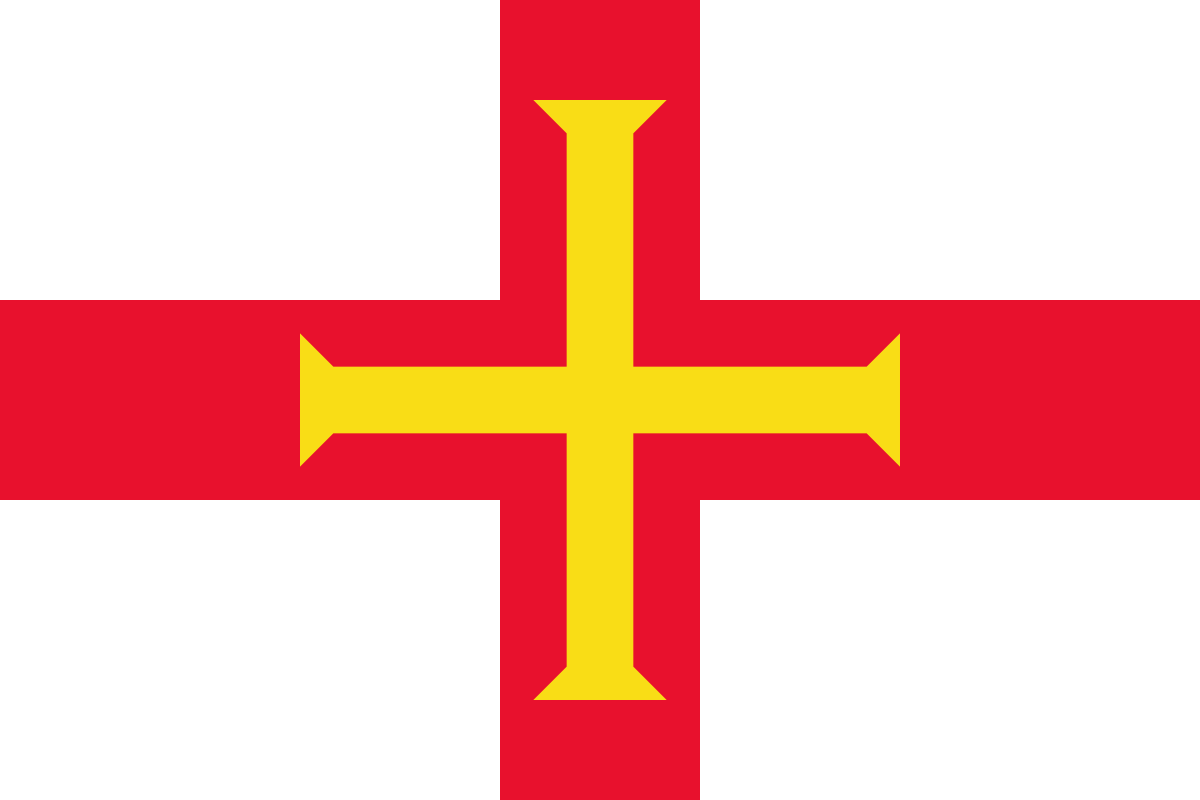
A white field bearing the red cross of Saint George, with a narrower gold cross laid over it. The gold cross is said to represent the one reputedly carried by William the Conqueror, Duke of Normandy, at the Battle of Hastings.
St George's crossgold cross1066
Did you know?
Until 1985 Guernsey simply used the plain red-on-white cross of Saint George — identical to England's flag. The gold cross was added to give the island a flag of its own.
Test your knowledge
Think you know your world flags? Try the FlagAtlas daily challenge, speed quiz, or explore all the territory flags.
📚 Revising for GCSE Geography? Visit our free revision page →
About Guernsey
Guernsey is the second-largest of the Channel Islands, lying in the English Channel off the coast of Normandy in France. It gives its name to the Bailiwick of Guernsey, which also includes Alderney, Sark, Herm and other smaller islands. Guernsey is a British Crown Dependency — self-governing, and not part of the United Kingdom or the European Union.
Saint Peter Port is the capital and main harbour. The reigning British monarch is head of state, and the United Kingdom is responsible for the island's defence and foreign affairs. Guernsey issues its own currency, the Guernsey pound, at par with pound sterling.
CapitalSaint Peter Port
RegionChannel Islands
PopulationAbout 63,000
Area65 km²
CurrencyGuernsey pound (= GBP)
LanguageEnglish; Guernésiais
The flag of Guernsey
Guernsey's flag is a white field with the red cross of Saint George reaching to the edges, and a slimmer gold (yellow) cross placed within it. This gold cross is what sets Guernsey's flag apart from the plain English flag it once shared.
A flag to end the confusion.
Because Guernsey had long used the plain cross of Saint George — the same as England — its flag was easily confused. In 1985 a gold cross was added, drawn from a symbol associated with William the Conqueror, giving the island a distinct flag of its own.
The gold cross is often called the "Cross of Goldan," and links the island's flag to its Norman heritage and the events of 1066.
The gold cross of William the Conqueror
The distinctive gold cross is said to represent a cross reputedly carried on the banner of William, Duke of Normandy — later William the Conqueror — at the Battle of Hastings in 1066. As Guernsey was part of the Duchy of Normandy, the symbol ties the island directly to that history.
When Guernsey decided to update its flag in the 1980s, this gold cross was chosen precisely because it rooted the new design in the island's own Norman past rather than simply copying another flag. The result, adopted in 1985, is one of the more unusual flags in the British Isles.
A short history of Guernsey
Guernsey was part of the Duchy of Normandy, and came under the same ruler as England after Duke William's conquest in 1066. When King John lost mainland Normandy to France in 1204, the Channel Islands remained loyal to the English crown, and have been attached to it ever since as a remnant of the medieval duchy.
The island developed its own parliament and legal system over the centuries. During the Second World War, Guernsey — like the other Channel Islands — was occupied by German forces from 1940 to 1945, the only British soil to be occupied during the war.
Today Guernsey is a prosperous, self-governing Crown Dependency, well known as an international finance centre.
The Guernsey flag's history
Guernsey's flag changed from a plain saint's cross into a distinctive national design within living memory.
Before 1985Guernsey used the plain red cross of Saint George — the same as England's flag.
1985 — official flagA gold cross was added within the red cross, adopted as the island's own flag.
TodayThe red-and-gold cross flies across Guernsey and represents the Bailiwick.
Geography of Guernsey
Guernsey is a small island of roughly 65 square kilometres, with high cliffs along its south coast falling to lower, sandier ground in the north. Its position in the Gulf of Saint-Malo gives it a mild climate and one of the largest tidal ranges anywhere in the world.
Guernsey's neighbours
The Normandy coast of France lies to the east and south, with Jersey — the largest Channel Island — to the south-east. The smaller islands of the Bailiwick, including Alderney, Herm and Sark, lie close by.
People, language and culture
English is the everyday language, while the island's traditional Norman language, Guernésiais, survives among a small number of speakers, and French historically had an official role. The island's Norman heritage is visible in its place-names and customs.
The French writer Victor Hugo spent much of his exile in Saint Peter Port, at Hauteville House, where he completed Les Misérables. Guernsey also gives its name to the Guernsey breed of dairy cattle and to the knitted "guernsey" sweater.
Guernsey today
Guernsey governs itself through the States of Guernsey, its parliament, and manages its own domestic affairs. Financial services form the core of its economy, alongside tourism, horticulture and specialist industries.
As a Crown Dependency, Guernsey sits outside both the United Kingdom and the European Union, while keeping close ties to each.
Explore Guernsey on FlagAtlas
Continue exploring Guernsey and the world's flags with these FlagAtlas resources.
Sources & further reading
This page combines the information already present on the FlagAtlas Guernsey page with additional context. Statistics such as population and area are dated because they can change over time.
Encyclopaedia Britannica — Guernsey