France before the Tricolour
Before the French Revolution, France did not have a modern national flag in the same sense that countries do today. Flags and banners were closely connected with the monarchy, royal authority, military forces and individual regiments.
White was strongly associated with the Bourbon monarchy. Different military and naval flags existed, and the appearance of flags could vary according to their purpose.
The Revolution changed this relationship between symbols and political identity. A new visual language emerged in which colours and emblems increasingly represented the French nation and its citizens, rather than simply the ruling dynasty.
The French Revolution begins
The French Revolution began in 1789 amid a severe political, social and financial crisis. The meeting of the Estates-General, the formation of the National Assembly and the storming of the Bastille on 14 July 1789 marked the beginning of a period that would transform France.
In Paris, revolutionary politics quickly produced a need for new symbols. People needed visible signs of allegiance to the city, the National Guard and the revolutionary movement.
This was the environment in which the three colours that would become France's national flag first came together.
Blue and red — the colours of Paris
Blue and red were the traditional colours of Paris. During the early Revolution they became strongly associated with the revolutionary city and its new political forces.
The National Guard in Paris used a blue-and-red cockade. A cockade was a circular badge or ribbon worn on clothing or a hat and became an important political symbol during the Revolution.
Where did the white come from?
White was traditionally associated with the French monarchy, particularly the Bourbon royal family.
During the early Revolution, the addition of white to the blue and red of Paris created a combination that could symbolise a new political relationship between the nation and the monarchy.
The French presidency describes the Tricolour as originating in the union of the King's white with the blue and red of Paris.
Lafayette and the Tricolour cockade
Gilbert du Motier, Marquis de Lafayette became commander of the Paris National Guard during the Revolution.
Traditional accounts associate Lafayette with the addition of the royal white to the blue-and-red Paris cockade. The French presidency describes Louis XVI's visit to Paris on 17 July 1789, when the king appeared with the blue-and-red cockade and, according to the traditional account, Lafayette had added the royal white.
Whether every detail of the story happened exactly as later tradition describes is uncertain. What is clear is that the three colours rapidly became a major symbol of the Revolution and the emerging French nation.
From cockade to flag
The Tricolour initially existed most visibly as a cockade, rather than the familiar rectangular flag.
During the summer of 1789 the three colours spread through Paris and beyond. They appeared on ribbons, clothing, banners and other forms of political display.
By the Fête de la Fédération on 14 July 1790, the three colours had become strongly established as symbols of the French nation. Contemporary and later sources describe this event as an important stage in the development of the Tricolour.
The first Tricolour flags
The early flag designs did not immediately have the exact appearance of the modern French flag.
In 1790 the French authorities introduced a naval flag using three vertical colours, although the arrangement differed from today's version. The vertical format also helped distinguish the French design from the red-white-blue horizontal flag of the Netherlands.
The Tricolour was therefore not created in one single moment. It evolved through several stages between the revolutionary cockade of 1789 and the definitive national flag of 1794.
1794 — the definitive French flag
On 15 February 1794 (27 Pluviôse Year II), the National Convention formally established the Tricolour as the French national flag.
The law specified three vertical bands of blue, white and red, with blue nearest the flagpole, white in the centre and red at the fly end.
This is essentially the design of the modern French flag. The French presidency records the 1794 law as the point at which the Tricolour was established as the national flag.
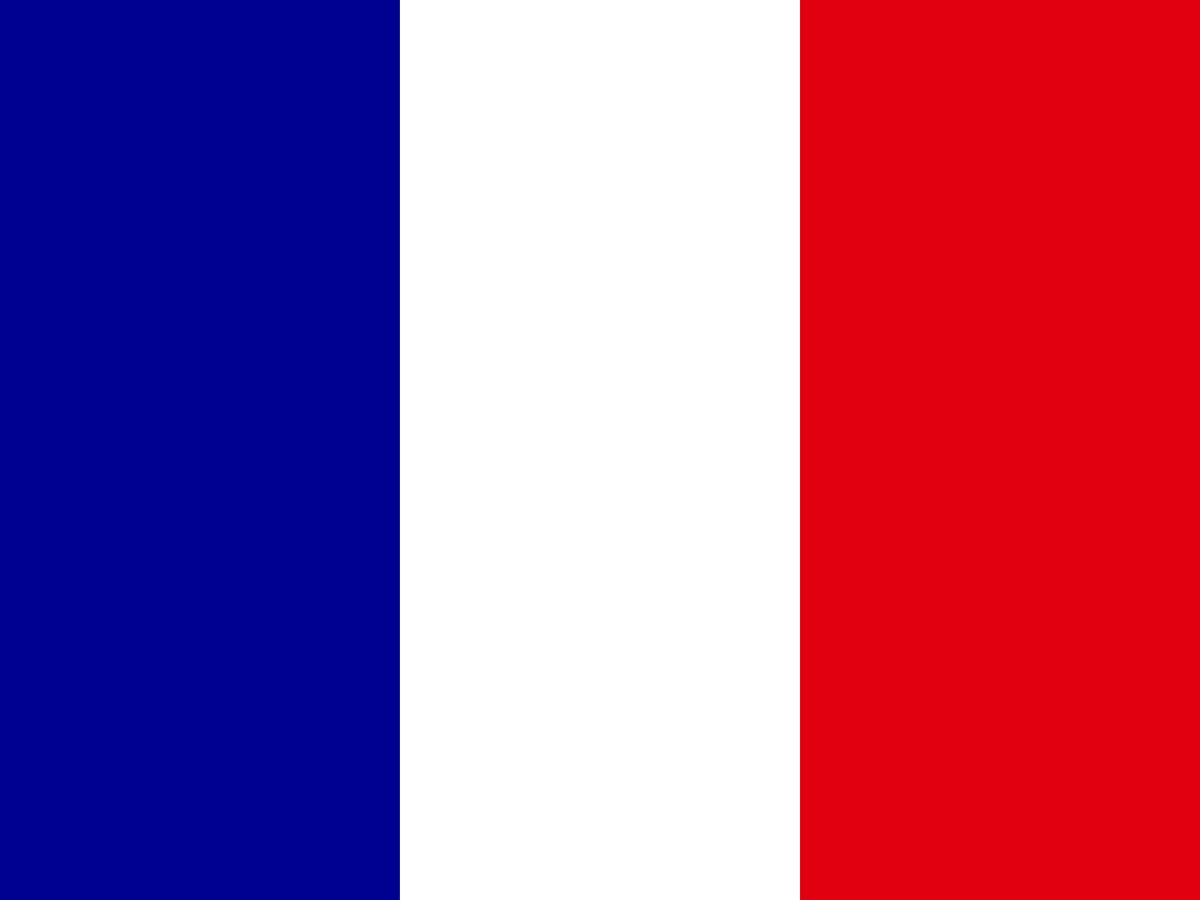
Why are the colours vertical?
The vertical arrangement helped distinguish the French flag from other European flags, particularly the Dutch red-white-blue horizontal tricolour.
France's use of three equal vertical bands also created an extremely simple design. It could be reproduced easily and recognised at a distance.
The final order — blue, white, red from the hoist to the fly — was established by the 1794 decree.
Did the colours originally have fixed meanings?
You will often see explanations saying that blue represents liberty, white represents the monarchy and red represents the people, or that the colours have other specific meanings.
The historical picture is more complicated. Official French sources explain the colours through the relationship between Paris's blue and red and the monarchy's white, while also noting that later symbolic interpretations developed around the flag.
For FlagAtlas, it is more accurate to distinguish the documented historical origins of the colours from later interpretations of what each colour represents.
The Tricolour under Napoleon
After the Revolution, Napoleon Bonaparte adopted the Tricolour as the flag of France and used it extensively with his armies and imperial government.
The flag became closely associated with French military power across Europe. Its simplicity made it highly effective as a military and national symbol.
By this stage the Tricolour had become much more than a revolutionary emblem. It was increasingly recognised internationally as the flag of France.
The Bourbon Restoration — the white flag returns
When the Bourbon monarchy was restored in 1814, the Tricolour was rejected as a symbol of the Revolution and Empire.
The royal government returned to a plain white flag, strongly associated with the Bourbon monarchy.
This lasted, with interruptions, until the July Revolution of 1830. The struggle between the white royal flag and the Tricolour demonstrated how strongly flags had become connected with competing political visions of France.
The Revolution of 1830 restores the Tricolour
In July 1830, the Three Glorious Days overthrew King Charles X.
The blue, white and red flag appeared again on the barricades as a symbol of opposition to the Bourbon regime. The new constitutional monarch, Louis-Philippe, restored the Tricolour as the national flag.
The French presidency describes the restoration of the blue-white-red flag in 1830 as a major moment in its permanent return to French national life.
The 1848 Revolution and the red flag
The Tricolour faced another challenge during the Revolution of 1848.
Some revolutionaries demanded an entirely red flag as a symbol of the new revolutionary movement. The provisional government initially adopted the Tricolour, but crowds on the barricades called for the red flag.
Politician and poet Alphonse de Lamartine argued strongly against replacing the national Tricolour with the red flag. The Tricolour survived and remained the national symbol of France.
The Third Republic makes the Tricolour permanent
During the Third Republic, the Tricolour gradually became accepted across a much wider range of French political opinion.
From the late nineteenth century it became increasingly associated with national ceremonies, military traditions and public life rather than with one particular revolutionary faction.
Official French sources describe the three colours as becoming firmly established as national symbols during this period.
The Tricolour today
The French Tricolour is the national emblem of France. Article 2 of the Constitution of the Fifth Republic states that the national emblem is the blue, white and red Tricolour flag.
It is flown from public buildings, used at official ceremonies and displayed during national commemorations. It is also widely used by French sporting teams and by people expressing national identity.
The flag's modern meaning is therefore broader than its revolutionary origins: it represents the French nation and the Republic.
Why the French Tricolour changed flag history
The importance of the French Tricolour goes beyond France itself.
The French Revolution helped popularise the idea that a simple flag could represent a nation, political ideals and ordinary citizens rather than merely a monarch.
During the nineteenth century, national movements across Europe and beyond increasingly adopted simple colour combinations and geometric designs. The Tricolour became one of the great models of modern national flag design.
The Tricolour and other three-colour flags
France is one of several countries whose national flags use three colours, but the French design is particularly influential because of its association with the Revolution and modern nationalism.
Other tricolours developed independently or under different historical influences. For example, Italy's green-white-red flag shares the vertical three-band format, while Ireland's green-white-orange flag also uses three vertical bands but has a very different historical story.
It is important not to assume that every three-colour flag is directly copied from France. Flag design spreads through many overlapping political, cultural and historical influences.
France, liberty and national identity
The Tricolour became closely associated with the political legacy of the French Revolution, including ideas of citizenship, national sovereignty and republican government.
France's national motto, Liberté, Égalité, Fraternité — Liberty, Equality, Fraternity — belongs to the same wider tradition of republican symbolism, although the motto and flag have separate histories.
The modern French flag therefore carries several layers of meaning: revolutionary history, national identity, republican institutions and the continuity of the French state.
A short history timeline
Before 1789
French flags and banners are closely connected with the monarchy, royal authority, military units and dynasties.
July 1789
Blue and red Paris colours are combined with royal white in the revolutionary cockade tradition. The three colours rapidly become associated with the emerging nation.
14 July 1790
The Fête de la Fédération helps establish the Tricolour as a major national symbol.
1790
Three-colour vertical naval flags are introduced, although their colour arrangement differs from the modern flag.
15 February 1794
The definitive blue-white-red vertical Tricolour is established as the French national flag.
1814–1830
The Bourbon Restoration replaces the Tricolour with the royal white flag.
1830
The July Revolution restores the blue, white and red Tricolour.
1848
The Tricolour survives another revolutionary challenge when supporters of a red flag demand its replacement.
20th century
The Tricolour becomes an established symbol of the French Republic and remains central to national ceremonies.
Today
Article 2 of the Constitution of the Fifth Republic defines the blue, white and red Tricolour as France's national emblem.
Why the Tricolour matters to FlagAtlas
The French flag marks an important change in the history of flags.
Medieval banners were often symbols of rulers, dynasties, armies or heraldic families. The Tricolour emerged from a revolution in which the idea of the nation as a political community became increasingly important.
That makes the French Revolution a key point in the story of how flags changed from medieval banners into the national flags we recognise today.
Explore more Flag History
Sources & further reading
This article uses official French government and presidential sources for the documented development of the Tricolour, while distinguishing later traditions and legends from points that are more securely established.
Further reading: Élysée — The French Flag, French Government — The history of the Tricolour, and DILA — Symbols of the French Republic.