There are only so many colours and simple shapes that work well on a flag, so lookalikes are almost inevitable. Sometimes it is pure coincidence (Chad and Romania). Sometimes it is shared history or a family of colours adopted on purpose (the red-white-blue of the Slavic nations, the red-gold-green of Africa). And even when two flags look the same, the meaning behind the colours is often completely different.
Chad and Romania
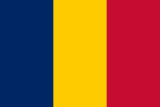
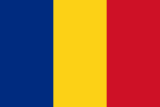
These are widely considered the two most similar national flags in the world. Both are vertical tricolours of blue, yellow and red, in the same order, in the same 2:3 proportion, with no crest or emblem to separate them. Placed side by side, even trained vexillologists have to look twice.
The remarkable thing is that the resemblance is pure coincidence — two completely independent design processes that happened to arrive at the same result more than a century apart. Romania's tricolour is the older of the two: it grew out of the revolutionary movements of 1848 and was formally fixed in the 1860s, its colours drawn from the country's historical provinces of Wallachia, Moldavia and Transylvania. Chad's flag came much later, adopted in 1959 as the country approached independence from France. Its first design used a green stripe, following the pan-African colours — but that looked too much like the flag of neighbouring Mali. Chad swapped the green for blue, and in doing so unknowingly created a near-twin of Romania's flag.
The similarity has even caused friction: in 2004 Chad raised the matter at the United Nations, but Romania declined to change a flag it had used since the 19th century. Neither country has budged. And despite the identical appearance, the colours tell different stories — for Chad, blue is the sky and hope, yellow the sun and the desert, and red the blood shed for independence. You can compare them yourself on the Chad and Romania flag pages.
Indonesia and Monaco
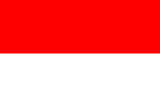
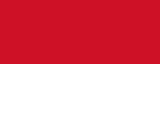
Indonesia and Monaco both fly a simple horizontal bicolour — a red band above a white one — and at a glance they are the same flag. The clearest difference is the proportion: Indonesia's flag is a taller 2:3, while Monaco's is a shorter, squarer 4:5. (Poland's flag uses the very same two colours in the opposite order, white above red, which is why it sometimes joins the confusion.)
Here the resemblance is coincidence rather than copying, and both sets of colours are surprisingly old. Monaco's red and white are the heraldic colours of the House of Grimaldi, the family that has ruled the principality since the end of the 13th century; the flag took its current form in 1881. Indonesia's red-and-white — Sang Saka Merah-Putih, "the lofty red and white" — traces back centuries to the banners of the Majapahit empire, and was raised as the national flag when Indonesia declared independence in 1945. Two very different places, each drawing on its own deep history, arriving at the same two stripes.
Ireland and Côte d'Ivoire

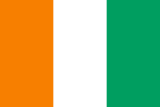
These two share the same three colours — green, white and orange — but in reversed order, which is the giveaway. Ireland places green nearest the flagpole and orange on the outside; Côte d'Ivoire (Ivory Coast) does the opposite, with orange at the hoist and green on the fly. Their proportions differ too: Ireland's flag is a long 1:2, while Côte d'Ivoire's is 2:3.
The meanings are entirely their own. In Ireland, green represents the Gaelic and Catholic tradition, orange represents the country's Protestant community (the followers of William of Orange), and the white between them stands for lasting peace between the two. In Côte d'Ivoire, the colours are read quite differently: orange for the northern savanna and the nation's growth, white for peace and its rivers, and green for the southern forests and hope for the future. Same palette, completely different symbolism.
Netherlands and Luxembourg
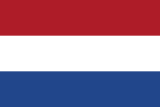
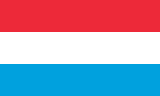
Both are horizontal red-white-blue tricolours, and this is a case where the similarity really does come from shared history. Luxembourg was joined with the Netherlands for much of the 19th century, and its colours derive from the same regional heraldry. The differences are subtle: Luxembourg's blue is a lighter sky blue and its flag is longer and thinner, while the Netherlands uses a deeper cobalt blue in a squarer 2:3. The resemblance is close enough that Luxembourg has, in recent decades, promoted an alternative "Red Lion" flag partly to give itself a more distinctive national symbol.
Why does this happen?
Two forces are usually at work. The first is simple mathematics. A flag has to read clearly from a distance and be easy to reproduce, so most stick to a handful of bold colours and a few simple layouts — vertical stripes, horizontal stripes, a cross, a canton. With so few workable combinations, accidental collisions become almost inevitable once a design is plain enough. That is exactly how Chad and Romania ended up as twins.
The second force is shared meaning. Many countries deliberately adopt a common family of colours to signal a shared identity. The red, white and blue of the Pan-Slavic nations (Russia, Serbia, Slovakia, Slovenia and others) all trace back to a single 1848 congress. The red, black, white and green of the Pan-Arab flags (Egypt, Iraq, Syria, Jordan, Sudan, Yemen) share a common origin. The red, gold and green of many Pan-African flags (Ghana, Mali, Senegal, Guinea, Cameroon) were taken from Ethiopia, Africa's great symbol of independence. And the Nordic cross unites the flags of Scandinavia. In each case the similarity is the whole point — it says "we belong together."
Similarity does not mean identical meaning
This is the key thing to remember: two flags can look the same and mean completely different things. A colour that stands for one idea in one country can stand for something unrelated in another. Chad's blue is the sky; Romania's comes from a historical province. Ireland's orange represents a religious community; Côte d'Ivoire's orange represents the savanna. Red might mean revolution in one flag, the blood of those who died for freedom in another, and simple courage in a third; green might mean Islam, or forests, or hope.
So a lookalike flag is rarely a copy — it is usually either a coincidence of simple design, or a deliberate nod to a shared history. The best way to tell two similar flags apart isn't just the colours, but the story behind them.
Frequently asked questions
Why do Chad and Romania have the same flag?
It's a coincidence. Romania's tricolour dates from the 19th century; Chad adopted its flag in 1959, swapping an original green stripe for blue to avoid looking like Mali's flag — which happened to make it almost identical to Romania's. Neither copied the other, and both have refused to change.
Which two national flags are the most similar in the world?
Chad and Romania — both vertical blue-yellow-red tricolours in the same order and proportion, distinguished only by a slightly different shade of blue.
Did Chad copy Romania's flag?
No. There's no evidence either country knew of the other's flag when designing its own; the match is accidental, arrived at more than a century apart.
What is the difference between the Indonesia and Monaco flags?
Both are red over white. The main difference is proportion — Indonesia is a taller 2:3, Monaco a squarer 4:5 — and the colours come from completely different histories.
Are the flags of Ireland and Côte d'Ivoire the same?
No — same three colours, reversed order. Ireland has green at the hoist and orange on the fly; Côte d'Ivoire is the other way around, with different proportions and different meanings.