The world's flags include dragons, birds, weapons, maps, whole star-fields — and even one that isn't a rectangle. What makes a flag unusual is almost always the story behind the design.
1. Nepal — the only non-rectangular flag
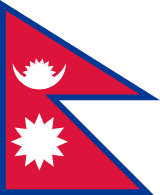
Nepal's flag is the only national flag on Earth that isn't a rectangle. It's built from two stacked triangular pennons, carries a moon and a sun on a crimson field, and has a deep-blue border, with its exact construction written into the country's constitution. The two peaks are often linked to the Himalayas, and the sun and moon to the hope that Nepal will endure as long as they do. It's probably the easiest flag in the world to recognise from its outline alone.
2. Switzerland — a square flag
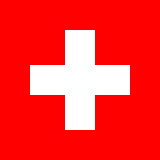
Almost every flag is longer than it is tall — but Switzerland's is a perfect square, a bold white cross on red. It's one of only two square national flags in the world, the other being Vatican City. (A rectangular version of the Swiss flag is used at sea, where square ensigns are impractical.) Its clean geometry even inspired the Red Cross emblem, which simply reverses the colours.
3. Qatar — the longest flag

Qatar's flag is unusual in two ways at once. It's an unmistakable maroon — a colour almost no other flag uses — divided from a white band by a nine-point serrated line. And its proportions are extreme: at roughly 11:28, it's the most elongated national flag in the world, far longer relative to its height than any other.
4. Bhutan — a thunder dragon
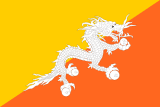
Bhutan's flag is dominated by Druk, the Thunder Dragon, drawn in white and clutching jewels, sprawled across a diagonal split of yellow and orange. The dragon is inseparable from the country's identity: Bhutan's own name for itself is Druk Yul, "Land of the Thunder Dragon". It's the only dragon on a sovereign flag — one of many creatures we round up in flags with animals on them.
5. Mozambique — an AK-47
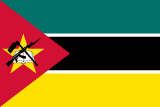
Mozambique's flag is famous for a startling detail: its emblem includes a bayonet-fixed AK-47 rifle, alongside a hoe and an open book, for defence, agriculture and education. It's the only national flag in the world to show a modern firearm — the standout example in our guide to flags with weapons.
6. Sri Lanka — the lion flag
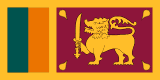
Sri Lanka's flag centres a golden lion holding a sword, framed by four leaves of the sacred bo tree, with two stripes representing the island's minority communities. The lion is a powerful symbol of Sinhalese heritage and gives the flag a strong, unmistakably heraldic character rarely seen elsewhere.
7. Brazil — a starry sky
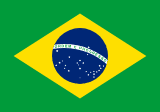
Brazil's flag hides an astronomical secret: the stars on its blue globe aren't decorative but a real map of the night sky over Rio de Janeiro on a specific date in 1889, each star standing for a state. Across it runs the motto Ordem e Progresso ("Order and Progress"). Few flags turn the actual heavens into their design.
8. Belize — the most detailed flag
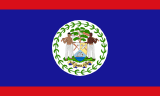
Belize's flag is extraordinarily detailed. Its central coat of arms shows two woodcutters with tools beside a mahogany tree and shield — the only national flag to prominently feature human beings — and it packs in around a dozen colours, more than any other. It's the headline act in our guide to the world's most complicated flags.
9. Turkmenistan — a woven carpet
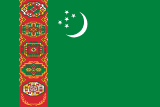
Turkmenistan's flag carries a vertical red stripe filled with five intricate carpet güls — traditional woven medallions, each representing a tribe — along with a crescent and five stars. The carpet detail makes it, by common agreement, the single most complicated national flag in the world to reproduce accurately.
10. Dominica — the only purple
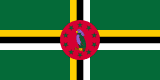
Dominica's flag features a Sisserou parrot at its centre — and in that parrot's plumage lies a genuine rarity: it's the only national flag in the world to contain purple. For centuries purple dye was so expensive it never entered flag design, which makes Dominica's a true one-of-a-kind.
11. Cyprus — a map of itself
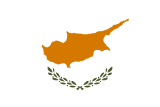
Cyprus does something almost no other country does: it puts a map of the island itself on its flag, in copper-orange (a nod to the copper the island is named for), above two green olive branches for peace. Only a handful of flags depict their own territory this way — Kosovo is the other well-known example.
12. Papua New Guinea — designed by a teenager
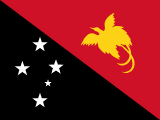
Split diagonally, Papua New Guinea's flag pairs a golden bird of paradise with the stars of the Southern Cross. Its charm is in its origin: it was designed in 1971 by a 15-year-old schoolgirl, Susan Karike, making it one of the few national flags known to have been created by a teenager.
13. The Philippines — a flag that changes in wartime
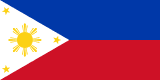
The Philippine flag looks conventional — blue and red bands, a white triangle with a golden sun and three stars — but it has a feature no other flag shares: it is deliberately flown upside-down in times of war, with the red band raised above the blue. In peacetime the blue is on top; flip it, and the flag itself signals that the nation is at war.
Why are unusual flags so interesting?
Unusual flags make the best starting point for learning, because each strange feature is really a question in disguise: Why is Nepal shaped like that? Why does Bhutan have a dragon? Why is Qatar maroon? Why does the Philippines fly its flag upside-down at war? Chase the answer and you almost always end up learning something about the country's history, geography or beliefs.
Frequently asked questions
What is the only non-rectangular national flag?
Nepal's — two stacked triangular pennons, with a sun and moon on a crimson field.
Which national flags are square?
Only Switzerland and Vatican City.
Which flag has a gun on it?
Mozambique's — the only national flag with a modern firearm, an AK-47.
Which flags have a map on them?
Cyprus shows a map of the island, and Kosovo depicts its own territory too — a very rare feature.
Which flag is the only one with purple?
Dominica, in the plumage of its Sisserou parrot.
Explore the world's flags
Find these countries in the Flag Explorer, dig into more oddities in the world's most complicated flags and flags with suns, or test yourself with the Flag Quiz.
Sources: FlagAtlas country and flag-history resources; official national sources for individual flag designs where available. Flag images via flagcdn.com.