The most complicated national flags carry detailed coats of arms or intricate emblems — Turkmenistan's woven carpet patterns, Belize's two woodcutters, the Dominican Republic's Bible, Bhutan's dragon. They pack in history and culture that a plain flag never could, at the cost of being much harder to draw or reproduce.
Turkmenistan — the most complicated of all
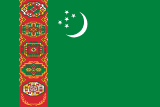
Turkmenistan holds the title for the most detailed national flag in the world. On a green field sits a white crescent and five stars — but the real complexity is the vertical red stripe near the hoist, which contains a column of five güls: elaborate carpet medallions, each a distinct traditional pattern representing one of the country's major tribes. Beneath them sit two crossed olive branches, added to mark Turkmenistan's status of permanent neutrality. Reproducing those carpet designs accurately is so difficult that no other national flag comes close to this level of intricacy.
Belize — the only flag with people
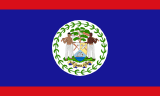
Belize's flag is unique in the world: it's the only national flag that prominently features human beings. At its centre is a detailed coat of arms showing two woodcutters — one of mestizo and one of African descent — holding an axe and a paddle on either side of a shield, with a mahogany tree above (a nod to the timber trade that shaped the country's history) and the Latin motto Sub Umbra Floreo, "In the shade I flourish". The emblem is ringed by a garland of 50 leaves, marking 1950 and the start of the independence movement. All that detail also gives Belize the most colours of any national flag — around a dozen.
Dominican Republic — the only flag with a Bible
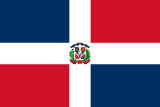
A white cross divides the Dominican flag into four rectangles, and at its very centre sits a finely detailed coat of arms — including something no other national flag has: an open Bible. Alongside it are a golden cross, a small trophy of national flags, and branches of laurel and palm, wrapped in ribbons bearing the mottoes Dios, Patria, Libertad ("God, Homeland, Liberty") and the country's name. It's a lot of symbolism to fit into a small central badge.
Bhutan — the thunder dragon
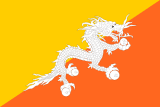
Bhutan's flag is dominated by Druk, the Thunder Dragon, drawn in fine white detail sprawling diagonally across the flag and clutching jewels in its claws. The diagonal split — yellow in the upper hoist, orange in the lower fly — represents the country's civil and spiritual traditions. The dragon is no minor emblem: Bhutan's own name for itself is Druk Yul, "Land of the Thunder Dragon". Its snarling, jewel-gripping detail makes it far more intricate than any plain tricolour — and it's the only dragon on a sovereign flag, as we note in flags with animals on them.
Mexico — an Aztec legend in the centre
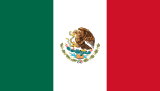
At first glance Mexico's flag is a simple green-white-red tricolour, but its centre holds one of the most intricate emblems of any flag: a golden eagle perched on a prickly-pear cactus, devouring a snake, standing on a rock in the middle of a lake, framed by oak and laurel. It illustrates the Aztec legend behind the founding of Tenochtitlan (modern Mexico City) — an entire origin myth rendered in miniature.
Ecuador — condor, mountain and steamship
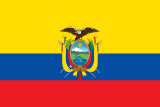
Ecuador's coat of arms is a small painting in its own right. An Andean condor spreads its wings over an oval scene containing Mount Chimborazo, the Guayas river, an early steamship, and a golden sun ringed by the astrological signs for the months of a key historical event — all resting above a bundle of fasces. Few flags try to depict an actual landscape; Ecuador packs a whole one in.
Why use complicated symbols?
If simple flags are easier to recognise, why do some countries pack in so much? Because detail can carry meaning that a plain design simply can't. A coat of arms can preserve a founding legend, honour the people and industries that built a nation, or bind together the symbols of several historic regions in one image. For these countries, the flag is meant to be a compact history lesson, not just a recognisable mark.
The trade-off is real, though. Complicated flags are hard to reproduce accurately — the fine lines of a carpet gül or a tiny Bible blur at small sizes, look different from one manufacturer to the next, and are almost impossible to draw from memory. That's the opposite of the design principles behind the world's simplest flags, where "so simple a child can draw it" is the goal. Complex or clean, though, every one of these flags is doing the same job: telling you who a nation is.
Frequently asked questions
What is the most complicated flag in the world?
Turkmenistan's — its intricate vertical carpet stripe, with five detailed medallions plus olive branches, a crescent and stars, makes it the most detailed national flag.
Which national flag has the most colours?
Belize's, with around a dozen colours, thanks to its highly detailed central coat of arms.
Which flag has people on it?
Belize — the only national flag to prominently feature humans, in the form of two woodcutters.
Which flag has a Bible on it?
The Dominican Republic — the only flag with an open Bible in its coat of arms.
Why are some flags so detailed?
To preserve history, culture and national symbols a plain flag couldn't express. The downside is they're hard to reproduce at small sizes and hard to draw from memory.