The simplest flags use just one or two colours and a basic shape — a disc, a cross, or a pair of stripes. Far from being boring, that simplicity is a strength: these are the flags people recognise instantly and can draw from memory. And a plain design can still be ancient and deeply meaningful.
Japan

Japan's flag — the Hinomaru, or "circle of the sun" — is about as pared-down as a national flag can be: a single crimson disc centred on a white field. That one red circle represents the sun, and it ties directly to the country's identity. Japan's own name, Nihon, means "origin of the sun", which is why it's known as the Land of the Rising Sun. The design has been associated with Japan for centuries and was formally adopted as the national flag in modern times. Its stark simplicity is exactly what makes it one of the most recognisable flags on Earth — you could sketch it in seconds. It also features in our guide to flags with suns on them.
Poland

Poland's flag couldn't be much simpler: two equal horizontal bands, white above red, with no emblem or artwork at all. But the plainness hides real heritage — the colours come straight from Poland's coat of arms, a white eagle on a red shield, which dates back to the Middle Ages. White above red is the fixed order (the reverse, red above white, would be a different flag entirely — Poland shares this near-mirror relationship with Indonesia and Monaco).
Indonesia and Monaco

Both use the mirror image of Poland's design — a red band above a white one — and both are strikingly simple. Indonesia's red-and-white, Sang Saka Merah-Putih, traces back centuries to the banners of the Majapahit empire, while Monaco's red and white are the heraldic colours of the ruling Grimaldi family. The two are so alike that only their proportions really separate them (Indonesia is a taller 2:3, Monaco a squarer 4:5) — a coincidence we explore in why some flags are almost identical.
Switzerland

A bold white cross on a plain red field — and, unusually, a perfect square. Switzerland is one of only two square national flags in the world (the other is Vatican City). The white cross has represented the Swiss Confederation since the medieval period, and the design is so clean and powerful that it inspired another famous emblem: the Red Cross, founded by the Swiss humanitarian Henry Dunant, simply reversed the colours to a red cross on white.
Ukraine
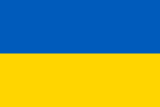
Two horizontal bands, blue above yellow — and one of the loveliest examples of a simple flag that paints a picture. The design is usually read as a blue sky above a field of golden wheat, a nod to Ukraine's vast farmland. Nothing more than two colours, yet it's both instantly recognisable and rich in meaning.
Denmark — the oldest of them all
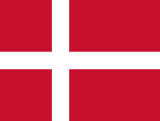
Denmark's Dannebrog — a white Scandinavian cross, shifted towards the hoist, on a red field — is widely regarded as the oldest continuously used national flag in the world, with roots reaching back to the medieval era and a founding legend dating to 1219. Its off-centre cross became the template for every Nordic flag that followed, from Sweden and Norway to Finland and Iceland. Proof that a simple design can also be the most enduring.
Why simple flags work
There's a reason so many of the world's best-loved flags are also the plainest. A flag has to do its job at a distance, flapping in the wind, shrunk to a tiny icon, or drawn from memory — and simple designs do all of that better. Flag experts often sum up good design with a handful of principles: keep it simple enough that a child can draw it from memory, use just two or three basic colours, make the symbolism meaningful, avoid lettering and fussy seals, and be distinctive. Judged by those rules, Japan, Switzerland and Denmark are close to perfect.
Simplicity also travels well. A clean design reproduces cleanly on everything from a stadium banner to a phone emoji, and it's easy for people to feel ownership of a symbol they can sketch themselves. The opposite approach — cramming in detailed crests and mottos — tends to produce flags that are hard to recognise and harder still to draw, as we show in the companion guide to the world's most complicated flags.
Frequently asked questions
What is the simplest flag in the world?
Libya's 1977–2011 flag — a plain green rectangle with no design at all — was the simplest ever. Among current flags, Japan, Poland, Ukraine and Switzerland are among the simplest.
What is the oldest national flag in the world?
Denmark's Dannebrog, a white cross on red, is generally regarded as the oldest continuously used national flag.
Which national flags are square?
Only two — Switzerland and Vatican City.
Why is Japan's flag so simple?
It's a single red disc for the sun, tied to Japan's name meaning "origin of the sun". The minimal design makes it hugely recognisable.
What makes a good flag design?
Simplicity above all — ideally simple enough for a child to draw from memory — plus two or three colours, meaningful symbolism, no lettering or seals, and a distinctive look.